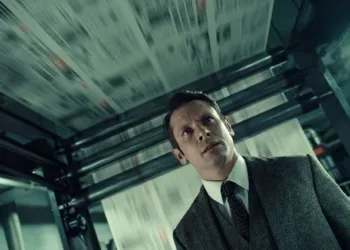








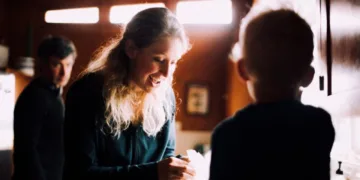






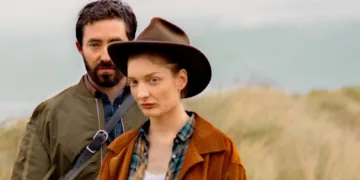
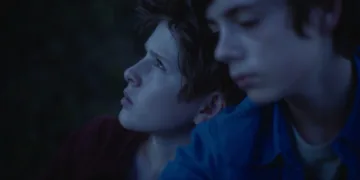








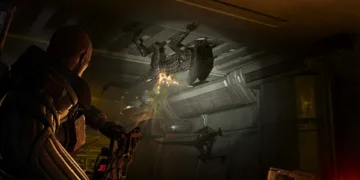

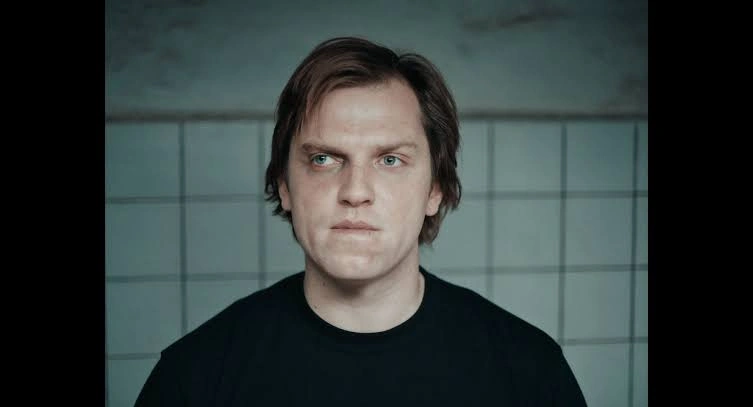

Jonas is declared fit for military service with the bureaucratic efficiency of someone renewing a driver’s license. A soldier tells him when to report, dismisses his responsibility for his young half-sister Leonie, and effectively removes the rest of his life from consideration. Nicolas Ehret understands that authoritarian systems rarely introduce themselves with thunder. Sometimes they hand you an appointment time.
Morgen war Krieg, Ehret’s feature debut, imagines a Germany where the European Union has collapsed, resources are shrinking, war is spreading, and a far-right government has restored compulsory military service. Jonas, played by Enno Trebs, considers himself a conscientious objector. The government considers him available.
His response is to run. Jonas takes Leonie, whom he has raised since their parents died, and seeks refuge with his estranged father Stuber near the Oder River. The plot is simple because it needs to be. Ehret is less interested in explaining how Europe collapsed than in examining what happens once a man’s moral identity meets a system with no interest in recognizing it.
The House by the Border
Jonas has avoided Stuber since childhood, so naturally his first major act of political resistance deposits him directly in his father’s home. Storytelling can be rude like that. Ulrich Matthes plays Stuber with a guarded stillness that makes his relationship with Jonas immediately legible. Neither man needs an argument to establish the distance between them.
Their silences have already done the administrative work. Stuber’s past as a ferry captain also carries a neat narrative irony. He once moved people across the Oder River. Now a local group is building a four-meter barbed-wire fence beside it.
Wibke, Stuber’s partner, helps lead that neighborhood initiative. Susanne Bredehöft gives the character an unnerving social flexibility. She can offer practical kindness in one scene and make a gesture feel faintly threatening in the next. Ehret wisely avoids presenting her as a cartoon fascist shouting slogans at breakfast. Her politics have entered her routines, her language, and her understanding of safety. Then there is Stuber’s father upstairs.
The elderly Nazi veteran lives in the attic, physically diminished and ideologically intact. His declaration that compassion is the disgrace of the age is one of the screenplay’s bluntest lines. Ehret occasionally lets characters state the film’s argument when the rooms, fences, and family history have already stated it quite clearly. The old man is less a fully developed person than an ideological fossil kept alive long enough to start talking again.
The family structure is still sharply designed. The grandfather remembers fascism without remorse. Stuber defines himself through disgust toward his father while participating in a community sealing its border. Jonas has built his identity around rejecting both generations, yet fear has already kept him from supporting Zelal’s hunger strike against the government.
Leonie complicates the pattern. Naila Schuberth’s quieter scenes with Matthes create a tentative warmth between her and Stuber. Watch how little the film asks them to say. Their closeness develops through shared space and small acts of attention while Jonas folds further into himself.
Everything Gets Narrower
Cinematographer Fabian Gamper shoots much of Morgen war Krieg in a cramped square frame, and the format steadily turns Jonas’s surroundings against him. Doorways press inward. Dark wooden interiors seem to absorb space. Stuber’s rural home should offer relief from the city and instead resembles a compound waiting for someone to test its perimeter.
Ehret places the wider conflict at the edges of the image. News reports provide fragments. Helicopters and drones pass overhead. Metallic sounds appear before their sources become clear. Birger Clausen’s score stays restrained, leaving practical noises to carry much of the tension.
The concrete mixer is particularly effective. Its repetitive thud accompanies the construction of the border fence, turning a political project into ordinary labor. Nobody is unveiling a monument to authoritarianism. People are pouring concrete and finishing a job.
The film’s strongest visual passage arrives after vigilante violence against refugees. The camera remains on a fog-covered road scattered with belongings and bodies. Ehret does not rush to a speech, an argument, or a close-up designed to instruct the audience how to respond. He lets the damage occupy the frame.
His narrative discipline is less consistent. After the forceful conscription sequence and Jonas’s retreat to Stuber’s home, the middle moves through a series of isolated confrontations that sometimes stall the story. Jonas is disoriented, so an episodic structure makes thematic sense. The problem is that thematic sense does not automatically create momentum. A few scenes linger after their dramatic purpose is clear.
The larger conflict also remains hazy. We know Europe has fractured and war is spreading, yet the opposing powers and mechanisms of political collapse receive little definition. That vagueness places us inside Jonas’s limited understanding, but it occasionally makes Ehret’s future feel arranged for the family drama rather than fully functioning beyond it.
Compassion Under Pressure
Trebs builds Jonas through physical retreat. He lowers his gaze, crosses his arms, sinks into chairs, and often appears to be waiting for someone else to make the next decision. It is a smart performance because Jonas’s central weakness is not cowardice in any simple sense. He has spent his life assuming that holding decent values and being a decent person are roughly the same activity. Then he promises to help a fleeing stranger and his injured son.
That choice gives the second half its spine. Jonas finally acts according to the principles he claims to hold, and the story immediately makes that action expensive. Leonie’s safety, the threat of military capture, Stuber’s position, and the village’s growing paranoia all become part of the cost. Scottish engineering textbooks probably have a term for this. Screenwriting calls it pressure.
Ehret’s sharpest decision is refusing to preserve Jonas as the film’s reliable moral center. Once violence escalates, survival instinct begins changing the calculations behind his choices. The shift works because Trebs never plays it as a sudden corruption. Jonas hesitates, adjusts, justifies, then adjusts again. Each step is small enough to survive on its own.
The screenplay occasionally overstates the generational argument, especially when characters discuss people raised through decades of peace and prosperity. The point is already present in Jonas’s stunned response to conscription and in his earlier refusal to stand beside Zelal.
He believed history was something previous generations had mishandled. Morgen war Krieg puts him in a house containing three generations and waits for that belief to fail. The frightening part is how little waiting is required.
The German dystopian drama Morgen war Krieg made its official world premiere at the 43rd Filmfest München on June 28, 2026, competing in the Neues Deutsches Kino category before entering a regional theatrical distribution rollout handled by AF – Media GmbH and Progress Film-Verleih. Audiences can catch the independent film at select festival screenings, art house cinema showcases, and upcoming regional programming across Germany. Set within an unstable, fractured future Europe where the European Union has completely collapsed and a right-wing populist regime has seized control of Germany, the tense narrative follows a thirty-three year old man named Jonas who decides to desert his mandatory military conscription, seeking refuge at the remote home of his estranged father where he confronts an eroding democratic society and the looming outbreak of war.
Full Credits
Title: Morgen war Krieg
Distributor: AF – Media GmbH, Progress Film-Verleih, ArtHood Entertainment GmbH
Release date: June 28, 2026
Rating: FSK 12
Running time: 114 minutes
Director: Nicolas Ehret
Writers: Nicolas Ehret
Producers and Executive Producers: Hüseyin Tabak, Mehmet Aktas, Daniel Ehrenberg, Kathrin Rodemeier
Cast: Enno Trebs, Ulrich Matthes, Naila Schuberth, Susanne Bredehöft, Rinat Khairullin
Director of Photography (Cinematographer): Fabian Gamper
Editors: Tobias Dietz
Composer: Birger Clausen
The Review
Morgen war Krieg
Morgen war Krieg works best when Nicolas Ehret keeps history inside one damaged family: Jonas hiding in his father's house, Stuber building beside a sealed river, and an old Nazi still speaking from the attic. The film occasionally explains its generational argument too plainly, while its episodic middle loses momentum. Yet Fabian Gamper's cramped framing, the concrete mixer's dull repetition, and Enno Trebs's increasingly cornered performance give the political collapse a frighteningly ordinary shape. Ehret's sharpest choice is making Jonas's morality something the plot can damage.
PROS
- Enno Trebs's tense, physical performance
- Oppressive square-frame cinematography
- Precise use of everyday sound
- Strong generational story structure
- Disturbing vigilante aftermath imagery
CONS
- Occasionally blunt ideological dialogue
- Meandering middle passages
- Political mechanics remain underdefined