




























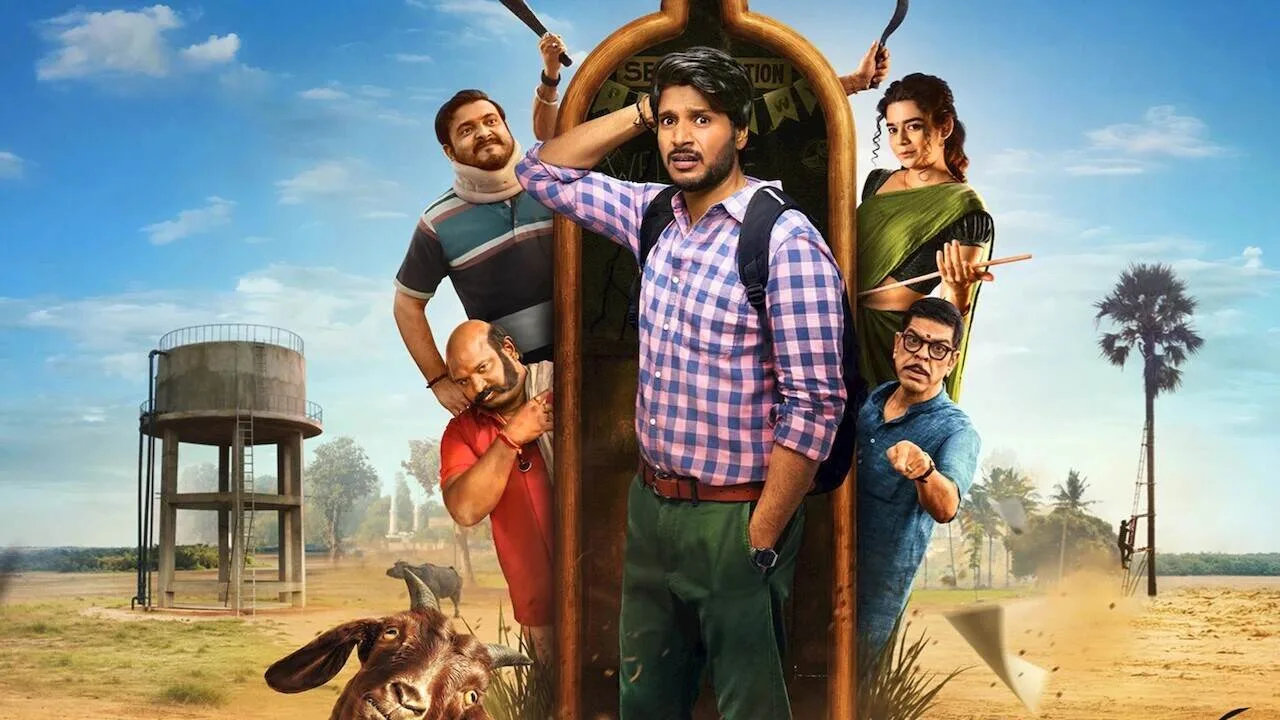

Sex education in Indian popular culture is rarely allowed to be practical; it is hidden in biology chapters, giggled through by classrooms, or smuggled into comedy as embarrassment. Netflix’s first Telugu original series builds its seven episodes out of that silence, sending Subramanyam “Subbu” Chillukuri Rao to a Telangana village where a diagram of the female reproductive system can provoke a torch-bearing mob.
Created and directed by Mallik Ram, Super Subbu gives Sundeep Kishan a premise that suits Telugu comedy’s taste for high-pressure humiliation. Subbu is a temporary computer lab instructor with little authority over his students, his future, or his own body. During a school inspection, three boys turn the lab computer into their private cinema, and Subbu, trying to impress the superintendent, projects a steamy Bollywood scene across the classroom. The punishment is framed like a career bargain: teach sex education in Maakipur for six months, and the scandal stays away from his father.
Shame Comes Home
That father, Kukkuteshwar Rao, is the series’ sharpest cultural figure. Murali Sharma plays him as a retired headmaster whose voice can turn a living room into a staff room. He recoils at a condom advertisement on television, catches Subbu with his fiancée Divya in an under-construction flat, then uses the incident to tighten his control over his son’s marriage prospects. He is educated, urban, respected, and still terrified of sexual knowledge. That detail matters. Super Subbu does not let the audience pretend that the taboo belongs only to villages, illiteracy, or rural superstition. Kukkuteshwar brings the shame home, polished and paternal.
Maakipur, by comparison, is painted in broader strokes. Its men boast about fathering children as proof of masculinity, chase away sex education officers, and treat contraception as an attack on male pride. Subbu’s assigned classroom, an abandoned train bogie used by couples for privacy, is one of the show’s best visual jokes: the state has arrived to teach intimacy in a place already conducting its own unsupervised syllabus. The village’s tiny mobile signal spot, turned into a paid access point, works in a similar register. Modernity is present, but never free.
Farce Without Cheapness
The farce can be blunt. Jokes about short stature and the villagers’ stupidity sometimes carry the stale aftertaste of older mainstream comedy, where ridicule is treated as rhythm. Yet Mallik Ram’s direction keeps the central subject from sliding into cheapness. The double meanings are frequent, the embarrassment is loud, and the body is always nearby, but the show rarely turns women’s health into spectacle. A lesson on “No Means No,” inspired by Subbu watching Vakeel Saab, begins as comic imitation and turns into a small domestic uprising. The later sequence in which he explains sanitary pads and birth control to village women inside an enemy’s house is warmer and sharper, because the laughs briefly make room for listening.
Sundeep Kishan’s performance is built from hesitation. Subbu enters scenes with the posture of a man already apologising, especially near his father. His shoulders close in, his speech softens, and every decision seems to request permission from someone who is not in the room. That makes his gradual shift into “Subbu Sir” feel credible. He does not suddenly become a reformer. He learns the subject because the job exposes his own ignorance first.
Getup Srinu’s Kantha gives the village episodes their comic counterweight. The neck brace, the sidekick loyalty, the panic around angry men and impossible targets could have become stock business, but Srinu keeps finding small beats of self-preservation. Mithila Palkar’s Swathi, an aspiring actress with a social media-era dream of escape, brings another texture to Maakipur. Her audition scene has the slightly painful optimism of a young woman performing for a world that may never arrive. Her conversation about women’s agency deserves a stronger dramatic frame than the predictable romantic tension the series builds around her and Subbu.
The romance with Divya suffers from the same compression. Maanasa Choudhary and Kishan share an easy sweetness, especially in the under-construction condo scene where desire, marriage, property and parental approval crowd the same unfinished space. But once Subbu settles into Maakipur, Divya becomes a marker of delayed adulthood rather than a fully alive participant in the conflict. The love triangle is legible long before the writing earns it.
Lessons Left Unfinished
The second half also rushes the village’s transformation. For a series about a taboo sustained across generations, Maakipur grows receptive with suspicious speed. The government target plot gestures toward a sharper critique of bureaucracy: sexual health becomes another number to report upward, and Subbu takes morally murky steps to hit those numbers. The show notices the danger, then moves past it before the consequences can sting. A subplot tied to his alcohol-fuelled collapse piles misery onto a character already carrying plenty.
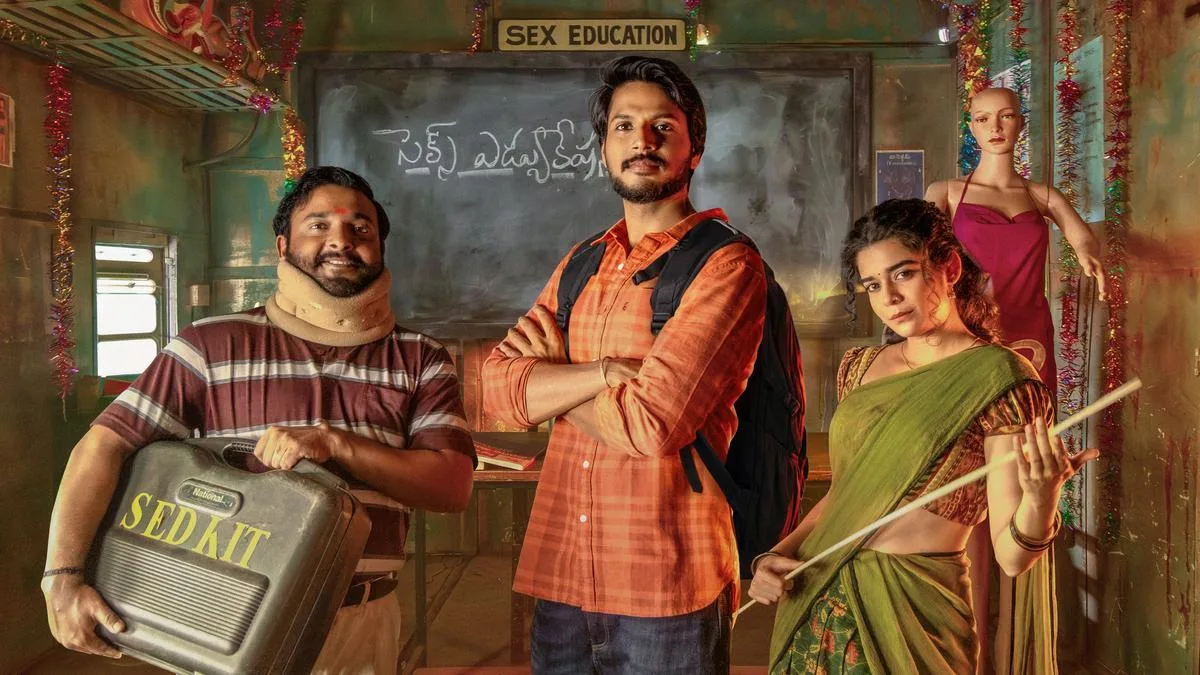
Still, Super Subbu belongs to a valuable strain of Indian social comedy: reformist, messy, popular in its comic instincts, and specific in its regional flavour. Anudeep Dev’s music, the classroom props, the chalkboard illustrations, the costumes and the earth-toned village spaces give the series a tactile Telugu identity rather than a dubbed-in idea of rural India. The best parts know that embarrassment is not a small obstacle. It is an inheritance. When Subbu stands before women explaining birth control with fear still visible on his face, the joke is no longer that he is unqualified. The joke is that almost everyone else was allowed to remain unqualified for so long.
The Telugu original comedy-drama series Super Subbu premiered on July 2, 2026, and is available to stream exclusively on Netflix. The story follows Subramanyam “Subbu” Chilukuri, a timid young man who unexpectedly lands a government job as a sex education officer in the conservative rural village of Maakipur, forcing him to tackle local taboos while finding his own confidence.
Where to Watch Super Subbu Online


Full Credits
Title: Super Subbu
Distributor: Netflix
Release date: July 2, 2026
Rating: TV-MA
Running time: 35–42 minutes per episode
Director: Mallik Ram
Writers: Mallik Ram, Ramesh Eligeti, Shivani Dhobal
Producers and Executive Producers: Rajiv Chilaka, Bharath Laxmipati
Cast: Sundeep Kishan, Mithila Palkar, Murali Sharma, Manasa Choudhary, Brahmanandam, Getup Srinu, Jeevan Kumar, Sampoornesh Babu
Director of Photography (Cinematographer): AJ Aaron
Editors: Marthand K. Venkatesh
Composer: Anudeep Dev
The Review
Super Subbu
Super Subbu takes a rarely centered subject in Indian streaming and gives it a distinctly Telugu comic grammar: loud village farce, family pressure, awkward desire, and sincere social correction sharing the same frame. Its best scenes, especially Subbu’s lessons on consent, menstrual health, and birth control, prove the premise has bite. The weaker stretch comes when Maakipur changes too quickly and the finale saves too many conflicts for later. Still, Sundeep Kishan and Murali Sharma give the show a sturdy emotional base.
PROS
- Strong sex education premise
- Sundeep Kishan’s anxious warmth
- Murali Sharma’s rigid authority
- Sensitive women’s health scenes
- Lively Telangana village setting
CONS
- Rushed final stretch
- Some broad caricatures
- Thin romantic triangle
- Open finale weakens closure
- A few stretched comic gags