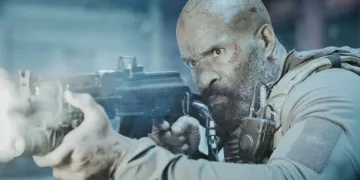





























Ukraine has a strange function in Man of War. It is a country under invasion, a site of mass violence, and, for William Kaufman’s film, an extremely efficient way to make an old rescue plot feel urgent. The geography is contemporary. The machinery is vintage.
Michael Connor (LaMonica Garrett) enters the story already assembled from familiar parts: shirtless, scarred, drunk, staring at a photograph with a loaded gun nearby. He is a former Navy SEAL and CIA operative who has apparently discovered that civilian life contains very few tactical insertions. Then his niece Riley (Rosmary Yaneva), an aid worker in Ukraine, calls in panic. She has been captured by the sadistic Russian commander Koniev (Daniel Bernhardt). Connor is sober enough to recognize purpose when it video-calls him.
Within minutes, he contacts his CIA-connected handler Charlie (Jason Patric), arranges passage into Ukraine, and starts moving toward Riley. Kaufman and co-writer Paul Reichelt waste little time on hesitation because Connor’s emotional crisis has a very convenient cure: war.
Call it conflict laundering, the conversion of historical catastrophe into clean personal motivation. Russia’s 2022 invasion gives Connor ruined streets, uncertain loyalties, and moral permission to shoot the correct people. The film rarely asks what happens when a real nation’s suffering becomes dramatic fuel for an American man’s recovery.
War Is a Monster, Apparently
The mechanics belong to decades of military rescue films. Connor travels, finds contacts, checks weapons, survives attacks, receives intelligence, and advances one location closer to Riley. His brief association with British mercenary Bunny (Linds Edwards) also establishes a future favor with all the subtlety of a rifle placed above Chekhov’s fireplace.
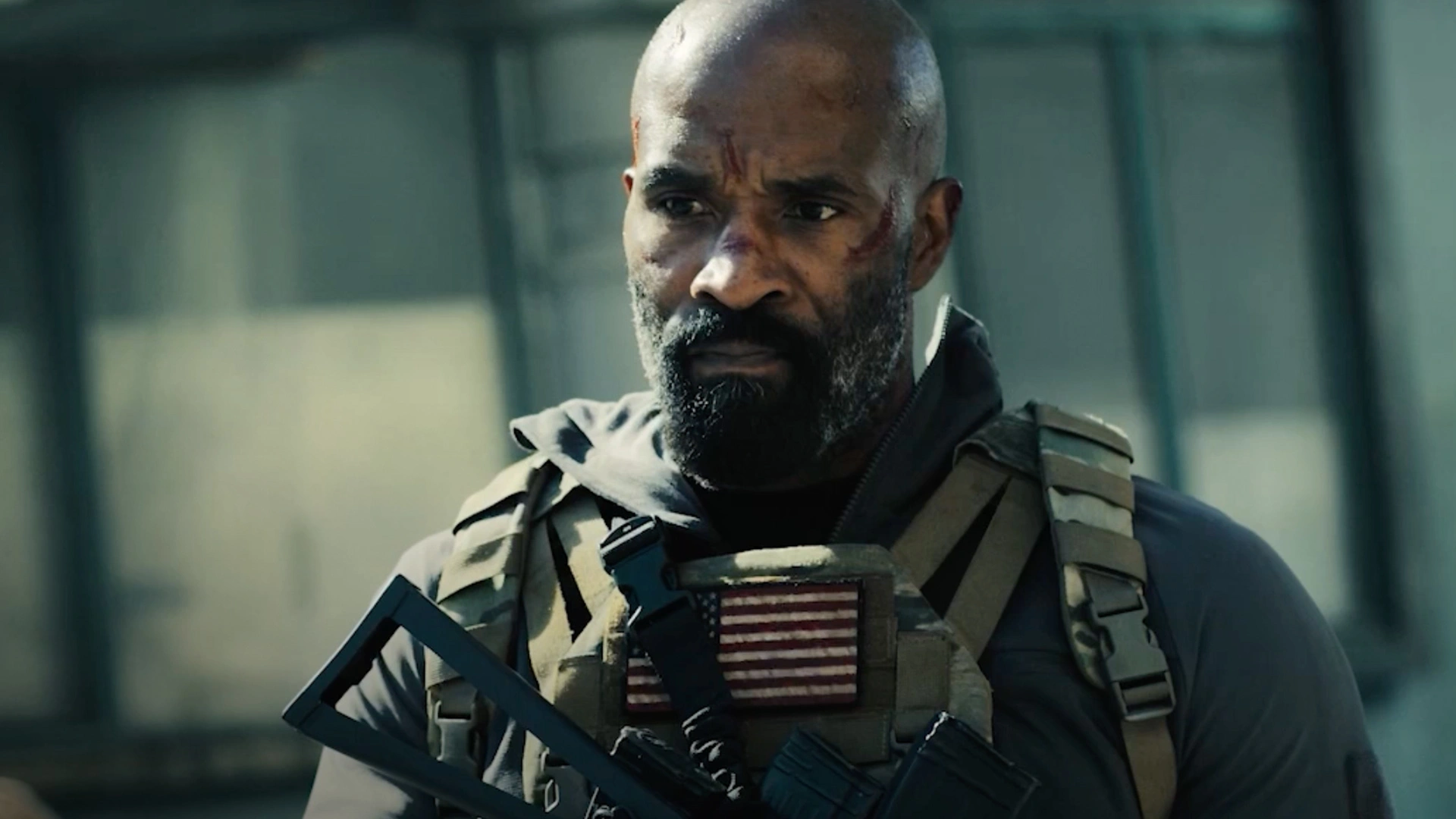
There is nothing inherently wrong with familiarity. Kaufman knows this particular genre’s rhythms. The issue arrives whenever Man of War tries to explain what all the gunfire means. Connor’s Ukrainian guide Dany (Andrew Howard) challenges him after Connor offers the observation that war is hell.
Why, Dany asks, has Connor made it his life? It is a sharp question because the opening has already provided the evidence. Connor looked dead while drinking alone. Place a mission in front of him and his body suddenly acquires purpose. The film sees this contradiction. Then it gets nervous and starts writing slogans.
“War is a monster” becomes the sort of line characters repeat when a screenplay wants philosophical credit without doing philosophical labor. “Fast is fine but accuracy is final” fares better because it describes behavior. We watch Connor act on that principle during firefights. The war dialogue tends to work in reverse: the characters announce ideas that the drama barely tests.
Kaufman clearly admires professional operators. Their efficiency, discipline, and physical competence receive loving attention. Yet the screenplay also wants to suggest that men such as Connor have surrendered part of themselves to violence. This could be the movie’s richest contradiction. Instead, Connor’s dependence on war becomes useful the exact second somebody needs rescuing. Convenient illness, that.
The Man Who Belongs There
Garrett gives Connor convincing physical authority. Watch the way he enters hostile spaces or performs quick ammunition checks. The movements have economy. His dry delivery fits a man who treats conversation like excess equipment.
The problem is that the performance has nowhere else to travel. Connor begins emotionally sealed and stays sealed through much of the mission. His alcoholism, old trauma, and bond with Riley are explained, yet Garrett rarely receives a scene where the character’s behavior changes under their pressure. Andrew Howard gets the better material as Dany.
His sarcasm immediately changes the temperature of Connor’s scenes. Better still, Dany has a relationship with this war that cannot be reduced to a mission briefing. His family is nearby. His homeland is being ripped apart. He fights because the alternative has entered his country and placed people he loves in danger.
That distinction matters. Connor travels into Ukraine to recover personal purpose through a rescue. Dany cannot leave the political reality outside the frame because it is his reality. Their conversations become strongest when Howard lets irritation, humor, and fear coexist without waiting for the script to label each emotion.
Bernhardt’s Koniev exists on the opposite end of this spectrum. He is pure predation, introduced through murder, threats, and sadistic control of captives. Bernhardt gives him a vicious physical presence and a nasty glint of enjoyment. Complexity is not invited to this particular party. The character’s function is to make Connor’s eventual violence feel righteous. Jason Patric’s Charlie spends much of his time communicating from one room, supplying information and support by phone. He changes shirts. The room survives.
Kaufman Speaks Fluent Gunfire
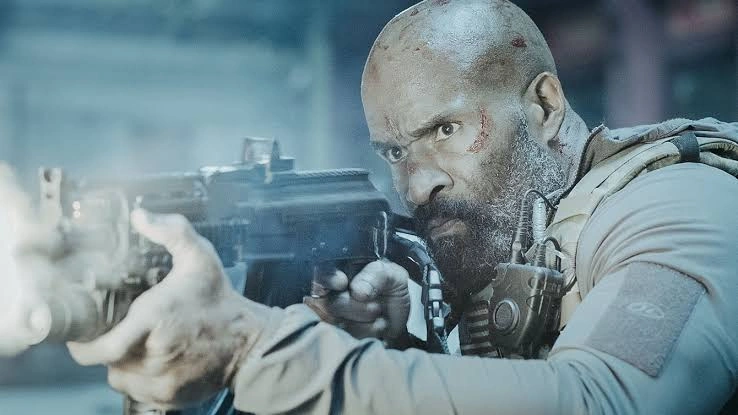
The film becomes far clearer when people stop discussing war and start moving through it. Kaufman’s action direction is built around procedure. Operators snap through ammunition checks, move between cover in short bursts, and handle rifles with an efficiency that avoids superhero posing. Action designer Radoslav Parvanov and stunt coordinator Stanimir Stamatov give the fights weight through bodies, weapon positioning, and controlled movement.
This is where Kaufman’s worldview becomes oddly legible. The dialogue says war is monstrous. The camera says competence is beautiful. There is a real tension in that split, possibly richer than the one Reichelt and Kaufman’s screenplay keeps verbalizing. During the larger firefights, Connor is finally presented in the environment that gives him coherence. His body, attention, and experience align. Civilian Connor drank beside a gun. Combat Connor knows exactly where the gun goes.
The final battle pushes this craft hardest, filling the soundtrack with sustained gunfire and moving the characters into increasingly desperate close encounters. The editing gains fury, sometimes at the expense of geography. Eyelines and cuts occasionally muddy the positions of fighters, while dim lighting makes certain exchanges harder to track. Other production limitations are less graceful. Vehicle scenes expose obvious green-screen backgrounds, and a recurring exterior building image draws attention to the budget rather than the battlefield.
At 110 minutes, the rescue also takes a long route toward a destination visible from the opening setup. The middle repeats travel, tactical discussion, philosophical declarations, and escalating encounters while Connor and Koniev remain separated. Kaufman is marking time until he can stage the violent confrontation his film actually trusts. Once the rifles start speaking, Man of War suddenly becomes articulate.
The high-octane military action thriller Man of War debuted as a straight-to-digital release via Well Go USA Entertainment on July 3, 2026. Audiences can currently stream or rent the independent feature across major video-on-demand networks, including Apple TV and Amazon Prime Video. Set against the chaotic opening stages of the Russian invasion of Ukraine, the intense narrative follows an elite, retired American Special Forces veteran who launches a desperate, unauthorized rescue mission when his adopted daughter, an active humanitarian aid worker, is taken hostage by a ruthless group of mercenary forces.
Where to Watch Man of War (2026) Online







Full Credits
Title: Man of War
Distributor: Well Go USA Entertainment
Release date: July 3, 2026
Rating: R
Running time: 111 minutes
Director: William Kaufman
Writers: William Kaufman, Paul Reichelt
Producers and Executive Producers: Andrew Lewis, Isaac Lewis, Stanimir Stamatov, Yanko Ushatov, Elias Axume, Paul Reichelt
Cast: LaMonica Garrett, Jason Patric, Andrew Howard, Rosmary Yaneva, Daniel Bernhardt, Linds Edwards, Boyan Anev, Greg Burridge
Director of Photography (Cinematographer): Mark Rutledge
Editors: Sara Kaufman
Composer: John Roome
The Review
Man of War
Man of War mistakes proximity to history for engagement with it. Ukraine supplies danger, moral urgency, and ruined streets, while Connor’s mission remains the same old extraction fantasy wearing contemporary camouflage. Call it conflict laundering: a real war converted into personal motivation for a familiar action hero. Still, William Kaufman knows precisely where to place a rifle, a body, and a camera during combat, and Andrew Howard finds the humanity the screenplay keeps announcing instead of dramatizing. The bullets land. The ideas mostly ricochet.
PROS
- Crisp tactical gunfights
- Andrew Howard's layered performance
- Convincing weapon handling
- Aggressive final-act combat
- Strong physical action
CONS
- Familiar rescue structure
- Thin political engagement
- Connor lacks emotional variation
- Overwritten philosophical dialogue
- Uneven climax geography