

















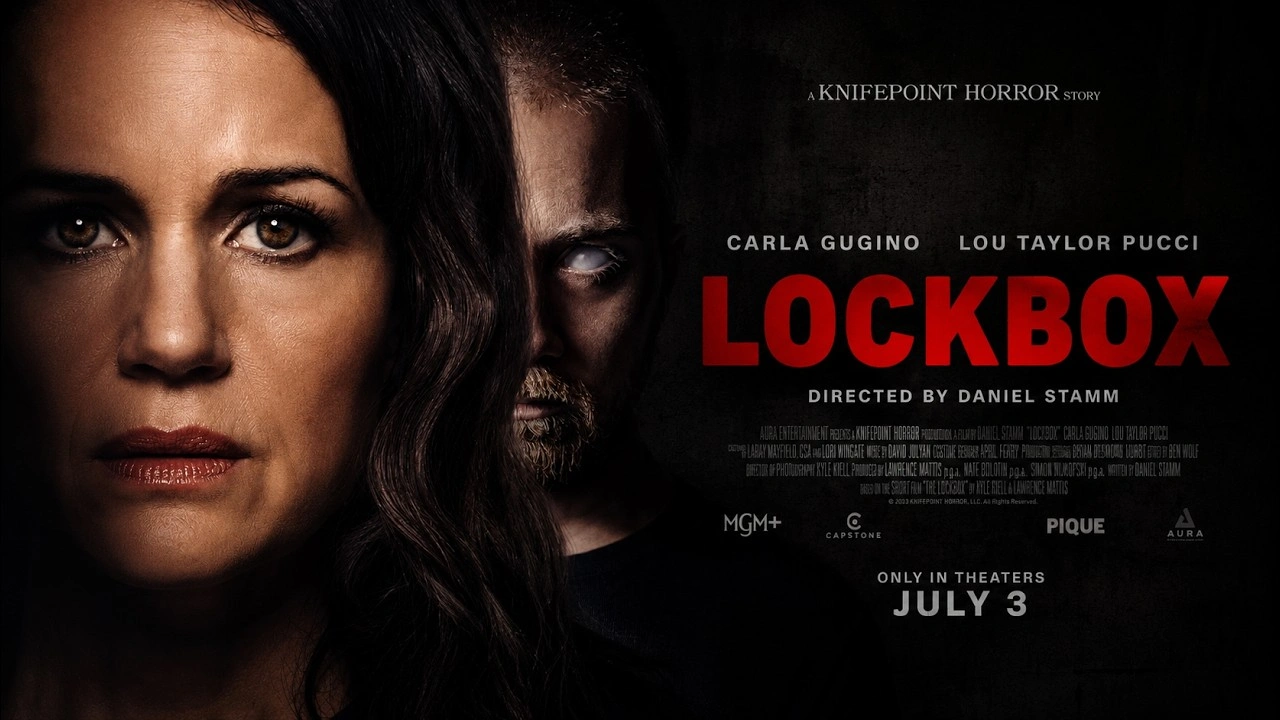

Ellen has already spent years reorganizing her life around someone else’s pain before Lockbox asks her to do it again. She gave up a career in fashion to care for her dying mother, and after that responsibility ends, she retreats to a small town looking for the most ordinary life she can build. Then a relative calls about Winthrop, a cousin she has not seen since childhood, and Ellen opens her home to him.
Director Daniel Stamm and screenwriter Justin Yoffe, adapting Soren Narnia’s Knifepoint Horror story “Winthrop,” connect trauma with supernatural vulnerability. Winthrop is a veteran living with PTSD, childhood abuse, sleepwalking, and a visible inability to settle into civilian life. The idea has weight. The film keeps finding ways to make that weight lighter.
A House Full of Unsaid Things
Carla Gugino gives Ellen a patience that the screenplay sometimes mistakes for passivity. When Winthrop sleepwalks, behaves erratically, or appears detached from himself, Ellen reacts with a level of calm strangely disconnected from what she is seeing. Gugino works against that problem through small choices. Her pauses before answering him and the way she watches him across the house suggest a woman constantly deciding how much fear she is allowed to show.
The script gives us several pieces of Ellen’s life, then rarely lets them interact. She was a fashion designer. She cared for her mother through illness. She is grieving. She volunteers at church, and her faith later becomes essential to the supernatural crisis. Any one of those details could shape how she confronts possession. Instead, Gugino has to build the bridge herself.
Lou Taylor Pucci faces a similar problem as Winthrop. His withdrawn posture and disoriented shifts in attention make the character’s distress readable, especially before Vahna’s death. Once suspicion falls on him, the film starts using Winthrop as a delivery system for visions, violent impulses, and demonic behavior.
His arrest for murder and later release barely affect the story. A potentially devastating event becomes another plot marker. The film wants trauma to explain why evil finds Winthrop. It spends far less time asking who Winthrop is when evil is absent.
Vahna at the Door
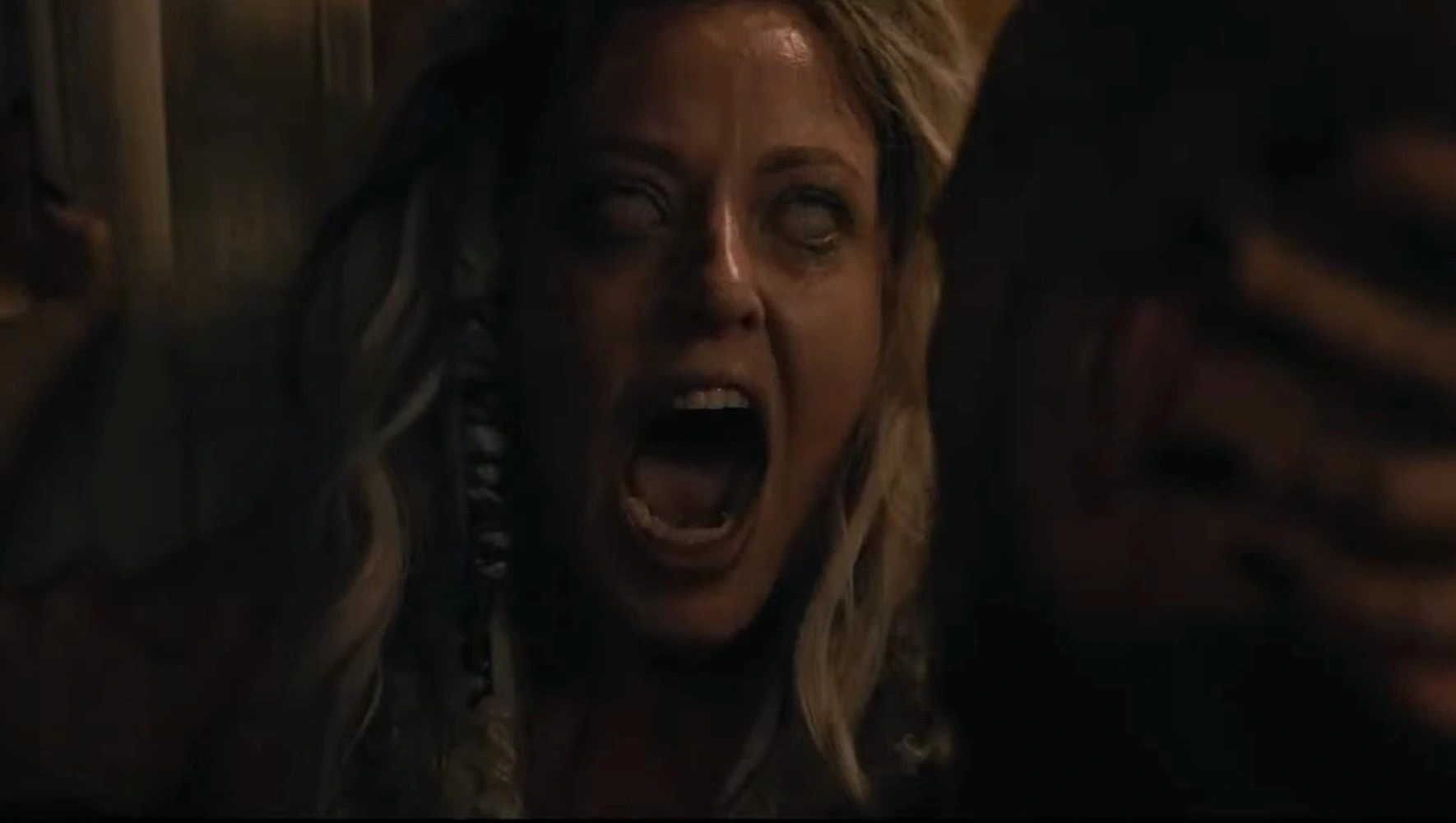
Katharine Isabelle arrives as Vahna Minter with white braided hair, blunt speech, and the social subtlety of someone kicking open a kitchen cabinet. She immediately changes the temperature of Ellen’s home. Her confrontations with Winthrop and warnings to Ellen give the early stretch a jolt of personality.
Isabelle commits completely to the character’s physical strangeness, yet Vahna signals danger so loudly that the mystery around her has little space to grow. Stamm stages several scares around sudden appearances, including mirror images and abrupt visual intrusions. A jump scare works by controlling attention, then breaking the viewer’s expectation of where a figure should be. Lockbox repeats that pattern often enough that surprise turns into scheduling.
The visual presentation is cleaner than the film’s dark promotional material suggests. You can see the rooms, faces, and movement clearly. The problem sits in the construction of tension. A figure popping into frame creates a reflex. Tension needs rules, anticipation, and the fear of a consequence you understand.
After Vahna disappears, the movie accelerates into possession, body transfer, suspicious priests, strange figures, and increasingly chaotic visions. The added energy helps, but Yoffe’s screenplay remains reluctant to explain the supernatural system.
We learn that evil can move between bodies and attach itself to vulnerable people. Its limits, history, and conditions stay frustratingly vague. Without rules, every new supernatural event can happen because the script needs it to happen. Horror loses pressure when anything is possible.
The Best Idea in the Box
The title finally gains meaning through the film’s strangest concept: a lockbox is a person capable of containing demonic entities. The proposed solution to Winthrop’s possession is therefore not simple expulsion. Evil has to go somewhere, and a human body can become its prison.
Most possession films build toward removal. Lockbox introduces transfer and containment, which immediately creates a moral problem. Saving Winthrop means asking another person to carry the thing destroying him.
The child used as a lockbox should force every character to stop and examine the ritual. Instead, the film moves through the choice with surprising speed. We receive too little history about the child, too little sense of agency, and too little discussion of what it means to turn a vulnerable body into supernatural storage.
This is where the film’s earlier treatment of trauma becomes especially frustrating. Winthrop is defined by the pain he carries from childhood and war. The lockbox child is defined by the evil he can carry for other people. Stamm and Yoffe have accidentally found a much harsher movie about damaged people being valued for their capacity to absorb suffering. I kept waiting for Lockbox to recognize what it had built.
The climax favors body horror, ritual mechanics, and demonic imagery instead. Stamm knows how to stage the physical chaos of the confrontation, and Gugino gives Ellen’s desperation a sincerity the screenplay has not fully earned. Then the film shifts toward sunlit sentimental imagery that feels borrowed from a gentler spiritual drama. After the moral ugliness of transferring evil into another human being, the brightness lands with a strange softness.
The American supernatural horror film Lockbox made its theatrical debut across the United States via Aura Entertainment on July 3, 2026. Audiences looking to watch the feature can experience it in select movie theaters nationwide or access it through upcoming digital premium video-on-demand networks and home media releases on MGM+. Based on the popular cult podcast Knifepoint Horror, the chilling story follows a woman who moves to an isolated house with her traumatized cousin, only to put her life entirely on the line to protect him when an eerie neighboring boy and a dangerous otherworldly entity arrive to hunt him down.
Where to Watch Lockbox (2026) Online







Full Credits
Title: Lockbox
Distributor: Aura Entertainment, MGM+
Release date: July 3, 2026
Rating: R
Running time: 94 minutes
Director: Daniel Stamm
Writers: Justin Yoffe, Soren Narnia
Producers and Executive Producers: Kearie Peak, David Magee, Shawn Williamson
Cast: Carla Gugino, Lou Taylor Pucci, Katharine Isabelle, Aeden Edwards, Jed Rees, Donald Sales, Lee Tichon, Darcey Johnson, Olivia Ducayen, Samantha Ferris, Mercedes de la Zerda
Director of Photography (Cinematographer): Alfonso Chin
Editors: Bridget Durnford, Daren Luc Sasges
Composer: Matthew Rogers
The Review
Lockbox
Lockbox has a genuinely clever possession concept buried inside a film that spends far too long circling familiar scares. Carla Gugino gives Ellen's faith and loyalty real weight, and the human-container idea briefly suggests a stranger, ethically messier horror story. The script barely tests that idea before rushing into its final ritual, leaving trauma, mythology, and character arcs frustratingly thin. Daniel Stamm can stage a clean scare, yet abrupt apparitions and CGI imagery cannot replace tension built through rules and consequence.
PROS
- Carla Gugino's sincere performance
- Distinctive lockbox concept
- Clear visual presentation
- Katharine Isabelle's physical presence
CONS
- Thin character development
- Underexplained supernatural rules
- Routine jump scares
- PTSD reduced to plot setup
- Moral dilemma left unexplored