























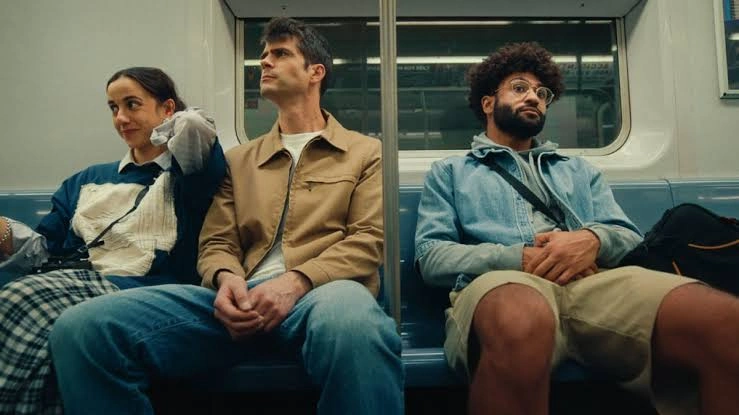

Simon has spent so long explaining his unfinished documentary that the explanation has become its own creative product. He calls it a nostalgia-driven travelogue concerned with the past, present, future, geography, and lost history, piling concepts together until the absence of a film almost disappears beneath the vocabulary. Alex Mallis and Travis Wood understand this particular form of artistic self-preservation with uncomfortable precision.
Their first narrative feature, co-written with Weston Auburn, places Simon (Tristan Turner) among New York filmmakers hovering around the lower levels of the festival circuit. At an early Q&A, every director gets to speak before time runs out on him.
It is a tiny humiliation, yet the scene captures the hierarchy of a creative world where visibility can feel like proof of existence. Simon responds by performing momentum. His thesis film remains on the festival circuit because he has been “milking” it, while his grand follow-up exists somewhere between accumulated travel footage and prolonged scouting.
That distinction matters. Simon is employed shooting taxi videos, but he wants to belong to a different cultural class, populated by filmmakers with projects, programmers with access, and people who casually discuss lenses or budgets over drinks. When a festival programmer asks about his new work, he claims it is nearly complete and already receiving positive reactions. Her reminder that the festival requires unseen films forces him into a clumsy retreat. The lie barely survives thirty seconds.
Turner plays these moments without asking for easy forgiveness. Simon talks too much, listens selectively, and treats other people’s lives as supporting material for his own anxiety. His habit of eating pizza crust first lands as an appropriately petty warning sign. A stranger might call it quirky. Ninety minutes with Simon suggests evidence.
The Economy of an Old Friendship
Bruce (Anthony Oberbeck) gives Simon something his artistic life cannot: unrestricted movement. His airline job allows him to nominate a yearly travel companion for free standby flights, and Simon has used that privilege to cross borders while collecting footage for his elusive documentary. The arrangement lets him feel productive without confronting the possibility that movement and progress are different activities.
The cultural fantasy of the mobile creative is particularly ripe for scrutiny here. Cheap flights, laptop labor, festival credentials, and footage gathered in distant countries can create the appearance of a life expanding. Simon has visited places. His film remains shapeless. His career has barely shifted. His friendship with Bruce has settled into the same pattern.
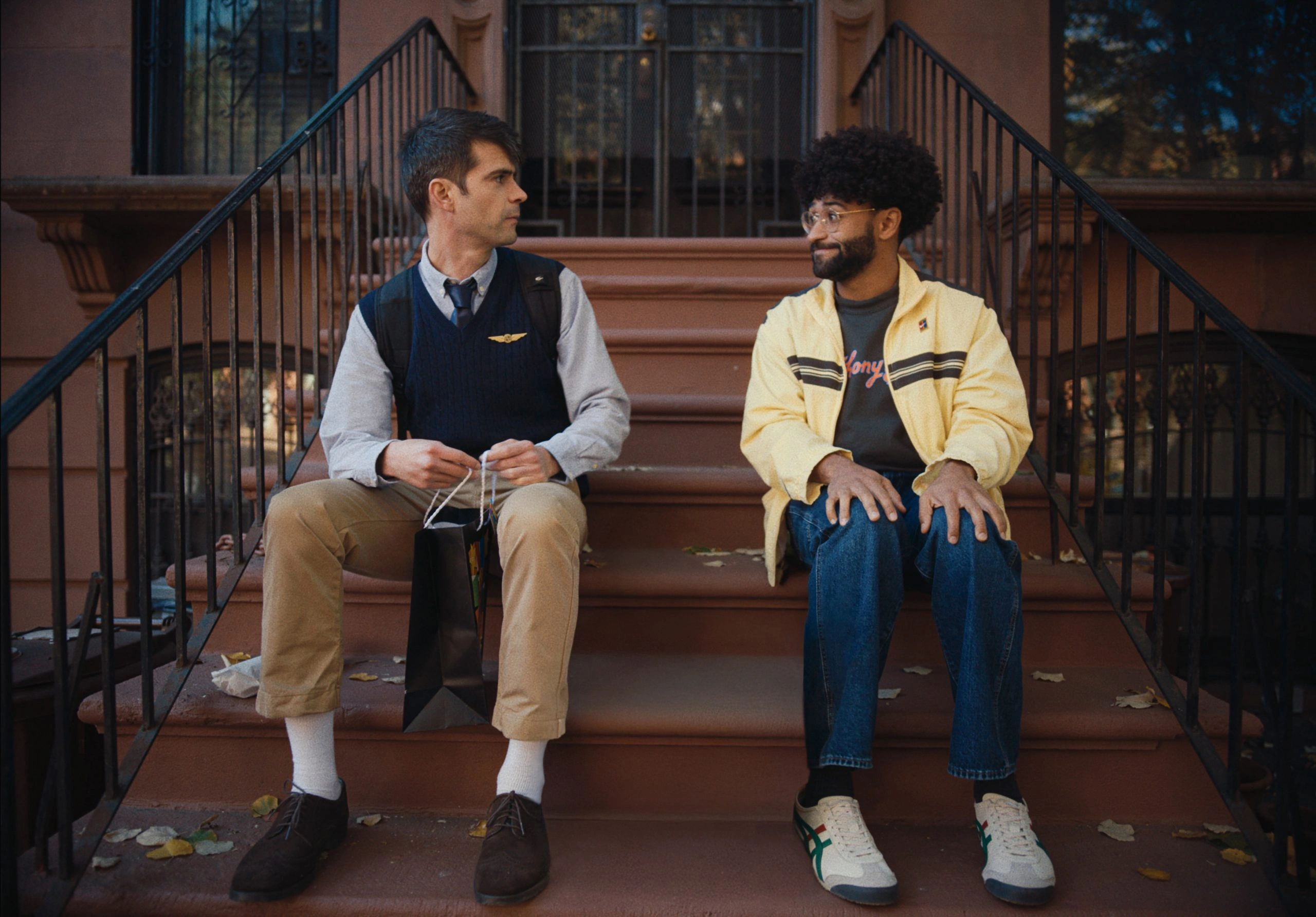
The men’s intimacy is built through routine. They sit outside their building, exercise together, recall being too stoned, and share domestic space with the ease of people who have known each other since childhood. Yet Simon’s zip-up steam room exposes the imbalance with comic efficiency. Bruce suggests that he use it privately in his bedroom. Simon drags it into the living room because he wants to keep talking to him. The gesture initially reads as affection. Simon then proceeds to talk at Bruce rather than engage with him.
Mallis and Wood make a smart formal adjustment when Bruce begins appearing in scenes without Simon. Until then, he has largely existed through Simon’s needs: roommate, audience, confidant, airline employee. Separate screen time quietly restores his autonomy. Oberbeck plays Bruce as patient and grounded, and that patience gradually stops looking infinite. His relationship with Beatrice gives him a life structured around mutual interest rather than emotional maintenance.
The friendship’s weakness is that its shared history remains lightly sketched. The film tells us Simon and Bruce have known each other since third grade, but their current bond is expressed through parallel habits and convenience. This limits some of the pain when the relationship fractures. The free flights carry stronger dramatic definition than several years of their supposed emotional history.
Beatrice and the Terror of Someone Else’s Momentum
Beatrice (Naomi Asa) threatens Simon before she takes a single standby flight. She is a filmmaker who appears to be moving at the pace Simon describes when speaking about himself. At the festival event, she makes an impression. She asks direct questions about Simon’s documentary. Her interest forces him to hear the weakness of his own answers.
Asa gives Beatrice a calm self-possession that sharpens Simon’s insecurity without turning her into a smug careerist. Her patience visibly thins as his exaggerations, competitiveness, and social carelessness accumulate. She also connects naturally with Bruce, leaving Simon to confront two anxieties at once: his closest friend is building a serious relationship, and the woman entering Bruce’s life resembles the artist Simon keeps insisting he will become.
His fixation on the travel companion privilege exposes the uglier transaction beneath the friendship. Simon seems less alarmed by emotional separation than by the possibility that Bruce will give Beatrice the free flights. The screenplay is mercilessly perceptive here. Adult friendships are often discussed in sentimental language, yet they can accumulate economies of access, convenience, housing, professional introductions, and favors. Affection exists inside those arrangements. So does dependency.
The central confrontation arrives late, roughly an hour into the film’s 90-minute running time. Simon’s repetitive anxiety is clearly intentional, and Turner charts his movement from eager optimism into jealous obsession with precision. The prolonged buildup leaves the aftermath comparatively compressed. Greater time spent with the fracture itself might have exposed deeper resentments between the men.
A Film Scene Fluent in Its Own Nonsense
The Travel Companion is funniest when studying indie-film culture at conversational distance. The opening Q&A includes rambling audience comments disguised as questions, vague artistic platitudes, and crew members pulled into discussions unrelated to their work. A misunderstanding about a “1.5” budget turns $1.5 million into $150,000 in the imagination of an impressed aspiring filmmaker. Elsewhere, a crew member claims to be shooting a mayonnaise commercial. These jokes work because the filmmakers understand how creative insecurity produces its own dialect.
Jason Chiu’s cinematography gives Brooklyn stoops, airport interiors, and ordinary apartments a warm polish. The imagery has a casual confidence suited to characters who notice film stock and lenses, while the editing repeatedly places Simon’s frantic motion beside periods of total creative inertia. He crosses cities, attends screenings, shoots footage, pitches ideas, and remains remarkably close to where he began.
Anil Joseph’s entrepreneurial cab driver offers one of the film’s better minor turns, partly because his later reappearance reminds us that Simon is not the only person trying to manufacture a future from unstable work. The difference is that other characters appear capable of recognizing the conditions of their lives. Simon keeps converting uncertainty into artistic language.
Mallis and Wood resist humiliating him beyond repair. Their comedy stays warmer than the darker film hiding inside Simon’s behavior, which occasionally softens the social critique. Yet the final movement earns its restraint. Losing access to Bruce’s flights strips Simon of the mechanism he has confused with ambition. For once, there is nowhere glamorous to go, no foreign footage to classify as scouting, and no boarding pass available to make stagnation resemble motion.
The American independent comedy-drama The Travel Companion held its world premiere at the Tribeca Festival on June 5, 2025, before arriving in select United States theaters via Oscilloscope Laboratories on April 10, 2026. Moviegoers can check local indie arthouse listings for ongoing screenings or access the feature through upcoming premium video-on-demand platform releases. The story follows an aimless documentary filmmaker living in New York City who relies heavily on his roommate’s airline employee perks for unlimited free flights, spiraling into a desperate comedic panic to save his travel privileges when his friend falls for a new girlfriend.
Full Credits
Title: The Travel Companion
Distributor: Oscilloscope Laboratories
Release date: June 5, 2025 (Tribeca Festival), April 10, 2026 (United States)
Running time: 91 minutes
Director: Alex Mallis, Travis Wood
Writers: Weston Auburn, Alex Mallis, Travis Wood
Producers and Executive Producers: Weston Auburn, Ryan Martin Brown, Paula González-Nasser, Alex Mallis, Travis Wood
Cast: Tristan Turner, Anthony Oberbeck, Naomi Asa, Joanna Arnow, Brit Fryer, Steven Phillips-Horst, Anil Joseph, Dara Messinger, Daryush Parsi, Peter Davis, Peter Fairman
Director of Photography (Cinematographer): Jason Chiu
Editors: Bryan Chang
Composer: Eliot Krimsky
The Review
The Travel Companion
The Travel Companion finds its sharpest material in the quiet economy of friendship, where affection, access, and professional insecurity become difficult to separate. Its festival Q&As and unfinished-film rhetoric capture a creative class fluent in describing progress while standing still, and Tristan Turner makes Simon's panic readable beneath his exhausting behavior. The central friendship could use greater emotional history, and the delayed confrontation leaves little space for its fallout. Still, Alex Mallis and Travis Wood recognize how adulthood can expose the transactional habits hiding inside old intimacy.
PROS
- Precise indie-film satire
- Tristan Turner's anxious performance
- Strong Bruce perspective shift
- Polished, warm cinematography
- Sharp creative-stagnation metaphor
CONS
- Thin friendship backstory
- Late central confrontation
- Repetitive middle stretch
- Gentleness limits darker comedy