













A government pamphlet can ruin a life without containing a single lie. Sweden’s Om kriget kommer told civilians how to respond to nuclear war, and Karl-Göran Persson commits the rare social crime of taking official advice literally. Everyone is told to prepare. He prepares.
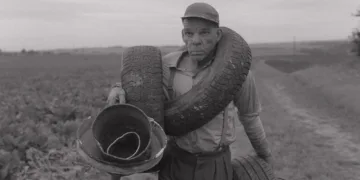
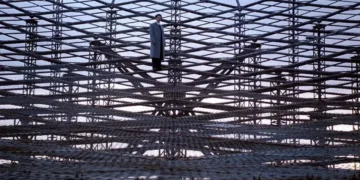
John Skoog’s Redoubt reconstructs Persson’s strange true story as a monochrome rural fable, following the southern Swedish farmhand as he converts his modest home into a fortress. Railway tracks disappear into concrete.
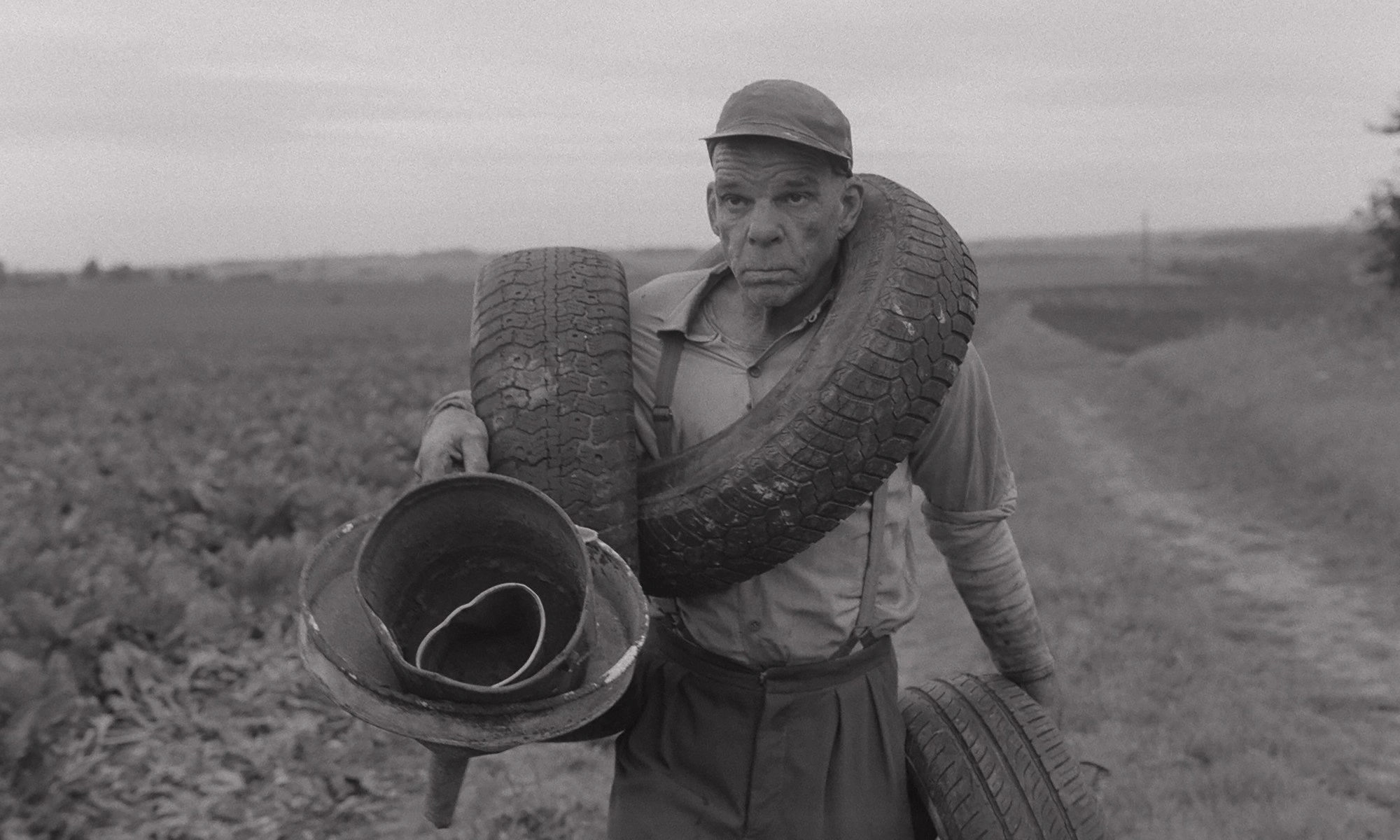
Bicycle parts, buckets, bed frames, and discarded metal become reinforcement. Once his pension arrives, money immediately returns to the structure. Call it the preparedness trap: survival becomes an occupation long before death has scheduled an appointment.
Skoog resists the easy diagnosis. Karl-Göran is never introduced through a scene of wild paranoia or violent behaviour. He attends church. He sings, dances, works, and talks with villagers. His fear has an official source, printed and delivered by the state. This complicates the familiar image of the mad recluse, since the difference between Karl-Göran and his neighbours may be one of intensity rather than belief. That distinction is uncomfortable. Good.
A Man Who Never Stops Building
Denis Lavant plays Karl-Göran primarily through his body. Watch him drag material across fields, crouch beside unfinished walls, or force his compact frame through the growing structure. Each action carries the awkward precision of a man who has repeated the same labour until repetition has become personality.
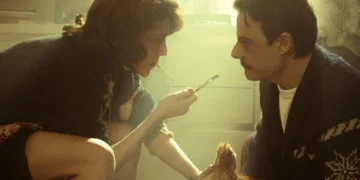
Lavant learned Swedish for the role, yet speech remains secondary. His accent contributes to Karl-Göran’s slight separation from the village, while his face keeps moving between vulnerability and something harder to name. At certain angles he resembles a creature hiding from daylight. Seconds later, he is playing with children or apparently trying to hypnotise a chicken. The film never asks these versions of him to reconcile.
His physicality sometimes recalls silent comedy. Practical tasks develop odd rhythms, and his gestures can approach pantomime without turning Karl-Göran into a joke. The church sequence makes this especially clear. Dressed in his Sunday clothes, he sings with extraordinary conviction about labour and devotion. Work, for him, has acquired religious properties. Concrete is sacrament. Hammering is prayer. (God presumably has concerns about the building regulations.)
The children understand him best because they have little interest in diagnosis. They follow him into the forest, listen to his ideas, and accept plans that include rooms for the royal family. Adults measure Karl-Göran against normal behaviour. The children measure him against imagination.
Then the social scenes begin thinning out. Singing and dancing give way to construction. His pension feeds the project. Lavant does not perform a sudden collapse because Skoog is interested in something quieter: the point at which a habit consumes so much time that nothing dramatic needs to happen. Life simply loses the competition.
The Landscape Stays Open, the House Closes In
Ita Zbroniec-Zajt’s black-and-white photography creates the film’s most persuasive argument before Skoog has to articulate anything. The Skåne fields are framed in wide, patient compositions with horizons that seem to offer limitless space. Karl-Göran keeps responding by building smaller rooms. There is a cruel visual joke here. The man terrified of confinement by catastrophe constructs his own confinement voluntarily.
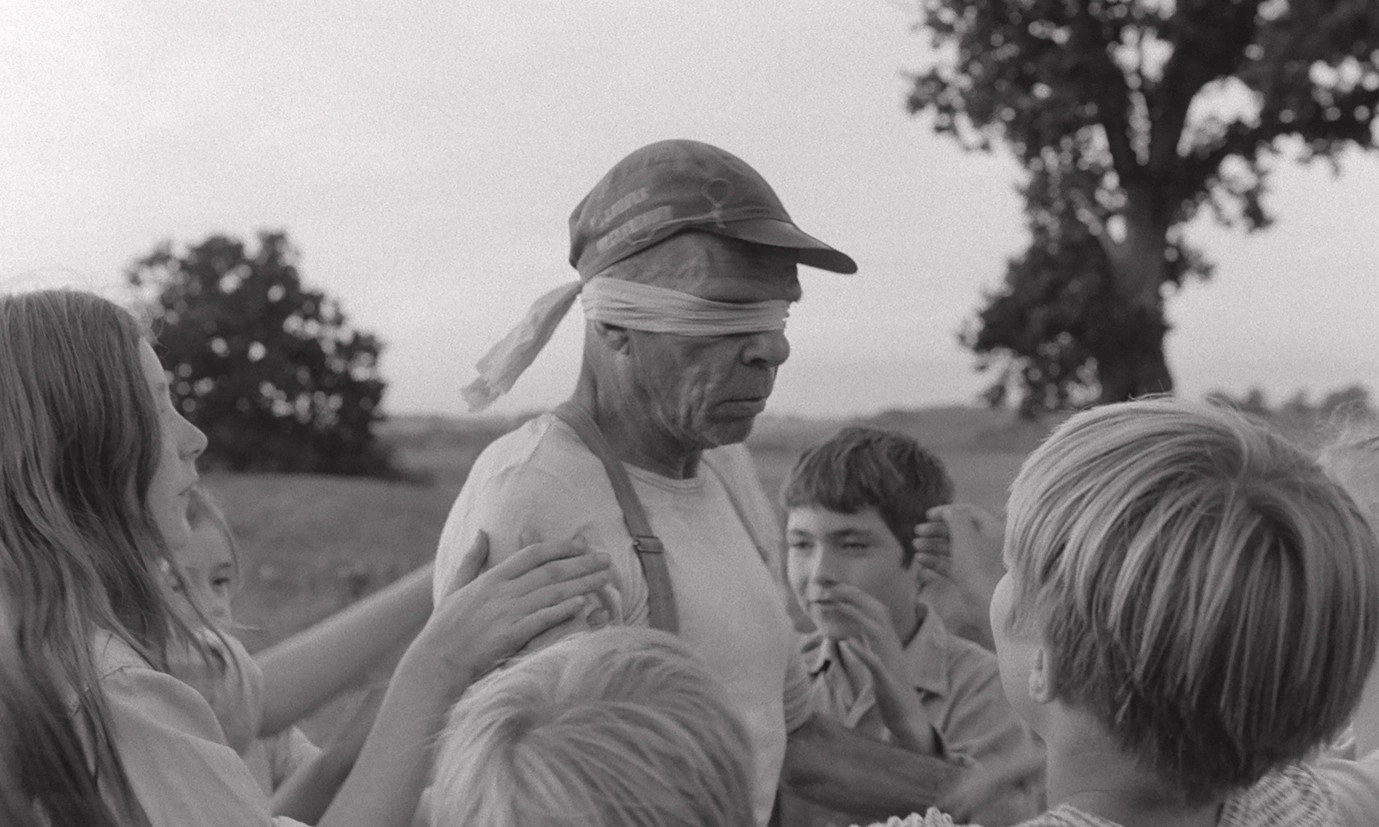
Skoog’s long static takes allow physical labour to retain its duration. Karl-Göran pours, carries, scavenges, and arranges. A brisk montage would turn him into an industrious eccentric and move us toward the next plot point. Redoubt stays. Repetition becomes pressure, then monotony, then a strange kind of hypnosis.
I initially resisted the slowness. Some sequences appear suspended between deliberate observation and plain inertia, and Skoog’s background in installation art occasionally becomes a liability. A film still requires movement of some kind, even internal movement. Or does it? Annoyingly, Redoubt makes a decent case against my complaint by turning the absence of momentum into Karl-Göran’s condition. He is endlessly active while remaining existentially stationary. The building changes shape, yet his life does not progress.
Inside, scrap and concrete create narrow chambers that resemble catacombs. Outside, diffuse light spreads across open farmland. The contrast is so blunt on paper that it should feel schematic, but Zbroniec-Zajt’s compositions avoid explanatory emphasis. The camera does not underline the irony. It lets Karl-Göran build it himself.
By the later passages, the redoubt resembles outsider sculpture, a private anxiety made public through architecture. Bauhaus believed form should answer function. Karl-Göran seems to invent Cold War anti-Bauhaus: function has become so psychologically unstable that form can never stop expanding.
Concrete Against the End of the World
The central question is tempting and slightly useless: was Karl-Göran mad? Skoog keeps placing evidence on both sides. A nuclear war never arrives, and military experts have questioned the shelter’s practical value. Yet the threat that begins his obsession was real enough for Swedish authorities to distribute survival instructions across the country. Karl-Göran did not invent the apocalypse. He merely refused to treat it as abstract.
That may be Redoubt’s sharpest idea. Modern societies are remarkably skilled at informing citizens about catastrophic possibilities, then expecting them to return calmly to lunch. Nuclear annihilation. Climate collapse. Pandemics. War. Read the instructions, remain aware, carry on. Karl-Göran breaks the social contract by asking what serious belief in the warning would actually look like. It looks ridiculous.
It also looks rather logical. Unable to control bombs, governments, or military strategy, Karl-Göran controls material. He finds another railway track. He mixes another load of cement. He makes a wall thicker. Physical labour converts cosmic uncertainty into small decisions with measurable results. Fear has no dimensions. Concrete does.
The children’s voice-over pushes his story toward folklore, giving the diminutive builder the air of a rural Don Quixote whose windmills happen to be geopolitical. Their sympathy matters because it removes the clinical distance adults instinctively impose on eccentricity. They see a man building something enormous because he believes people may need it.
The cruelest paradox is visible in the scenes Skoog places around the labour. Karl-Göran appears happiest while playing with children or joining communal rituals. His shelter is designed to preserve human life, yet constructing it gradually removes him from human contact. Protection becomes isolation. Preparation eats the present to defend a hypothetical future.
I keep returning to the surviving house. Karl-Göran feared that twentieth-century war would erase everything, so he built an object stubborn enough to remain. The war never reached him. The object endured anyway. Maybe the redoubt failed. Maybe permanence was the real shelter he was building.
The poetic, historical art-house drama Redoubt made its high-profile festival debut at the San Sebastián International Film Festival in September 2025 before executing its full Scandinavian and UK theatrical rollouts on February 27, 2026. Cinematic enthusiasts can watch the film in select independent picture houses through Sovereign Film Distribution or via European independent streaming services. Captured in gorgeous black-and-white cinematography, the narrative centers on an eccentric Swedish agricultural laborer who, consumed by Cold War tensions, obsessively turns his rural farmhouse into a fortified community shelter for his neighbors.
Full Credits
Title: Redoubt (originally titled Värn)
Distributor: Sovereign Film Distribution, TriArt Film AB, Plattform Produktion
Release date: September 2025 (San Sebastián International Film Festival Premiere), February 27, 2026 (Sweden/UK Theatrical Release)
Rating: 12A
Running time: 85 minutes
Director: John Skoog
Writers: John Skoog, Kettil Kasang
Producers and Executive Producers: Erik Hemmendorff, Caroline Drab, Ruben Östlund
Cast: Denis Lavant, Livia Millhagen, Aron Skoog, Michalis Koutsogiannakis, Agnieszka Podsiadlik
Director of Photography (Cinematographer): Ita Zbroniec-Zajt
Editors: Jussi Rautaniemi, John Skoog
Composer: Anne Gry Friis Kristensen, David Gülich
The Review
Redoubt
Redoubt turns Cold War preparedness into what might be called the preparedness trap: the act of surviving becomes so consuming that life quietly slips elsewhere. John Skoog’s patience sometimes borders on inertia (yes, there is a difference, though the film enjoys testing it), yet Denis Lavant gives every repetitive task a strange spiritual charge. The concrete grows thicker. Karl-Göran’s world grows smaller. I am still unsure if the redoubt represents madness, devotion, or the logical endpoint of officially sanctioned fear. Skoog is wise enough to leave the cement wet.
PROS
- Denis Lavant’s physical performance
- Haunting monochrome cinematography
- Precise study of fear and fixation
- Rich visual symbolism
- Ambiguous moral perspective
CONS
- Deliberately static pacing
- Elliptical final stretch
- Elliptical final stretch
- Narrative momentum frequently stalls