





A decade is a strange amount of time for nostalgia. Long enough for a child to become a teenager, and apparently long enough for Disney to decide that one of its most successful modern animated films belongs in the sacred category of Material We Must Recreate Before Anyone Forgets the Merchandise. Thomas Kail’s Moana arrives with the eerie confidence of a memory that has memorized itself.
The story remains where Disney left it in 2016. Moana, daughter of Motunui chief Tui, is being prepared to lead an island whose people do not sail beyond the reef. Then the coconuts rot, fish vanish, and the goddess Te Fiti’s stolen heart becomes Moana’s responsibility. She sails into the ocean, finds Maui, and tries to repair an old divine theft.
None of this is broken. Jared Bush and Dana Ledoux Miller work from sturdy narrative architecture, while Lin-Manuel Miranda and Mark Mancina return to songs already tested by countless car rides with children. The curious choice is fidelity. Moana discovers herself by ignoring the map handed to her. Kail’s film checks the old map before every turn.
A New Wayfinder
Chief Tui trains Moana through ritual. The future chief will place her stone on the ancestral pile, taking her position in a visible line of inherited responsibility. The film’s central argument sits inside that image: tradition can preserve a people and still become a prison when preservation replaces thought.
Moana treats tradition as a damaged archive. The secret cave makes this plain. Tala takes her granddaughter to a hidden fleet of voyaging canoes, and “We Know the Way” reveals that crossing the ocean was once part of Motunui’s identity. Moana’s rebellion becomes an act of historical recovery. Her ancestors remain the answer; her father simply remembers too few of them.
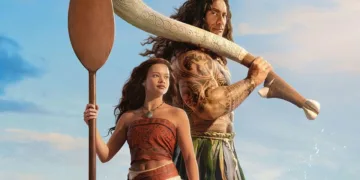
Catherine Laga’aia understands this tension. During “How Far I’ll Go,” she does not play Moana as a generic dreamer staring toward a prettier life. Her face keeps returning to duty, then to the sea, then back to the village. The simple movement gives the song a visible argument. She wants the horizon and feels guilty for wanting it.
Her voice carries the number easily, with clean sustained belts and a cadence close enough to Auliʻi Cravalho’s original performance to make comparison unavoidable. That similarity threatens to turn Laga’aia into a human photocopy. She keeps slipping past it. On the canoe, especially when Maui dismisses her mission, she gives Moana a sharper impatience. Watch how quickly her expression hardens after one smug interruption. The script gives her familiar lines. The irritation feels newly present.
Rena Owen gives Tala the looseness Motunui needs. Her playful manner sits against Chief Tui’s rigidity, and the cave scene works because Owen treats the revelation like an opening door rather than a delivery of lore. Tala’s later connection to the manta ray carries the spiritual imagery without forcing solemnity.
Moana’s strongest act remains her final recognition of Te Kā. She asks the ocean to part, walks toward a creature made of fire, and identifies rage as evidence of injury. Disney heroines frequently defeat villains by discovering courage. Moana does something stranger. She revises the category of villain.
The Demigod Problem
Dwayne Johnson returning as Maui sounds like the easiest casting decision in the project. The animated character already borrowed his physique, public confidence, and ability to make vanity feel friendly. Put the real man in the wig, add the magical tattoos, and let cultural recycling complete its circle.
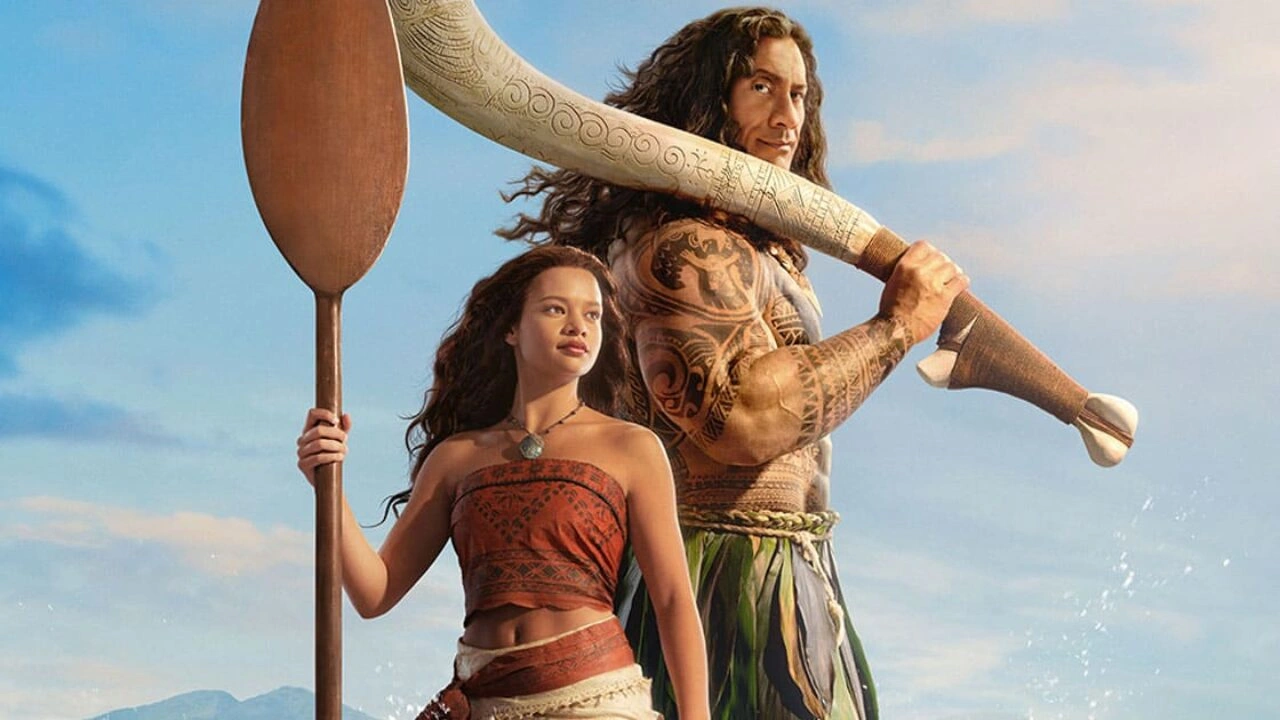
Except animation was doing serious labor. In 2016, Maui’s self-regard lived in his entire body. His face stretched, his poses expanded, and the little tattoo version of Maui could puncture his ego without saying a word. Johnson’s live-action performance relies on smirks, winks, and the relaxed certainty of a star who knows the camera has already agreed with him.
His first major exchange with Moana exposes the difference. Maui should overwhelm the scene with ridiculous self-belief as he manipulates her, traps her, and attempts to take the canoe. Johnson is pleasant. Occasionally funny. Strangely settled. Laga’aia arrives with urgency because Moana believes her island may die; Johnson often answers from somewhere closer to an expensive press tour.
I changed my mind about him briefly during “You’re Welcome.” Kail allows animated mural imagery to invade the number, Maui’s boasts multiplying across stylized backgrounds while the tattoos continue their silent commentary. For a few minutes, the film stops treating realism like a legal obligation. Johnson looks freer because the world around him finally exaggerates at his level. Then the number ends.
The later relationship between Maui and Moana inherits the original film’s efficient bonding structure. They fight, survive the Kakamora, pursue Maui’s hook through Tamatoa’s lair, and move into wayfinding lessons. Respect grows. Live action, though, draws attention to missing connective tissue.
Maui’s fear of abandonment and Moana’s frustration with failure had room to breathe between set pieces. Kail recreates the bridge instead of checking what might exist beneath it. The cartoon once made two archetypes feel unusually alive. The humans sometimes make them feel diagrammed.
Caught Between Two Mediums
Calling this Moana “live action” requires a generous definition of both words. Laga’aia and Johnson are physically present. The ocean, creatures, environments, Maui’s transformations, Te Kā, and several action beats arrive through digital construction. Animated people inside an animated world have become photographed people inside another heavily animated world. Progress has a sense of humor.
Oscar Faura’s cinematography can be handsome. Wide ocean views give Moana’s isolation scale, and the Motunui beaches look inviting without becoming a tourism commercial. “We Know the Way,” performed among a large ensemble of Pacific Islander actors, gains communal energy from bodies rowing, dancing, and singing together. Then Heihei walks in.
His googly-eyed stupidity was designed around cartoon timing. The sudden head movements, delayed reactions, and impossible physical gags belong to elastic animation. Beside human performers, the same behavior becomes strangely detached, like a GIF has wandered onto a film set and nobody wants to embarrass it.
The Kakamora sequence suffers from a related problem. Coconut-armored pirates fire blow darts and swarm the canoe in fast, exaggerated patterns. Kail reproduces the animated set piece without rethinking its physical grammar. The new medium barely changes the danger.
Tamatoa fares better precisely because realism has already left the room. Jemaine Clement’s giant treasure-hoarding crab glows inside a theatrical cavern while “Shiny” turns vanity into production design. The scene embraces artificiality, and the movie relaxes. I began to suspect that Kail’s strongest instinct is the one he uses least: let the ridiculous remain ridiculous.
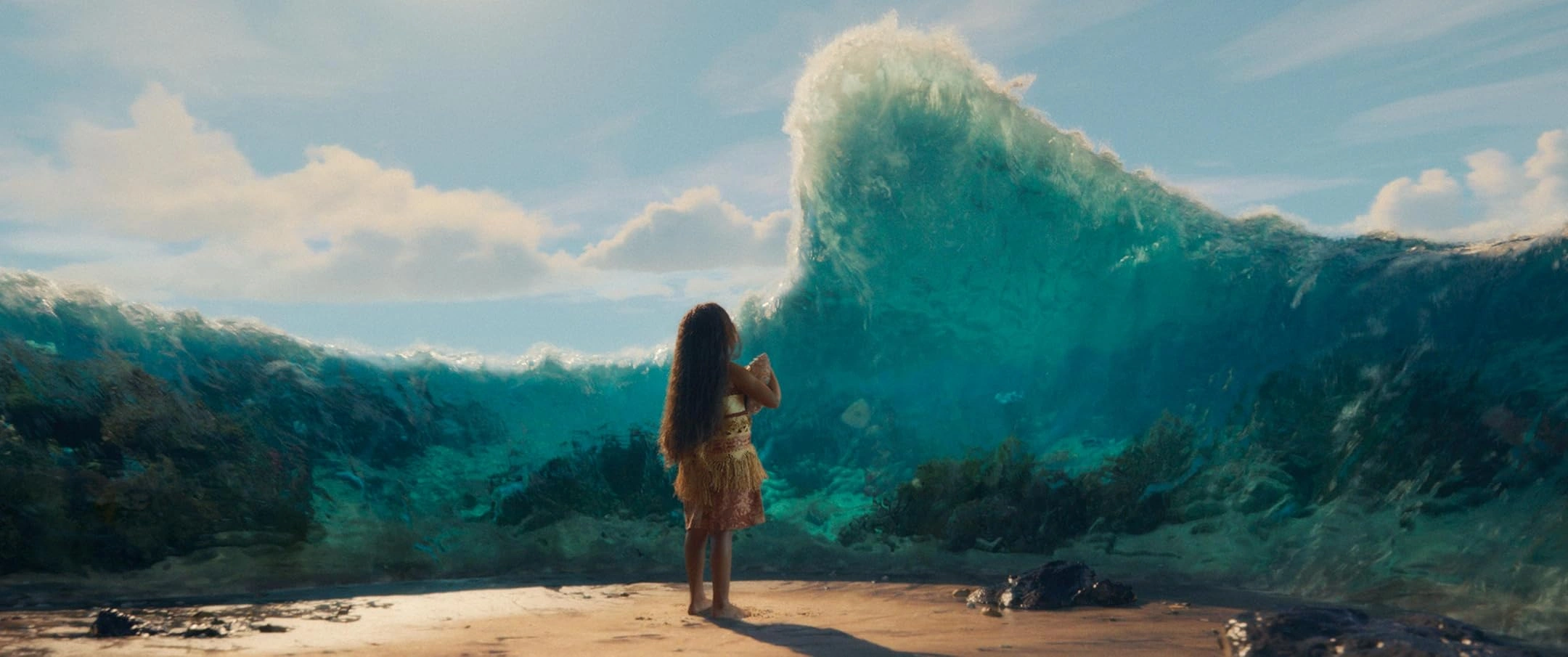
The ocean survives the translation with surprising grace. Water rises around young Moana, moves objects, parts, and gently directs her without receiving a human face. The effect keeps the sea between character and force of nature. It communicates without becoming a chatty blue sidekick. Disney restraint. Remarkable.
Te Kā presents the opposite challenge. The towering lava creature looks close to the animated design, and the final approach still depends on scale. Moana asks the ocean to open a path, walks forward, and waits as fire moves toward her. She sees Te Fiti inside the monster before Te Kā can see it herself.
Some composited sea backgrounds and spiritual effects expose the seams, especially when photographed actors appear to occupy a separate visual plane from the environment. The problem is aesthetic indecision. Animation can distort reality to externalize emotion. Live action can make fantasy tactile. This Moana often chooses a third position: expensive simulation.
The Reef Disney Will Not Cross
Disney’s remake strategy has produced its own strange cinematic ideology. Animation increasingly behaves like a draft, a successful proof of concept waiting for human faces and newer rendering software. Call it format promotion: the story has apparently been upgraded because the hair follicles now have better lighting.
Moana may be the purest expression of that idea. Young Moana meets the ocean. “How Far I’ll Go” sends her toward the reef. Tala reveals the hidden canoes. Maui performs “You’re Welcome.” The Kakamora attack. Tamatoa sings “Shiny.” Maui’s hook breaks. Te Kā gives chase. Moana returns the heart. The route is preserved so faithfully that comparison becomes the film’s unofficial interactive feature.
Johnson cannot reproduce animated Maui’s elastic narcissism. Heihei’s comedy becomes awkward around human actors. The ocean action sometimes feels composited rather than inhabited. The speed of Moana and Maui’s friendship becomes easier to question because the remake adds little between familiar stops. Fidelity prevents disastrous changes and quietly smothers discovery. I realize that sounds like praise for cowardice. Perhaps it is.
The richest material still works because it was rich before Kail arrived. Tala opening the cave changes Moana’s understanding of her people. The ocean choosing a child creates a relationship without dialogue. Moana walking toward Te Kā turns empathy into action. Miranda, Opetaia Foaʻi, and Mancina’s songs retain their force.
Yet the film’s cultural imagery now sits inside a different industrial frame. The 2016 story used wayfinding, communal memory, and Polynesian-inspired mythology to imagine a people recovering an abandoned culture of exploration. Ten years later, Disney has taken that tale and used it to preserve familiar intellectual property in almost identical form. There is a term for this sort of thing. Corporate wayfinding: sail confidently into open water while keeping one eye on the quarterly map.
Moana places her stone on the ancestral pile only after learning that leadership requires leaving safety behind. Disney has rebuilt her voyage with immense technical resources and then refused the same lesson. The ocean calls. The spreadsheet checks the coordinates.
The epic live-action musical fantasy Moana arrives in theaters on July 10, 2026, distributed worldwide by Walt Disney Studios Motion Pictures. Viewers looking to see the production can catch it exclusively on the big screen during its initial global theatrical release window before it transitions onto Disney+ for home streaming. The reimagined story follows an adventurous Polynesian teenager who responds to a mystical call from the sea, setting sail with a legendary, shape-shifting demigod to lift a terrible curse threatening her home island community.
Where to Watch (2026) Online



Full Credits
Title: Moana
Distributor: Walt Disney Studios Motion Pictures
Release date: July 10, 2026
Rating: PG
Running time: 115 minutes
Director: Thomas Kail
Writers: Jared Bush, Dana Ledoux Miller, Ron Clements, John Musker
Producers and Executive Producers: Dwayne Johnson, Beau Flynn, Dany Garcia, Hiram Garcia, Lin-Manuel Miranda, Auliʻi Cravalho, Scott Sheldon, Charles Newirth, Thomas Kail
Cast: Catherine Lagaʻaia, Dwayne Johnson, John Tui, Frankie Adams, Rena Owen, Jemaine Clement, Amaya Masoli, Emma Puahi-Shapazian, Tealoha Hokulani Carrera, Arya Kasarla
Director of Photography (Cinematographer): Óscar Faura
Editors: Melanie Ann Oliver
Composer: Mark Mancina, Lin-Manuel Miranda, Opetaia Foa’i
The Review
Moana
Moana turns a story about recovering the courage to explore into an argument for staying exactly where the map says. Call it corporate wayfinding: every landmark from 2016 is located, photographed, and carefully returned to shareholders (the ocean, presumably, has a fiscal quarter now). Catherine Laga'aia gives the film curiosity and warmth, while Dwayne Johnson's subdued Maui exposes how much animation once did for him. The songs survive. The images survive. What rarely appears is discovery, which is rather awkward for a movie built around crossing the reef.
PROS
- Catherine Laga'aia's warm performance
- Powerful “How Far I'll Go”
- Tala and the voyaging cave
- Strong Tamatoa sequence
- Enduring musical material
CONS
- Near-identical remake structure
- Subdued live-action Maui
- Awkward cartoon-realism clash
- Thin Moana-Maui development
- Little directorial identity