



























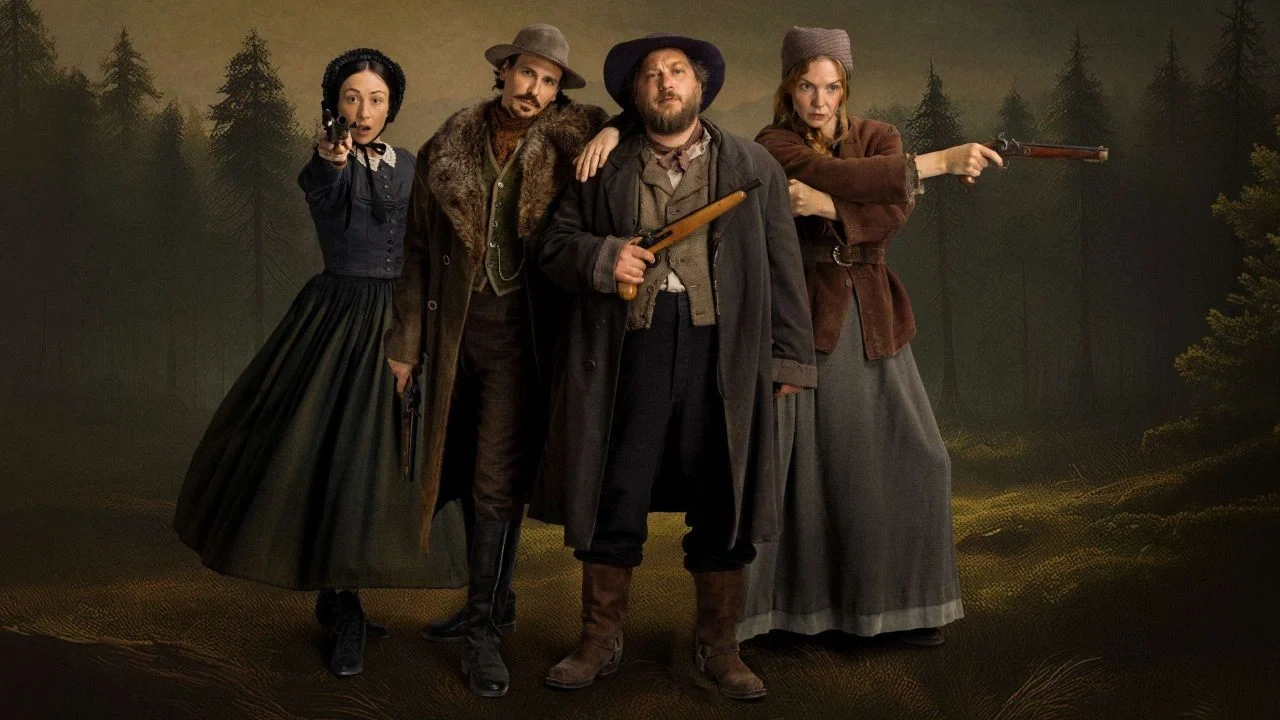

Five thousand guilders can make an imaginary bear breathe. In a poor Hessian village, hunger has already begun to deform ordinary life. Bakers are robbed, soldiers turn up dead, and revolutionary pamphlets pass between hands that have little left to lose. The Major-General, played by Bernhard Schütz with the damp confidence of a bureaucrat who mistakes obedience for affection, offers the population a simpler story. A bear is responsible. Kill it, claim the reward, and order will return.
Peter Meister’s Bear Hunting treats this fabrication as political machinery. Anger is redirected from the palace toward the forest, where desperate people can exhaust themselves chasing fur, blood, and the possibility of sudden wealth. The lie succeeds because it arrives in the shape of hope.
The film sets its tragicomic parable in the Grand Duchy of Hesse during the social unrest of the 1830s, drawing on the language of Georg Büchner’s revolutionary writings. “Peace to the shacks! War on the palaces!” appears on the underground leaflets, yet Meister surrounds the slogan with men who struggle to govern their own appetites. Revolution is printed in bold type. Human weakness occupies the margins.
Ink, Flesh, and Treachery
Heinrich secretly reproduces Büchner’s pamphlets while planning to flee to America with Minna, who happens to be his brother’s wife. David Scheid gives him the broad physical presence of a folk hero, then steadily empties that image of certainty. Heinrich wants political liberation, romantic escape, and the bear bounty. Each desire compromises the others.
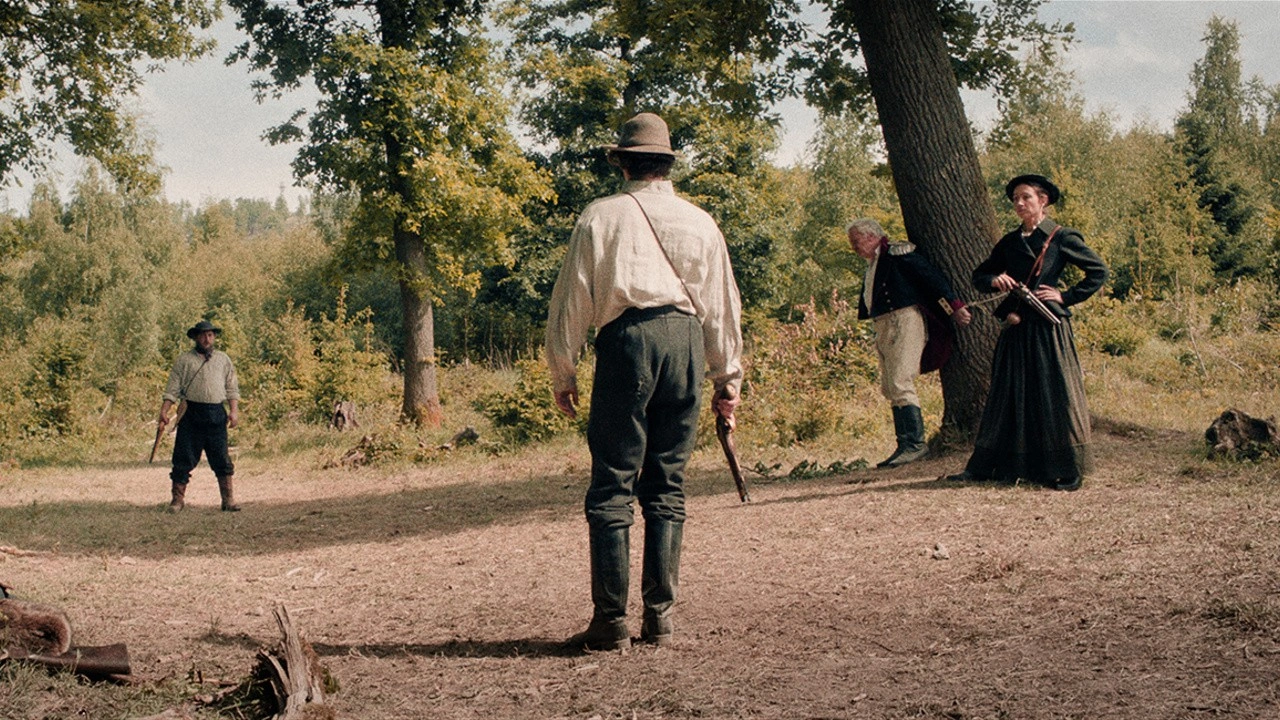
His brother Gustav prints the official newspaper, turning the Major-General’s decrees into public truth. Christopher Schärf makes Gustav’s ambition visible in the way he addresses authority, his posture tightening whenever courtly advancement appears possible. The two brothers operate rival presses, one revolutionary and one obedient, yet neither man possesses the moral clarity suggested by his publication.
Also Read





Their conflict gives the film its most bitter joke. The printed word appears powerful enough to move a village, while the printers themselves remain governed by jealousy, vanity, lust, and fear. Heinrich’s affair with Minna makes his political idealism feel fragile. Gustav’s servility makes his respectability grotesque. Both men speak of better futures while injuring the people nearest to them.
Schütz’s Major-General belongs to a different register. His elaborate hats and oily manners place him near caricature, yet his interest in Heinrich’s wife Agnes carries a quiet threat. He does not need to believe his own bear story. Power has the luxury of treating fiction as an administrative tool.
A War Among Trees
The forest first appears lush and almost generous under Florian Mag’s photography. Green light filters through the branches, offering the illusion of space beyond the village’s poverty. Once the hunt begins, that same landscape contracts. Paths lead toward traps. Gunshots arrive without clear targets. Men stumble through undergrowth, wound one another, and mistake panic for courage.
Manfred Döring’s production design makes the village feel worn rather than decorative. The homes are sparse but warm, the church rises over the settlement with stone authority, and official uniforms carry a cleanliness unavailable to the hungry. The distance between palace power and rural deprivation is expressed through fabric, timber, food, and the condition of walls.
A sheep tied to a tree watches the human confusion with blank patience. The metaphor is blunt, almost stubbornly so, yet its stillness gains force beside the frantic hunters. The villagers have been offered a scapegoat and become a flock around it.
The Düsseldorf Düsterboys accompany this collapse with folk harmonies, tropical rhythms, and rough-edged punk energy. Their music refuses to preserve the nineteenth century behind glass. During the woodland pursuit, the score gives the men’s clumsy violence the rhythm of a drunken procession. History feels close enough to smell.
The middle stretch loses pressure when romantic quarrels and secondary encounters interrupt the movement from deception to bloodshed. Meister’s laconic humor keeps individual scenes alive, especially when hunters fall into traps they prepared for the bear, but the narrative sometimes wanders through the forest with them.
Then Heinrich’s secret printing is discovered. The hunt changes direction. The promised animal fades from importance, and human bodies become acceptable substitutes.
Those Who See the Lie
Agnes enters the forest armed and dressed with the severe practicality of a western gunfighter. Pheline Roggan plays her concern for her teenage son without sentimental display. She understands that the bear does not exist, yet knowledge offers no protection against men who have already chosen frenzy.
Minna seeks another form of escape. A former actress dreaming of America, she drifts through opium smoke and romantic fantasy, imagining distance as salvation. Aenne Schwarz gives her scenes with Heinrich a tired sensuality. Their affair feels less like passion than two prisoners describing an unlocked door neither has reached.
The shepherdess also recognises the fraud. Meister repeatedly grants the women clearer sight than the men, then limits their influence over the story’s direction. Agnes can carry a gun. Minna can manipulate desire. The shepherdess can name the deception. The machinery surrounding them continues to turn.
This imbalance weakens the satire. The women stand nearest to the film’s intelligence, yet the narrative remains fascinated by male foolishness. Their insight becomes another resource the village wastes.
When the final confrontation erupts, comedy and death occupy the same patch of earth. The hunters abandon restraint, officials expose their cowardice, and the promised revolution arrives as mutual destruction rather than collective awakening. Meister keeps the violence absurd, almost jaunty, when it might have become unbearable.
That gentleness is both the film’s grace and its wound. Bear Hunting watches a population trade anger for spectacle, then smiles sadly as the forest fills with bodies. Somewhere beyond the trees, the palace remains untouched.
The satirical period piece premiered on July 1, 2026 at Filmfest München in Germany. Set in the year 1834, the narrative centers around a major who creates a massive bounty for tracking down the last remaining wild bear in the country as a political strategy to distract a highly dissatisfied local population. The comedic chaos unfolds primarily across film festival screenings and regional European theatrical circuits, co-produced by German public television network ZDF.
Full Credits
Title: Bear Hunting
Distributor: Port au Prince Pictures, Frisbeefilms, ZDF – Das kleine Fernsehspiel
Release date: July 1, 2026
Running time: 1 hour 34 minutes
Director: Peter Meister
Writers: Peter Meister
Producers and Executive Producers: Manuel Bickenbach, Alexander Bickenbach, Peter Meister
Cast: David Scheid, Christopher Schärf, Bernhard Schütz, Pheline Roggan, Aenne Schwarz, Hannes Linder, Lukas Meister, Maximilian Brauer, Wolfram Koch, Caro Braun, Anna Bögger, Mathias Renneisen, Kai Schumann, Isaak Dentler
Director of Photography (Cinematographer): Florian Mag
Editors: Jan Ruschke
Composer: Pedro Crescenti, Peter Rubel, The Düsseldorf Düsterboys
The Review
Bear Hunting
Bear Hunting turns a forest into a theatre of hunger, vanity, and obedience, where men chase an invented animal while power slips quietly past them. Its production design, dry performances, and unruly folk-punk score give the village a bruised, lived-in texture. Yet the satire speaks too softly when anger should scorch the frame, and the women who understand the lie remain trapped at its edges. The film grins at political despair when it might have bared its teeth.
PROS
- Rich period atmosphere
- Sharp political premise
- Strong ensemble performances
- Distinctive folk-punk soundtrack
- Effective grotesque finale
CONS
- Uneven middle section
- Satire lacks force
- Underused female characters
- Some culturally specific humour may not travel