



























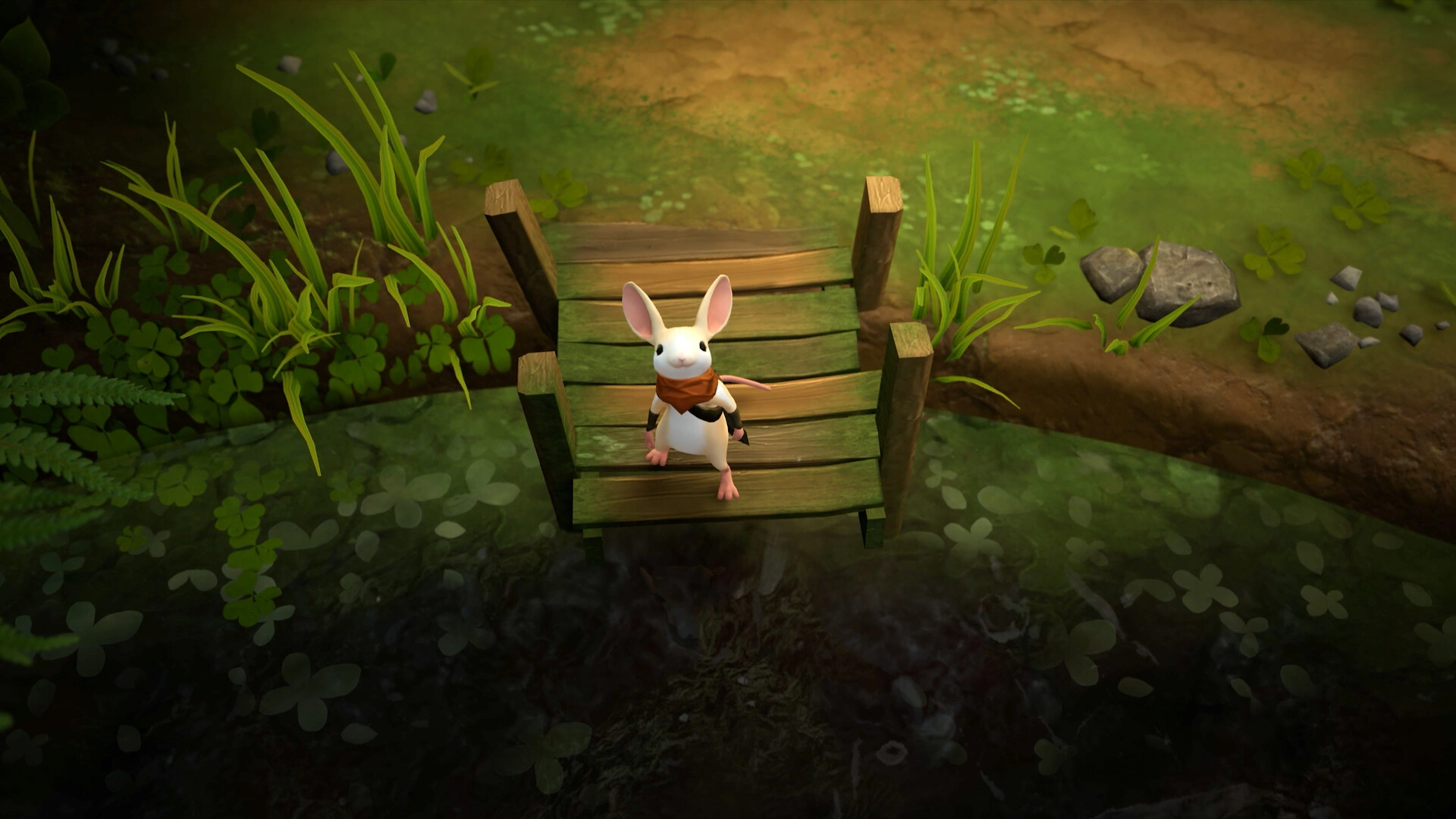

Moving Quill with one stick while dragging an enemy toward a pressure plate with the other captures the design idea that gives Moss: The Forgotten Relic its identity. Quill may carry the sword, yet the player occupies the world beside her as the Reader, a visible magical presence able to heal her, manipulate scenery, and interfere with hostile creatures. The relationship exists through mechanics before the story asks anyone to care about it.
Polyarc’s compilation brings Moss, its Twilight Garden content, and Moss: Book II to standard displays after their original releases on VR platforms. Removing the headset creates an obvious problem. These environments were built to be inspected by leaning around miniature ruins, peering behind walls, and searching each diorama from a physical position. The new version replaces that freedom with scripted camera movement and conventional controls.
The conversion loses some spatial clarity, yet the game underneath the technology remains remarkably sturdy. Its puzzles still rely on cooperation between Quill and the Reader, its storybook presentation still gives each chapter a gentle rhythm, and Quill still celebrates a solved room by looking toward the player for a high five.
Two Books, One Necessary Continuation
The first book gives Quill a simple heroic task. After discovering a shard of magical Glass, she becomes connected to the Reader and draws the concern of her uncle Argus. His attempt to protect her ends with his capture by Sarffog, the serpent tied to the destruction of their kingdom. Quill responds by crossing forests, ruins, and Arcane strongholds to rescue him.
Its early rooms introduce the game’s vocabulary carefully. Quill jumps between platforms, cuts through small groups of enemies, and activates switches, while the Reader moves blocks or positions creatures where their attacks can trigger distant mechanisms. The structure resembles a sequence of compact Zelda puzzle rooms viewed from above. Each chamber introduces a problem, teaches the relevant interaction, then asks the player to combine it with something learned earlier.
The Sarffog encounter closes the first book with a satisfying mixture of evasion, platforming, and environmental control. Played alone, that ending feels abrupt. Within this collection, Book II begins quickly enough to reveal the first game as an extended opening act.
The sequel increases the scale through the search for further Glass shards and the threat posed by Tylan, an imposing owl whose design makes Quill appear especially vulnerable. Sahima’s introduction also gives the story and mechanics fresh energy. Her chakram offers a new attack style, but its greater value appears in puzzles where the weapon can be lodged into surfaces and recalled to activate routes. This is the sequel’s clearest improvement: new tools receive rooms built specifically around their properties.
Coordination Becomes the Puzzle
The strongest challenges ask the player to manage several actions at once. Quill may need to ride a platform while the Reader holds an enemy in place, aims its projectile toward a switch, and moves another object before the route closes. Success comes from understanding the relationship between systems rather than finding one hidden answer.
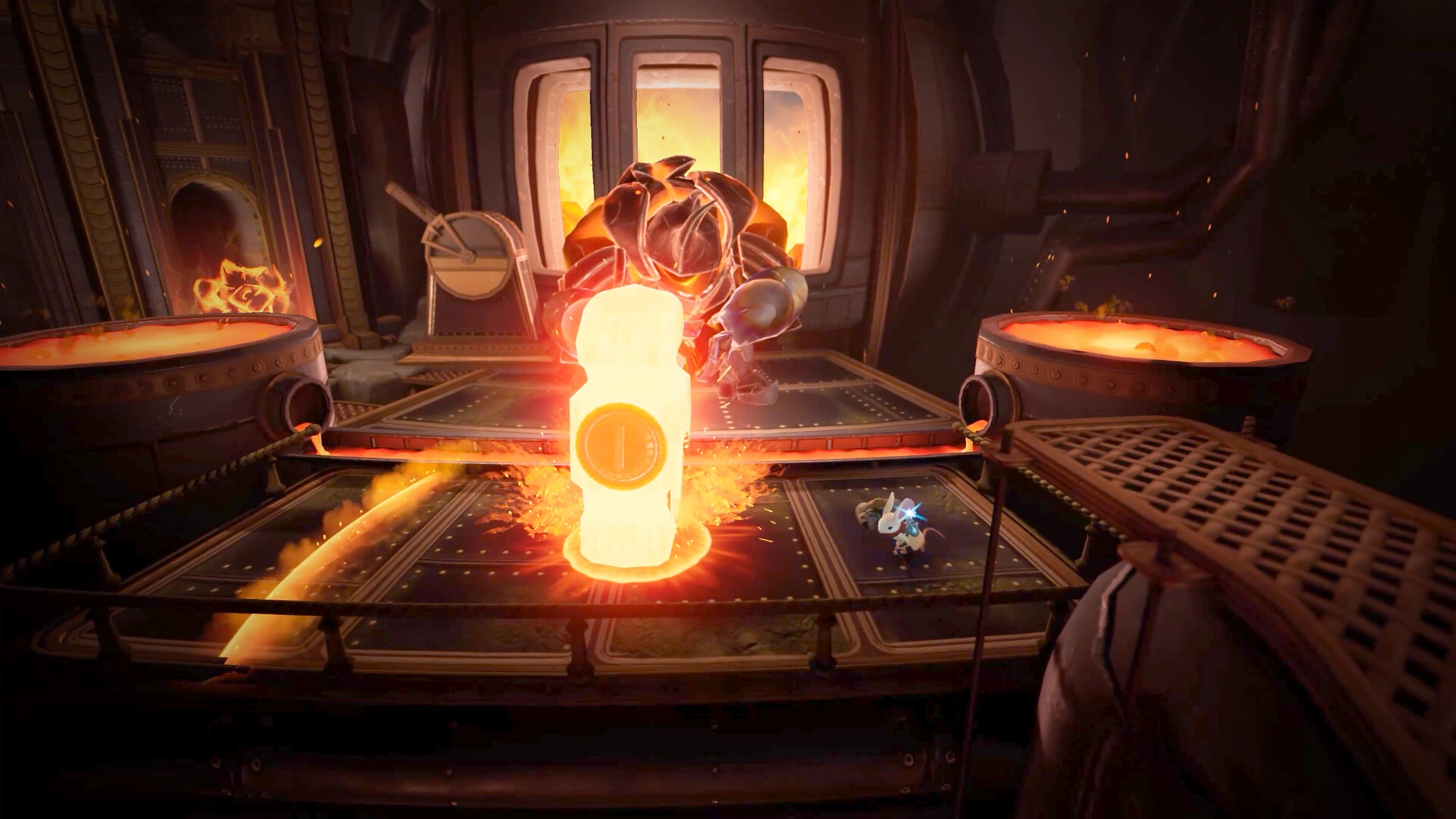
Book II builds on this coordination through Quill’s dash and expanded weapon set. The dash makes sword combat faster, then becomes part of traversal sequences that require Quill to cross gaps or strike distant targets. The chakram creates another useful layer because throwing and recalling it alter the order in which mechanisms can be reached. Mechanical progression feels meaningful because each new ability changes the problems designers can place inside a room.
Regular combat receives less attention. Arcane forces arrive in repeated waves drawn from a limited enemy pool, and many encounters ask Quill to slash or bash the same creatures until the exits reopen. The Reader can restrain an opponent or redirect its attack, which adds tactical value, but prolonged battles near the end of each book expose how narrow the fighting system remains.
Boss encounters work better because they treat combat as puzzle solving. Sarffog and Tylan require players to study movement patterns, use the arena, and coordinate Quill’s actions with the Reader’s influence. Frequent checkpoints and accessible healing keep failure from becoming punishing. Combat can also be skipped, a practical option for younger players or anyone interested mainly in the puzzles and story.
The Camera Sets the Limits
Scripted framing preserves the miniature-theatre presentation, with Quill moving through spaces that resemble elaborate models arranged beneath the player. Forest paths, industrial machinery, frozen mountains, and ruined castles all use scale effectively. Massive doors and ordinary plants become architecture when the heroine is only a few inches tall.
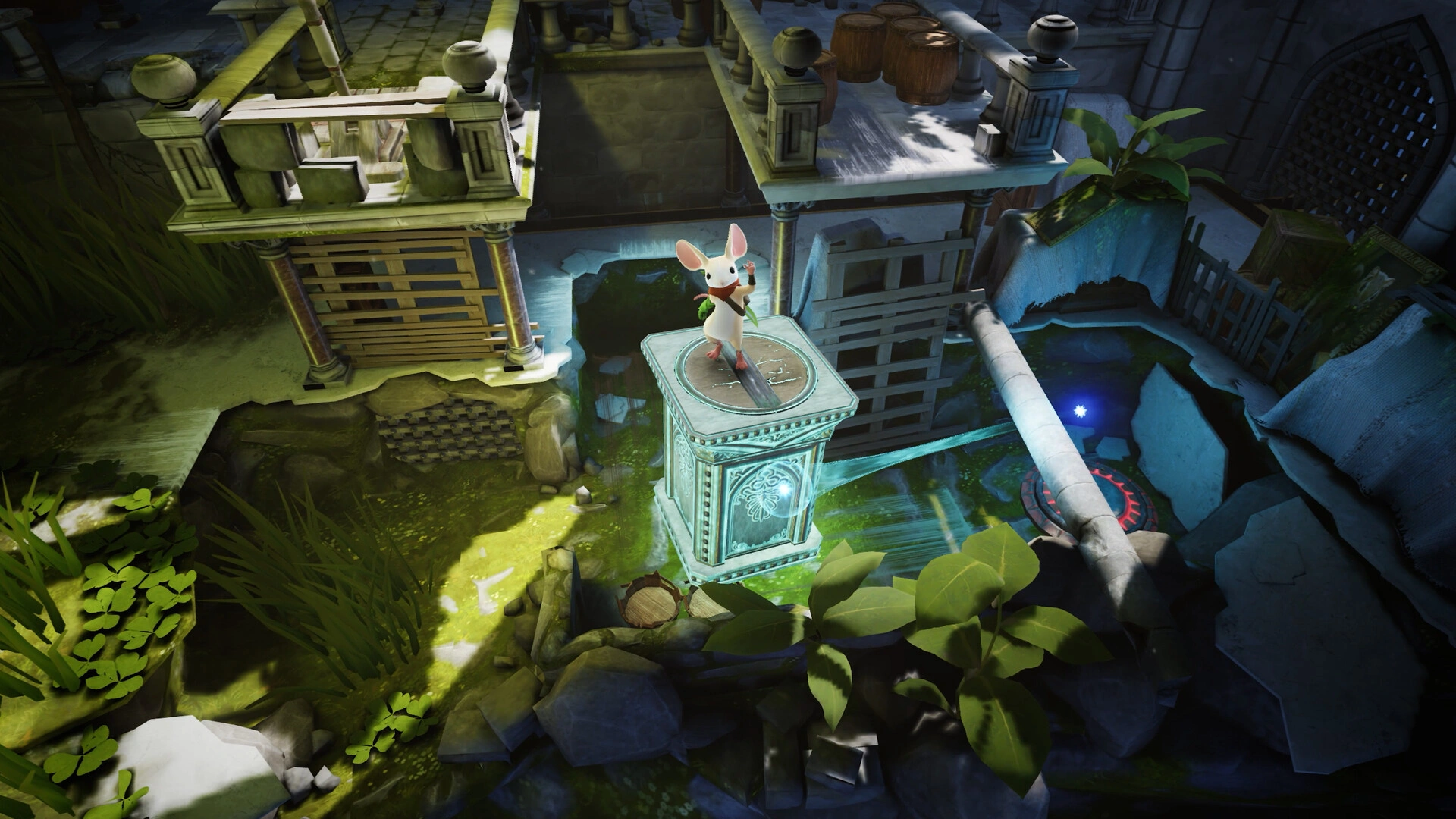
Yet fixed angles occasionally clash with the original level design. Some jumps are difficult to judge because the camera flattens the distance between platforms. Other rooms hide sections that would have been visible through physical movement in VR, making familiar spaces harder to recognize when revisited. A small amount of camera rotation could have reduced these issues, but both sticks already serve the dual-character control scheme.
Generous checkpoints soften the irritation when Quill misses a ledge or tumbles during a combo. They cannot restore the lost control over perspective.
Quill’s animation carries much of the emotional load that the camera cannot. She glances toward the Reader after danger, performs small dances, raises her hand for celebration, and reacts physically when healed. These gestures turn interface actions into communication. The illustrated book pages and measured narration support the same idea, presenting the game as a tale being shared between storyteller, reader, and hero.
The final shifting-perspective sequence in Book II shows how confidently Polyarc can reshape its visual language for a standard display. VR made the original presentation distinctive. The bond between Quill and the person guiding her gives it staying power.
The Review
Moss: The Forgotten Relic
Moss: The Forgotten Relic proves that Quill’s adventure was never dependent on a headset. Controlling Quill and the Reader at once still creates puzzles built around coordination, timing, and spatial awareness, while Book II expands that foundation through the chakram, dash, and stronger encounter design. Scripted camera angles occasionally obscure jumps, and repeated Arcane battles expose the combat’s limited enemy pool. Yet the dual-character mechanics, expressive animation, and continuous two-book structure keep this adaptation remarkably intact.
PROS
- Clever dual-character puzzles
- Strong mechanical growth in Book II
- Expressive Quill animations
- Beautiful miniature environments
- Both games form one coherent adventure
CONS
- Fixed camera disrupts some jumps
- Repetitive regular combat
- Limited enemy variety
- Uneven Twilight Garden continuity