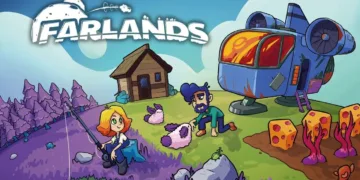
























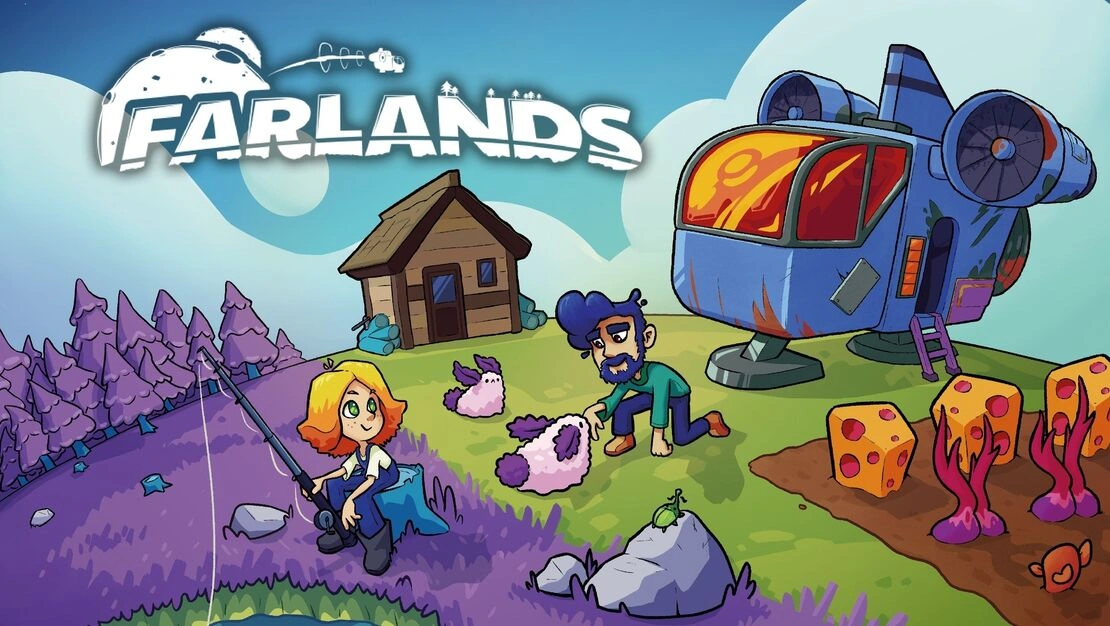

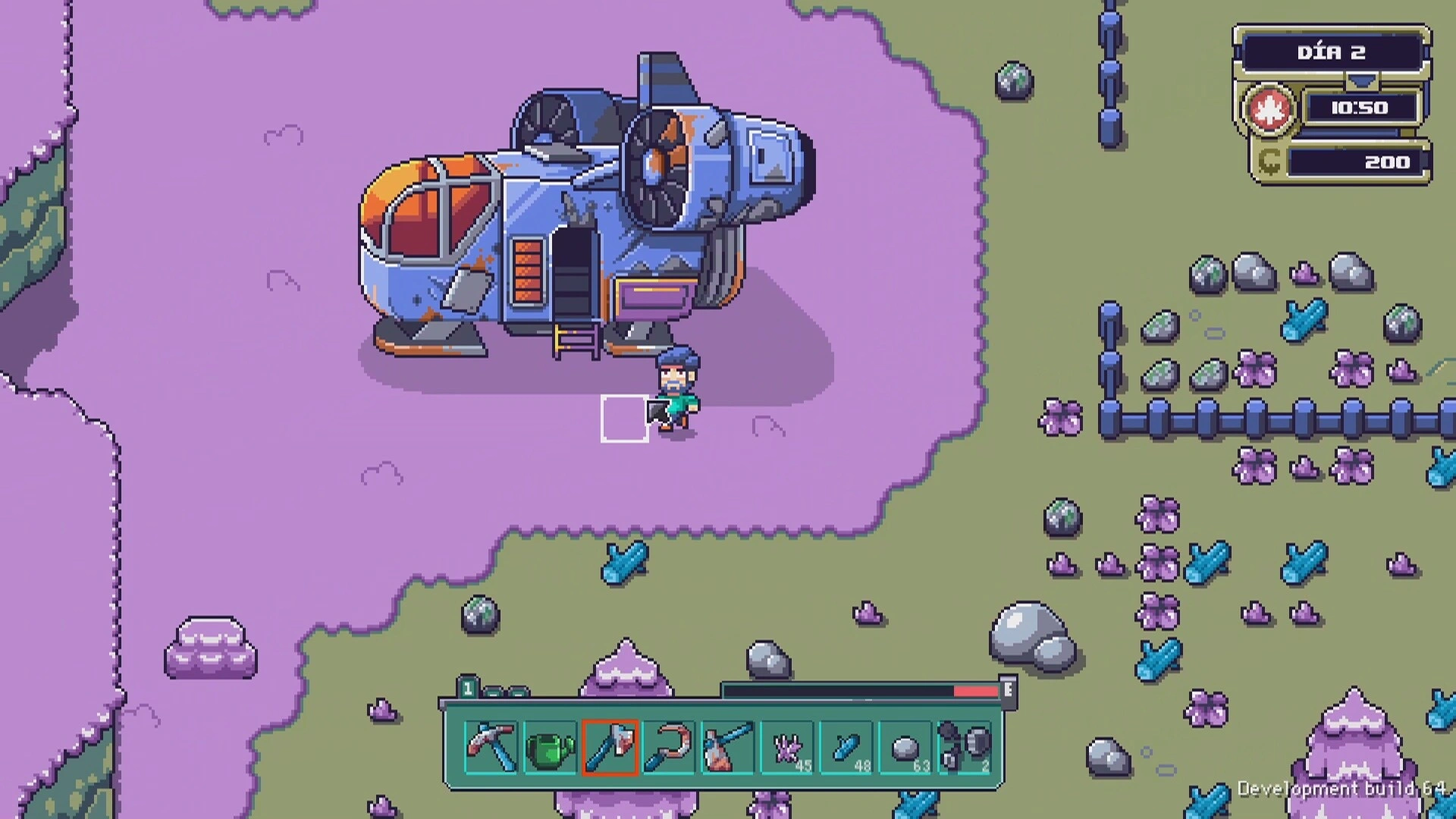
Buying an entire planet for the price of a suspicious bargain gives Farlands its sharpest joke and its clearest design promise. The player leaves a grey city, boards a failing ship, and arrives at a neglected homestead with a toolkit, a few seeds, 200 credits, and a cat-like droid waiting to be repaired. The scene carries the gentle absurdity of a European science-fiction comic, yet the work awaiting you comes straight from the Japanese farming-sim tradition: clear the weeds, till the soil, plant crops, sleep, repeat.
That inheritance is visible in every early action. Fallen logs and stones block the farm. Crops belong to one of three 28-day seasons. Galea supplies alien livestock, while Terbin holds the blacksmith, seed vendors, and potential partners.
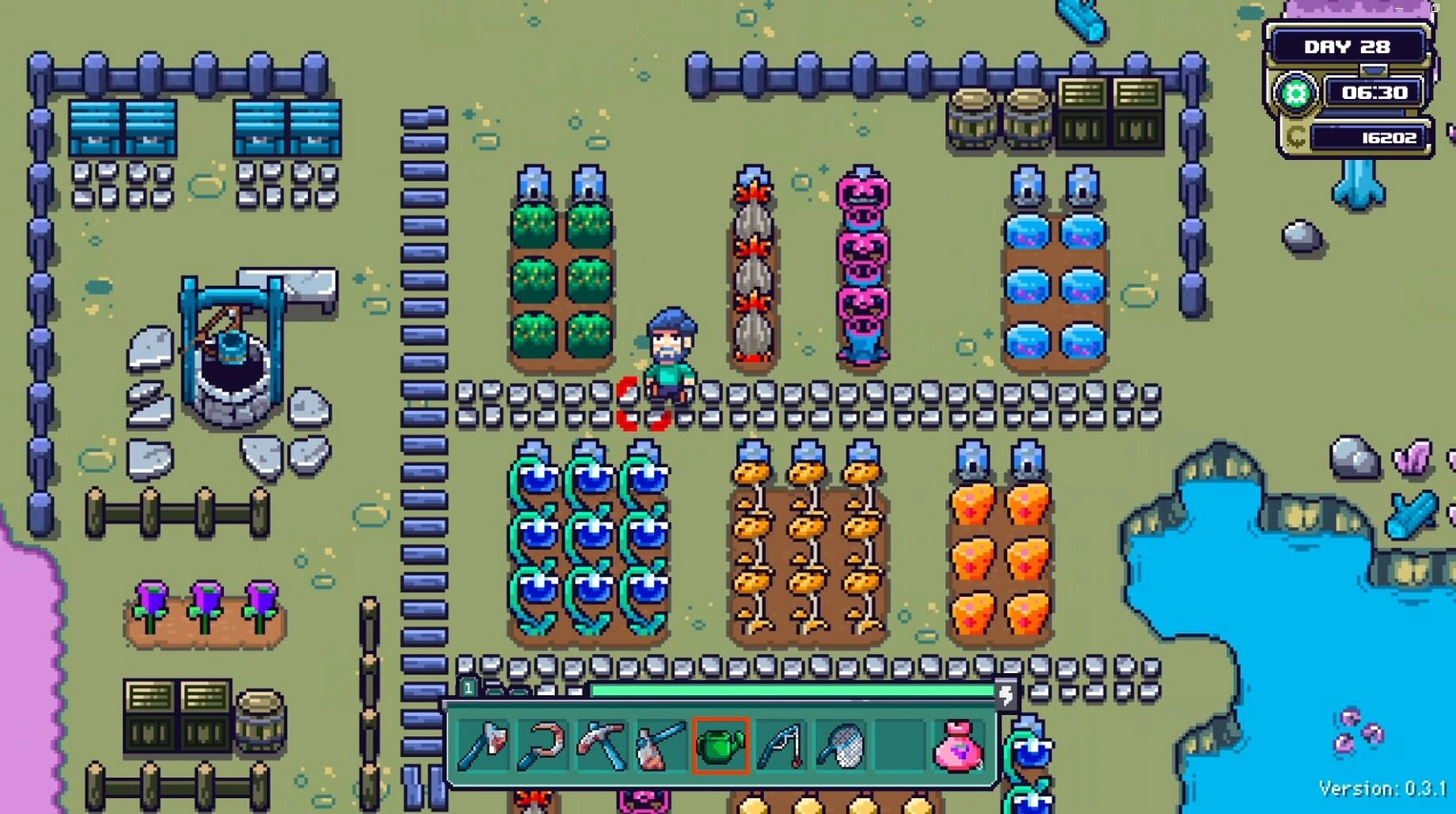
Farlands changes the nouns before it changes the grammar. Cottonbunnies replace cows, fuel cells replace bus tickets, and purple soil replaces the usual field of green. The pleasure remains recognisable across borders because the daily ritual has travelled remarkably well.
A Solar System Built Around Chores
The spaceship gives those rituals a different scale. Reaching Terbin, Galea, or Bohr consumes one fuel cell and roughly five in-game hours. Longer routes demand engine upgrades, larger fuel capacity, and, for Darmstad, protection from its airless environment. A trip cannot be treated like a walk into town. Crops need watering before departure, materials must be packed for repairs, and enough wood or coal has to be processed for the return flight.
This is where the space setting earns its place. In many farming games, geography is decorative convenience. Here, distance becomes a resource. Sleeping on the ship restores only half a stamina bar, so a poorly planned visit can leave the next day hollowed out before work begins.
Forgetting one upgrade component on the home planet means spending fuel and hours to retrieve it. The mechanic borrows the logistical thinking of Western survival games, then folds it into the softer rhythm of a life sim.
The system is strongest when preparation produces a clean chain of actions. Clear trees quickly, divide materials across the tabbed inventory, fuel the ship, deliver specimens to the Ark, then stop at Terbin’s mechanic for an upgrade that changes both range and the ship’s appearance. Tool animations are unusually fast, which keeps the routine brisk. The blacksmith swallowing an old tool and spitting out a polished replacement gives improvement a comic physicality that menus rarely achieve.
Collecting a System Before It Is Sold
The Ark turns exploration into an argument about ownership. GorCorp CEO Gorman wants to strip the solar system for resources. Mayor Oola seeks protection from the Empyrean, whose price is a catalogue containing crops, minerals, fish, insects, animals, and artefacts from each planet. The player saves the region by recording its life before a corporation can reduce that life to inventory.
There is a productive contradiction here. The Ark treats species and materials as items in empty slots, while GorCorp treats the same world as material for extraction. One collection preserves; the other consumes. The difference rests on use, not method.
Each new bug, crop, or mineral carries an icon showing its category and donation status, so ecological rescue becomes a checklist. It is a very contemporary form of environmentalism: protect the galaxy by completing the database.
The planets make that database readable. Bohr’s mine introduces teleport checkpoints every ten floors. Hafnir replaces that manageable rhythm with dark chambers, stronger enemies, and creatures that demand specific tools or angles of attack.
The idea of fighting with farm equipment fits the genre’s refusal of military identity, yet the execution is muddy. Enemies collide with the player before the correct response can be studied, and the scythe often becomes the answer through trial rather than understanding.
A World Wider Than Its People
The pixel art gives each location a cultural and visual accent. Pink and purple fields separate the home planet from the green-brown vocabulary of rural simulators, while alien crops and animal designs keep Galea and Terbin from feeling like the same village under different skies.
Festivals deepen the setting through short scenes and group conversations, including Terbin’s rare-rain celebration, yet they offer little participation. There is no permanent calendar, so seasonal mail carries information that the interface should retain.
That thin guidance reaches the social systems too. Eight romance candidates respond to conversation, jokes, flirting, and preferred gifts, but repeated dialogue leaves the cast feeling smaller than the map. The game can send the player across a solar system, then give them little reason to linger beside the people living there.
Technical friction narrows the sense of freedom further. Overnight autosaves and area transitions can hold Switch players in darkness for long stretches. Small text needs the UI-size option on Switch Lite. Incorrect instruction cards, similar resource icons, misplaced mine teleports, and reported late-game blocks make a completed task feel uncertain. Farlands imagines cultures scattered across planets, yet its most persuasive language remains the one spoken by tools, fuel, crops, and a ship waiting at the edge of the field.
The Review
Farlands
Farlands carries the farming traditions of Harvest Moon and Stardew Valley into a solar system where distance, fuel, and alien resources reshape the daily routine. Its planetary travel creates thoughtful preparation, while the Ark gives exploration a clear purpose. Familiar farming, limited social depth, thin guidance, and technical faults keep its science-fiction setting from fully remaking the formula. Still, its efficient tools, expressive pixel art, and satisfying collection loop make this a worthwhile destination for genre devotees.
PROS
- Purposeful planetary exploration
- Fast, efficient tool use
- Striking alien environments
- Rewarding Ark collection system
- Thoughtful travel preparation
CONS
- Familiar farming structure
- Thin tutorials and guidance
- Limited NPC interactions
- Uneven mine combat
- Loading times and bugs