


![Kingdom Hearts Collection [I-III] Review](https://gazettely.com/wp-content/uploads/2026/10/Kingdom-Hearts-Collection-I-III-1-75x75.webp "Kingdom Hearts Collection [I-III] Review: KHII Holds Steady as Newer Entries Fluctuate 6")



















![Kingdom Hearts Collection [I-III] Review](https://gazettely.com/wp-content/uploads/2026/10/Kingdom-Hearts-Collection-I-III-1-360x180.webp "Kingdom Hearts Collection [I-III] Review: KHII Holds Steady as Newer Entries Fluctuate 32")








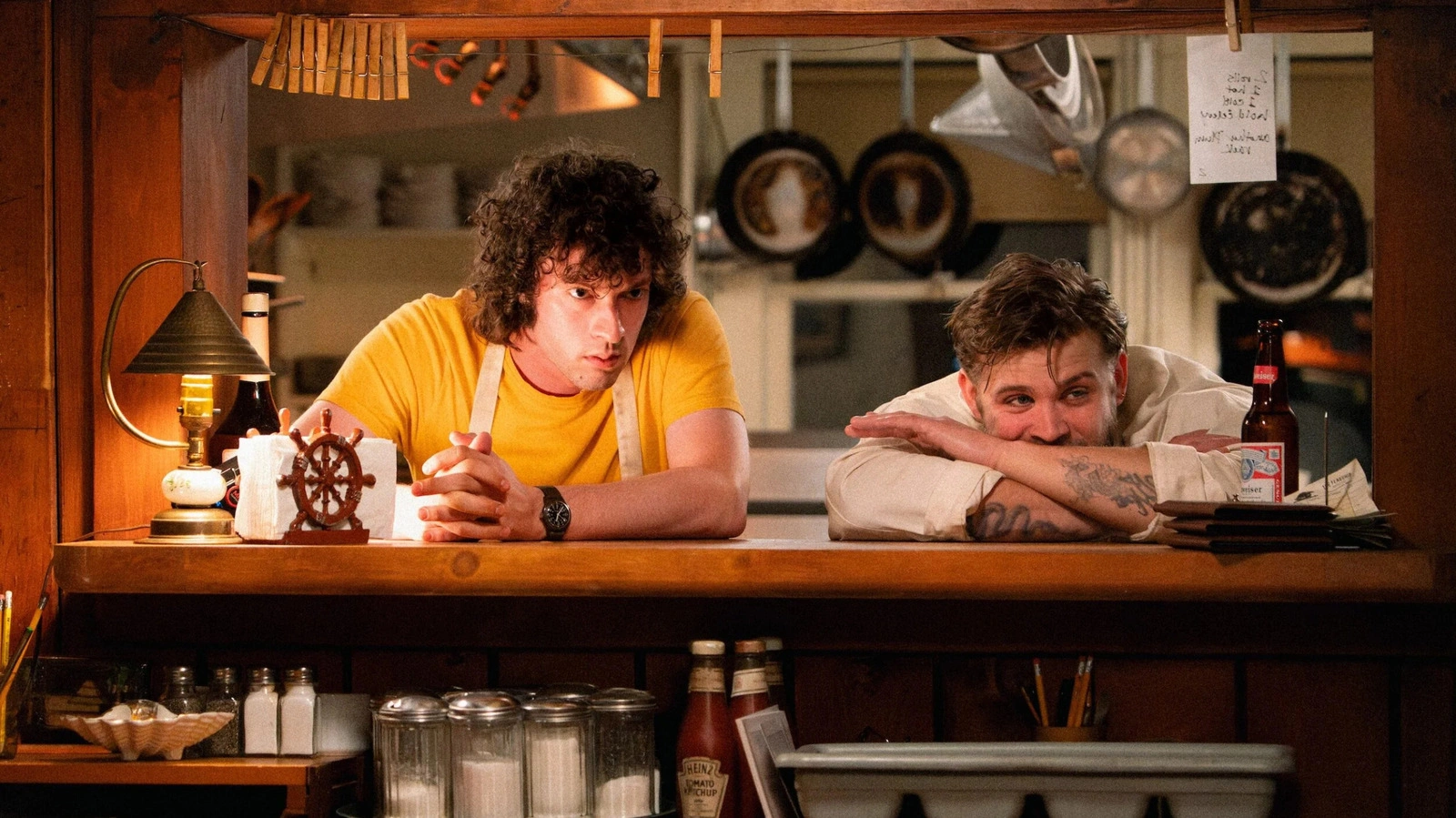

Anthony Bourdain enters Tony as a young man who believes vocabulary can substitute for experience. At nineteen, he speaks about an unfinished novel with the confidence of someone discussing a completed masterpiece, assumes Vassar will award him a writing fellowship, and treats Nancy’s attention as another prize waiting for collection. His arrogance is sincere, which makes it oddly fragile. One rejection is enough to collapse the entire performance.
Matt Johnson confines Bourdain’s early life to a single summer in Provincetown, Massachusetts, drawing from Kitchen Confidential while reshaping its anecdotes into a coming-of-age film. This narrow focus saves Tony from the museum-tour rhythm of many biopics.
There are no obligatory childhood traumas, career montages, famous television sets, or actors awkwardly reenacting interviews available online. The man known to millions is kept outside the frame. What remains is a spoiled, intelligent, dishonest young adult who has no idea what to do next.
Tony responds to the failed fellowship by lying to his family, following Nancy to Cape Cod, and pretending he still has a literary future awaiting him. Dominic Sessa understands that these lies are less about deceiving other people than maintaining Tony’s preferred image of himself. His voice grows louder when his confidence weakens. When Nancy mentions her boyfriend, the bravado stays in place for a few seconds before Sessa’s eyes expose the humiliation underneath.
The film’s real subject is vocation, though Johnson treats vocation as an accident rather than a calling delivered by fate. Tony gets drunk, loses his money, sleeps outside a restaurant, and accepts work washing dishes because he has nowhere else to go. History tends to tidy such moments after the fact. Tony resists that tidiness for most of its running time. A life changes, yet nobody hears the machinery turning.
Discipline, Appetite, and the Kitchen
The restaurant gives Tony something writing has not: resistance. Plates return dirty. Potatoes must be sliced correctly. A late employee cannot charm the evening service into waiting. The kitchen does not care how Tony imagines himself, which is precisely why it begins to shape him.
Johnson makes the workplace feel physical. Steam hangs in the cramped rooms, bodies collide during service, insults pass between cooks as quickly as utensils, and every minor error creates another task for someone already exhausted. A rapid training montage covers Tony’s early failures, but the stronger scenes slow down and observe labor without romantic decoration.
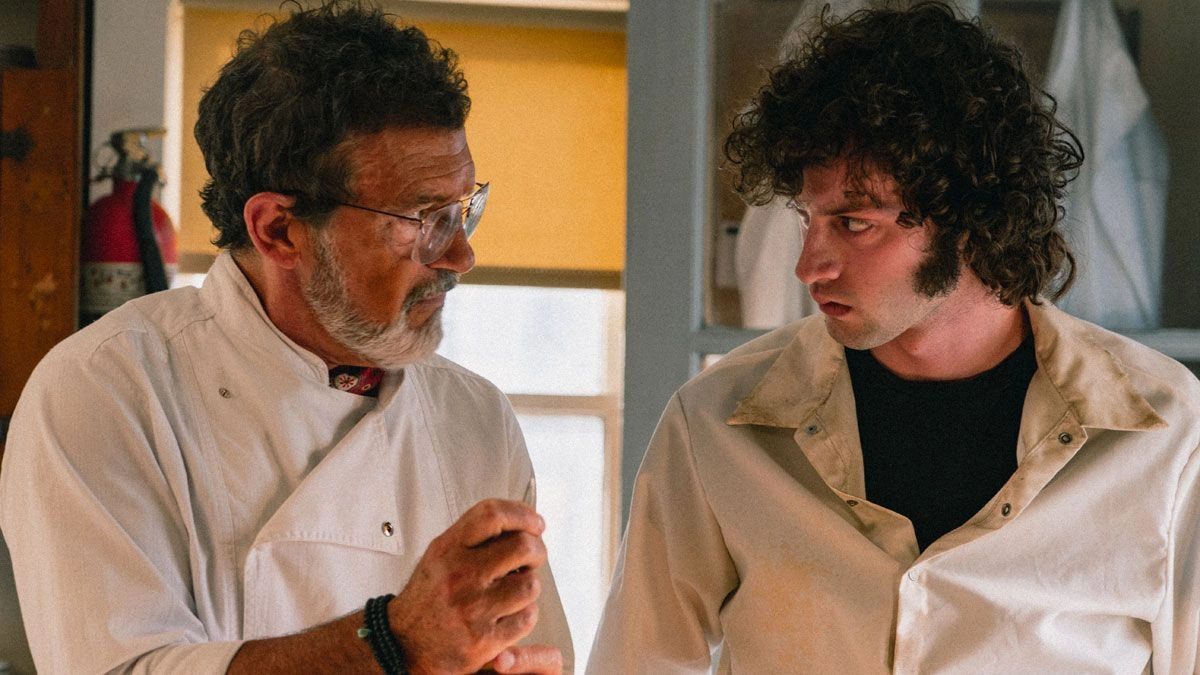
On a day off, Chef brings Tony into the empty kitchen and makes ketchup from scratch. Tony refills salt containers while Chef works through the recipe with patient concentration. Nothing spectacular happens. The scene matters because Tony watches an adult take pride in a task nobody else will notice.
Antonio Banderas plays Chef with a sternness that never needs theatrical anger. He wakes Tony with a bucket of water after the young man oversleeps, draws firm boundaries around tardiness and blasphemy, then offers him guidance without announcing himself as a mentor. Banderas makes care look practical. A hammock, a shift, a corrected mistake, and a lesson in preparation carry greater emotional weight than any speech about potential.
Leo Woodall’s Sal presents a different education. He possesses the ease Tony keeps trying to manufacture: sexual confidence, casual violence, quick humor, and an appetite for drugs and petty theft. Chef teaches Tony that repetition can become craft. Sal suggests that recklessness can become personality.
The film places Tony between these men without reducing either one to a simple moral signpost. Sal’s charisma is real, which explains the danger. Chef’s discipline is valuable, though it cannot forcibly save anyone. Call this the romance of competence. Tony arrives wanting admiration without evidence. The kitchen introduces the radical idea that ability might have to be earned.
The Man Behind the Myth
Sessa’s performance keeps Tony watchable through behavior that should make him intolerable. He grabs, boasts, lies, fights, and repeatedly treats Nancy as a destination rather than a person. Sessa never asks the audience to excuse him. Instead, he reveals how badly Tony needs each performance of superiority to work. His most effective moments arrive after a mistake, when the face empties and the adolescent theatre briefly stops.
Nancy receives less attention. Emilia Jones gives her enough intelligence to recognize Tony’s inventions, especially when he continues claiming to be in Provincetown on fellowship money. Yet the screenplay often uses her as pressure applied to Tony’s ego. Her disappointment registers clearly; her desires rarely receive equivalent space. She becomes the witness who confirms his failure, then recedes once cooking offers him another identity.
The supporting cooks create a convincing social world through sharp contrasts in rhythm and temperament. Stavros Halkias uses blunt comic timing to puncture the kitchen’s masculine mythology, while Michael Jibrin’s severe focus gives the line a sense of professional consequence.
Johnson is fascinated by the pirate-crew image Bourdain later used to describe restaurant workers, but the film occasionally becomes seduced by that image. Drugs, sexual conquest, and aggression can feel like borrowed shorthand for danger rather than discoveries rooted in these particular men.
Johnson threads references to Bourdain’s future through needles, self-destructive stories, and intimations of death. Most remain quiet enough to register as shadows cast backward by public knowledge. The final coda loses some of that restraint by explaining the significance of a summer the film has already made legible. Biographical cinema often distrusts ambiguity at the final moment, apparently fearing that viewers may leave without completing the assigned lesson.
Yet Tony is strongest when it forgets the famous name waiting beyond the frame. A young man stands in a dirty kitchen, discovers that attention can be directed outward, and begins to understand that making something well may offer a temporary defense against himself. Temporary is doing considerable work there.
Tony is a biographical comedy-drama film scheduled for release in select theaters by A24 on August 7, 2026. Set in 1975, the film follows a 19-year-old Anthony Bourdain taking a summer job at a Cape Cod restaurant, sparking a transformative journey that shapes his future. Audiences can watch the film in theaters upon its rollout.
Where to Watch Tony (2026) Online






Full Credits
Title: Tony
Distributor: A24
Release date: August 7, 2026
Rating: 14A
Director: Matt Johnson
Writers: Matt Johnson, Todd Bartels, Lou Howe, Matthew Miller
Producers and Executive Producers: Trevor White, Tim White, Matt Johnson, Matthew Miller
Cast: Dominic Sessa, Emilia Jones, Dagmara Domińczyk, Rich Sommer, Stavros Halkias, Leo Woodall, Antonio Banderas, Monica Raymund
Director of Photography (Cinematographer): Michael Bauman
Editors: Curt Lobb
Composer: Jay McCarrol
The Review
Tony
Tony understands that identity often arrives through labor before it arrives through language. Matt Johnson avoids embalming Anthony Bourdain as a finished icon, presenting him instead as an intelligent, dishonest, frequently obnoxious young man whose first kitchen job gives his chaos a shape. Dominic Sessa makes that contradiction watchable, while Antonio Banderas supplies the film’s moral gravity through small acts of discipline and care. The closing coda explains what the preceding scenes had already expressed, yet it cannot spoil a perceptive portrait of vocation discovered almost by accident.
PROS
- Dominic Sessa’s layered performance
- Antonio Banderas’s restrained warmth
- Lively, convincing kitchen atmosphere
- Focused single-summer structure
- Sharp tension between discipline and self-destruction
CONS
- Nancy remains thinly developed
- Supporting characters lean on familiar types
- Final coda is too explicit
- Narrow scope may frustrate some viewers