































Michael Price and Olivia Siffre get their new law practice out of an IHOP booth and into a luxury office, where construction continues around them. The upgrade has excellent comic qualifications. These two lawyers, fired from the same technology startup, have decided to represent people whom Silicon Valley’s established firms would rather leave waiting. Their workplace gives that ambition a recurring physical inconvenience: they can start challenging the powerful before anyone has finished building their headquarters.
Then comes the money. Natalia, played by Busy Philipps, will finance the operation provided it helps her pursue her billionaire former husband. Robert and Michelle King’s Cupertino understands how useful a condition like that can be to a television series. Funding brings an agenda, an agenda brings cases, and a new character arrives with reasons to interfere.
Natalia’s legal training and connections gradually extend her usefulness beyond paying bills, while Philipps moves between exuberance and wounded feeling without making either register seem like an interruption. The firm acquires resources and a sponsor whose grievance comes attached. Independence has a preferred client.
Across the first ten episodes, the weekly cases are the strongest reason to keep visiting. A chatbot encourages a child toward violence; a large language model influences organ-transplant selection; AI-generated songs take royalties away from human artists.
These premises locate technological harm at different points in ordinary life. One concerns influence, another the delegation of medical authority, another the ownership of work. The legal format gives each problem someone to argue with. An algorithm may be opaque, but the company profiting from it can retain counsel.
That conversion is the Kings’ particular skill. As in The Good Wife and The Good Fight, recurring lawyers and judges give institutional conflict personalities, habits, and grudges. The subject can be frightening without every participant having to announce its importance.
Jackie Earle Haley’s folksy judge supplies one comic register within a rotating bench that also includes Jackie Hoffman and Peter Riegert. Their presence lets the court itself become a variable rather than a neutral container for the week’s debate. The lawyers have to deal with the human administering the rules while pursuing the people who would prefer their technology to escape them.
The cases do begin to share an argumentative destination. The transplant dispute and the royalty dispute involve sharply different injuries, yet both return to companies exercising consequential power without adequate responsibility. That recurrence is understandable, and the brisk storytelling keeps it enjoyable.
Still, a new application of AI does not automatically produce a new dramatic discovery. Cupertino is especially good at finding another person harmed by the arrangement; it is less consistently surprising about the arrangement itself. Topicality supplies fresh paperwork faster than it supplies fresh thinking.
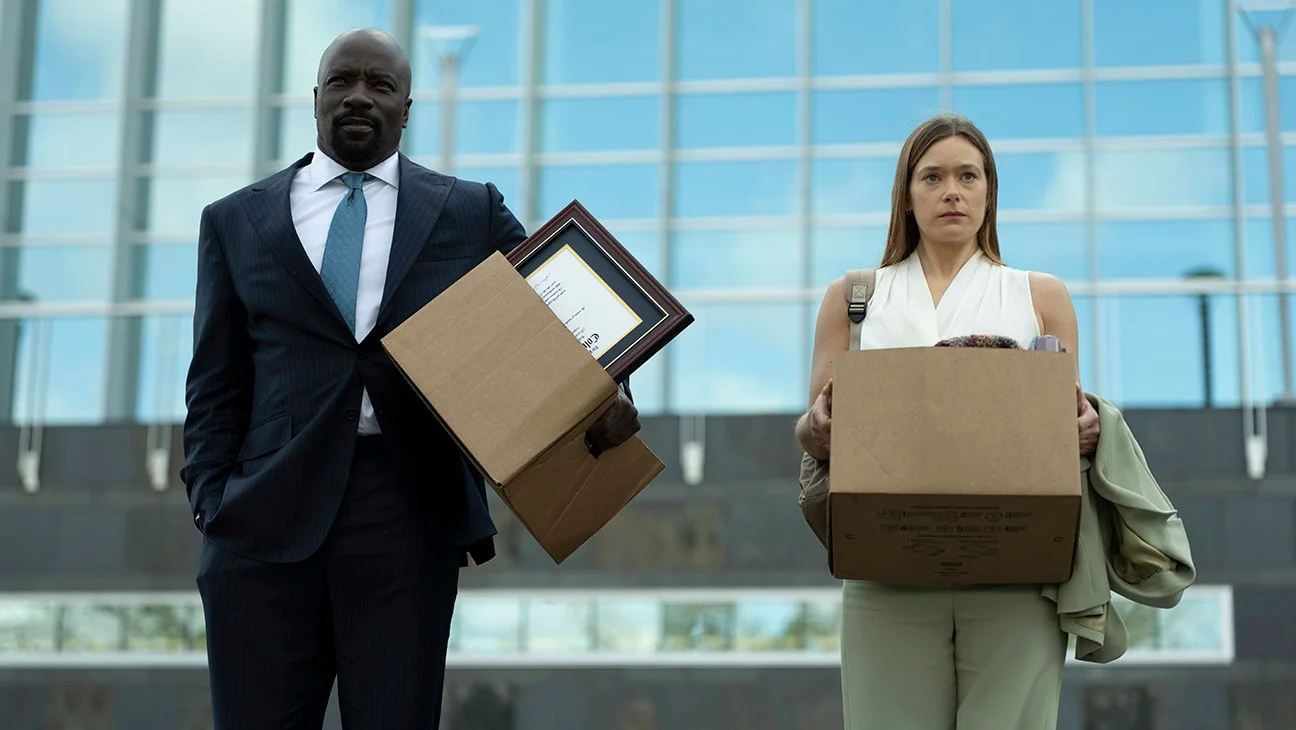
Mike Colter and Rachel Keller make that familiarity easy to accept. Colter gives Michael enough swagger to command the professional exchanges, with bursts of goofiness that prevent competence from becoming a permanent facial expression.
Keller’s warmer, less imposing Olivia makes their partnership feel welcoming without flattening the difference in experience. Their chemistry has the ease of an emerging sibling relationship, with a mentor-and-junior aspect that suits the work. It gives the series a dependable human rhythm between disputes. Watching them become comfortable together is a pleasure the show does not need to manufacture through romantic suspense.
Michael’s history with Nicole, his former colleague and lover, produces a different kind of electricity. Renée Elise Goldsberry makes professional opposition feel charged by familiarity: this adversary knows the person conducting the argument. Michael’s conflict with his prominent lawyer father, Bayard, played by Joe Morton, brings another existing relationship into his working life.
Those connections are efficient sources of friction, though efficiency sometimes gets ahead of depth. Olivia’s Christian faith and conservative Upper Midwest background also establish personal coordinates, but the early episodes give the partnership a firmer shape than either protagonist’s inner life. We learn quickly how these people function together. The harder task is making their private pressures feel equally specific.
The supporting cast helps explain both the show’s fluency and its fondness for convenient solutions. Ella Stiller’s Christy Palladino combines office assistance with investigation, repeatedly drawing on her extended family’s blue-collar connections to obtain useful access. Stiller’s comic assertiveness makes those interventions lively, and the device gives the firm a network outside the corporate sphere. Its usefulness is also its limitation. When another relative can supply a route into the problem, investigation begins to resemble a family directory. The joke works; repetition makes the assistance easier to anticipate.
Vik, played by Nik Dodani, provides another necessary bridge, moving from client to technical ally and helping the lawyers interpret the evidence their cases require. Together, Christy and Vik keep expertise distributed across the ensemble. Michael and Olivia can lead the action without becoming implausibly proficient in every field. That division of labor pays off in the continuing case involving Bo, Rob McClure’s suspicious whistleblower, whose information concerns an AI company preparing to release a highly human-like model with inadequate safeguards.
Bo’s story changes the scale of the danger. The weekly disputes identify particular harms; the continuing investigation asks what happens when the potential harm exceeds the size of any available case. Corporate surveillance gives that question an immediate consequence for the lawyers themselves.
Yet the serialized strand has a less direct dramatic grip than the strongest weekly plots. A transplant decision or lost royalties gives the audience something concrete to weigh. Bo’s guarded information keeps attention trained on what may be coming. The uncertainty generates suspense, but it also postpones the argumentative clarity that makes the courtroom material so satisfying.
The firm’s office across from Apple neatly expresses the show’s mixture of recognition and invention. Real giants supply familiar geography and names, while fictional companies carry the principal villainy. That arrangement gives the writers room to construct cases, though it also makes this Silicon Valley feel tailored to the needs of a recurring legal ensemble.
Through these ten episodes, Cupertino has built an appealing place to return to while proposing that the surrounding world may become radically unsafe. Bo’s investigation now poses a question the weekly format cannot settle simply by finding another client: can this threat force the firm to change how it works?
Cupertino premieres on CBS and Paramount+ on October 8, 2026. The legal drama follows a wronged former tech startup employee who teams up with a dismissed attorney to launch a practice fighting back against Silicon Valley giants.
Where to Watch Cupertino Online










Full Credits
Title: Cupertino
Distributor: CBS, Paramount+
Release date: October 8, 2026
Rating: TV-14
Running time: 42–45 minutes per episode
Director: Robert King
Writers: Robert King, Michelle King
Producers and Executive Producers: Robert King, Michelle King, Liz Glotzer, Sam Hoffman
Cast: Mike Colter, Rachel Keller, Renée Elise Goldsberry, Busy Philipps, Ella Stiller, Nik Dodani, Joe Morton
The Review
Cupertino
Cupertino makes technological anxiety excellent weekly television, with lively legal disputes and an ensemble worth returning to. Colter and Keller anchor the firm’s growing collection of talents, favors, and financial obligations. The cases sometimes reach familiar conclusions, and the characters’ private lives lag behind their professional chemistry. Bo’s mystery has less immediate force than the courtroom stories. Still, corporate irresponsibility proves a remarkably reliable booking agent.
PROS
- Distinct technological harms give the weekly cases tangible stakes.
- Colter and Keller establish an appealing partnership.
- Supporting characters contribute directly to the storytelling.
- Recurring legal opponents keep institutional conflict lively.
CONS
- Different cases sometimes repeat the same underlying argument.
- Personal characterization trails the ensemble’s chemistry.
- Christy’s family connections make investigative solutions predictable.
- Bo’s mystery lacks the weekly disputes’ immediate dramatic grip.