


























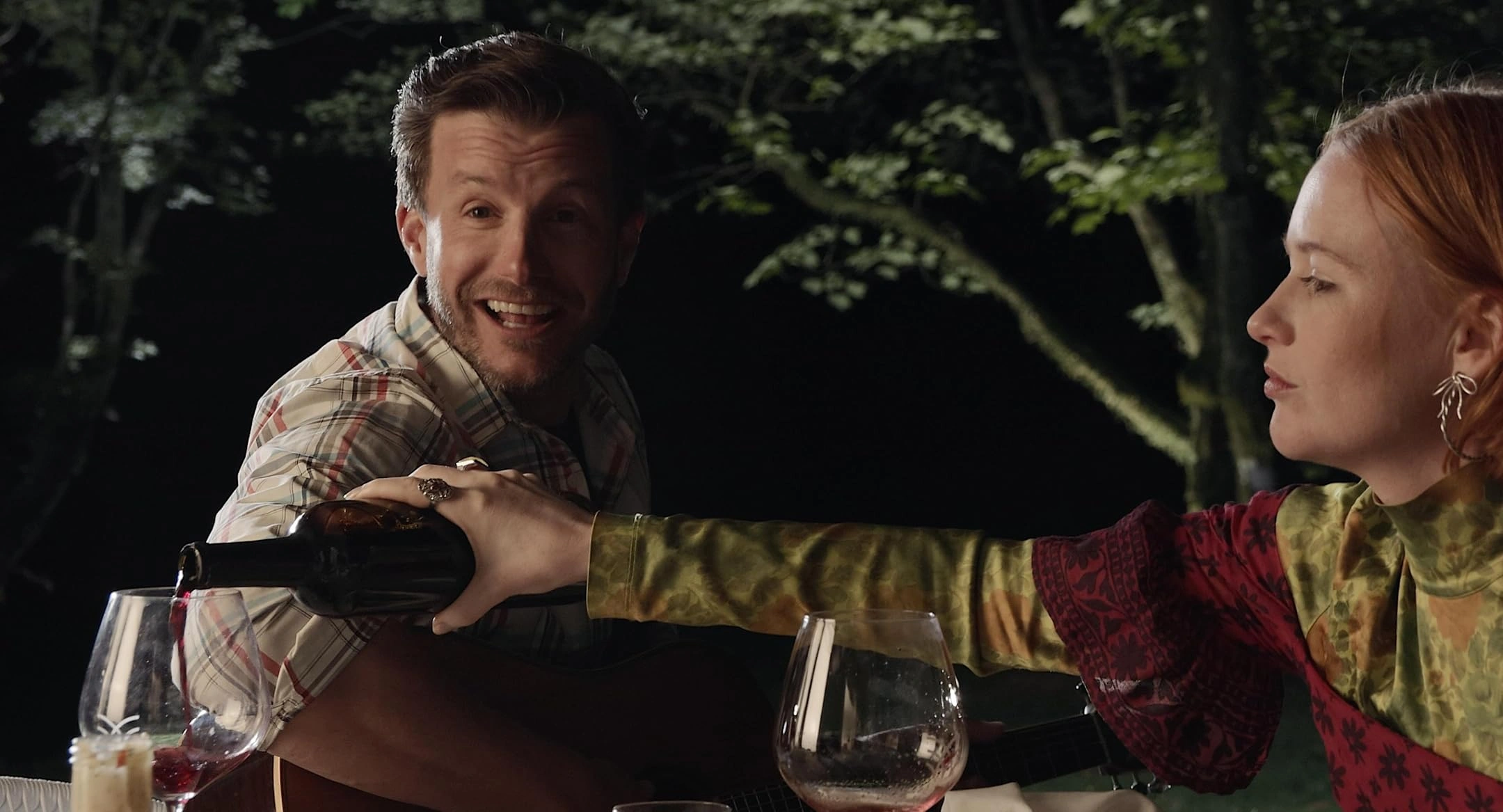
Three women arrive at a luxury farmstay to celebrate turning 30, carrying old friendships with the careful stiffness of luggage nobody volunteered to pack. Angie, Isabel, and Clare knew each other at school, yet every exchange suggests that time has reduced intimacy to obligation. Their partners have never met, giving the weekend the unstable chemistry of a dinner party arranged by people who have forgotten why they liked one another.
James Robert Woods uses that discomfort as the foundation of his feature debut. He wrote, directed, produced, shot, and edited The Birthday Trip, set at a corporate-owned retreat in the New South Wales Southern Highlands. The location promises rural authenticity without requiring its guests to experience rural life. Wine is poured, charcuterie is admired, and the landscape waits patiently for the visitors to begin disappointing each other.
Their professions form a neat catalogue of middle-class self-construction. Angie makes austere documentaries and arrives with Lars, a finance worker whose friendliness exceeds his ability to read a room. Isabel has accepted a television job at the ABC, while Mark earns his money through military-drone technology and behaves as though good manners erase the implications. Clare is an artist between exhibitions. Jim writes corporate jingles, possesses the sharpest political vocabulary of the group, and uses it chiefly to establish intellectual dominance. These people have learned how to explain themselves. Listening to anyone else remains a separate skill.
Conversation as Combat
Woods understands that social cruelty rarely announces itself. It accumulates through timing, tone, and the slight pause before somebody pretends a remark was harmless. Lars recounts an incident involving an unfortunate bodily malfunction on a golf course. Mark responds with the pinched disgust of a man who considers vulgarity a greater moral failure than manufacturing weapons.
The scene works because neither man occupies stable ethical ground. Lars is embarrassing, open, and incapable of recognizing discomfort. Mark is controlled, condescending, and protected by refinement. Their clash turns etiquette into camouflage. The person who violates social codes appears offensive; the person whose career carries lethal consequences can pass the wine and remain respectable.
The women’s reunion is governed by similar evasions. Angie, Isabel, and Clare perform the gestures of enduring friendship while measuring careers, partners, taste, and status. Resentment travels through glances before it reaches speech. Nicola Frew gives Clare’s silent judgments an almost physical pressure, while Annelise Hall lets Isabel’s professional confidence flicker whenever the group questions her choices. Josephine Starte makes Angie’s seriousness feel both principled and curated, a distinction the character would prefer nobody examine.
The film’s cultural references give these conversations an Australian specificity. One guest admits to falling asleep during The Dry. Another mentions Babe: Pig in the City, a choice that becomes funnier once the group learns the original farmhouse sits nearby. Shakespeare enters through wine-fuelled intellectual posturing, then returns through a late reference to The Tempest. The allusions reveal people using culture as social evidence. A film title or literary quotation becomes a small certificate of belonging.
Jim is the clearest expression of this habit. David Quirk delivers his lines with the confidence of a man who can identify every hypocrisy except his own. His social awareness becomes another hierarchy, granting him permission to humiliate anyone less fluent in the approved language.
The Threat of Ordinary Behaviour
The camera treats the retreat as a place where something terrible may happen, then leaves the guests to manufacture a quieter form of damage. Handheld movement unsettles otherwise mundane scenes, while tight framing traps bodies at tables, in doorways, and within rooms that should feel spacious. Luxury begins to resemble containment.
A person chopping wood at night appears threatening because Woods has trained the audience to suspect a genre turn. The force of the action, the darkness, and the group’s alarm suggest an approaching act of violence. Nothing decisive follows. The moment exposes how quickly privileged visitors interpret unfamiliar labour as danger, especially when it enters the carefully managed setting they have purchased.
The film repeatedly approaches horror without surrendering to it. No killer arrives to simplify the group’s problems. No supernatural event converts resentment into survival. The tension remains lodged in interrupted sentences, badly timed jokes, and conversations that continue several beats past comfort.
Woods’s editing allows those beats to breathe. A remark lands, silence gathers around it, and the speaker decides to continue. The comedy grows from that decision. Luke Jacobz is particularly effective at extending Lars’s stories beyond the point of rescue, while Ben Gerrard gives Mark’s reactions a polished contempt that often says more than his dialogue. The result resembles a thriller in which everyone has mistaken self-knowledge for safety.
Curated Authenticity
Felix, the resort’s “experience curator,” occupies the film’s most revealing position. Robert Preston plays him with a nervous attentiveness that gradually becomes physical strain. He smiles, explains, accommodates, and absorbs. His guests receive polished cottages and pastoral calm. His own family lives in deteriorating staff accommodation nearby.
Sapphire Blossom gives Felix’s wife a fury rooted in material conditions rather than comic eccentricity. She is caring for several young children in a cramped environment while Felix performs serenity for wealthier strangers. The contrast exposes the farmstay’s real product: hardship edited out of view.
The guests believe they have purchased authenticity. What they have purchased is the appearance of simplicity, maintained by workers denied the comfort being sold. Felix must convert stress into hospitality, while Sapphire is treated as a disruption because she cannot make exhaustion aesthetically pleasing.
A subplot involving corporate marketing executives sharpens the satire. They travel to the property to present revised language for an acknowledgement of country, adjusted to fit branding goals. Ethical recognition becomes copywriting. Institutional responsibility is reduced to tone, alignment, and marketable phrasing.
That corporate gesture mirrors the guests’ private behaviour. They speak fluently about culture, politics, art, and morality, yet their principles rarely survive contact with status or convenience. Mark’s employment, Angie’s documentary seriousness, Isabel’s media ambitions, and Jim’s advertising work each reveal a compromise hidden behind cultivated language.
The weekend ends without granting anyone a persuasive transformation. The confrontations leave marks, yet insight remains scarce. Woods refuses the comforting fiction that humiliation produces growth. Some people can see themselves clearly and simply choose to look elsewhere.
The Birthday Trip is an Australian black comedy-drama film released in theaters on July 30, 2026. The film follows three lapsed high school friends and their respective partners who rent a luxury farmstay in the New South Wales Southern Highlands to celebrate a joint thirtieth birthday, only for simmering social tensions and personal insecurities to boil over. Viewers can watch the film in select theatrical screenings.
Full Credits
Title: The Birthday Trip
Distributor: Badlands
Release date: July 30, 2026
Rating: MA 15+
Running time: 99 minutes
Director: James Robert Woods
Writers: James Robert Woods
Producers and Executive Producers: Stephanie Jane Day, James Robert Woods
Cast: Sapphire Blossom, Nicola Frew, Ben Gerrard, Annelise Hall, Luke Jacobz, Robert Preston, David Quirk, Josephine Starte
Director of Photography (Cinematographer): James Robert Woods
Editors: James Robert Woods
The Review
The Birthday Trip
The Birthday Trip turns a luxury rural retreat into a display case for educated vanity, corporate ethics, and friendships sustained through habit. James Robert Woods lets wine, charcuterie, and cultural fluency become instruments of class performance, while Felix and Sapphire bear the cost of the guests’ curated authenticity. The film’s refusal to manufacture a grand revelation suits its targets: these people can survive humiliation without learning from it. Tight framing, abrasive dialogue, and a uniformly sharp ensemble make social discomfort feel dangerously close to suspense.
PROS
- Caustic, culturally specific dialogue
- Strong ensemble performances
- Precise class satire
- Unsettling handheld camerawork
- Robert Preston’s fraying hospitality
CONS
- Limited narrative momentum
- Some literary references feel affected
- Supporting corporate subplot feels slight