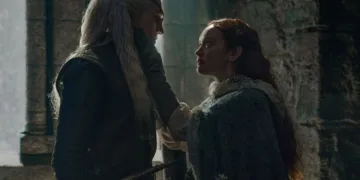


























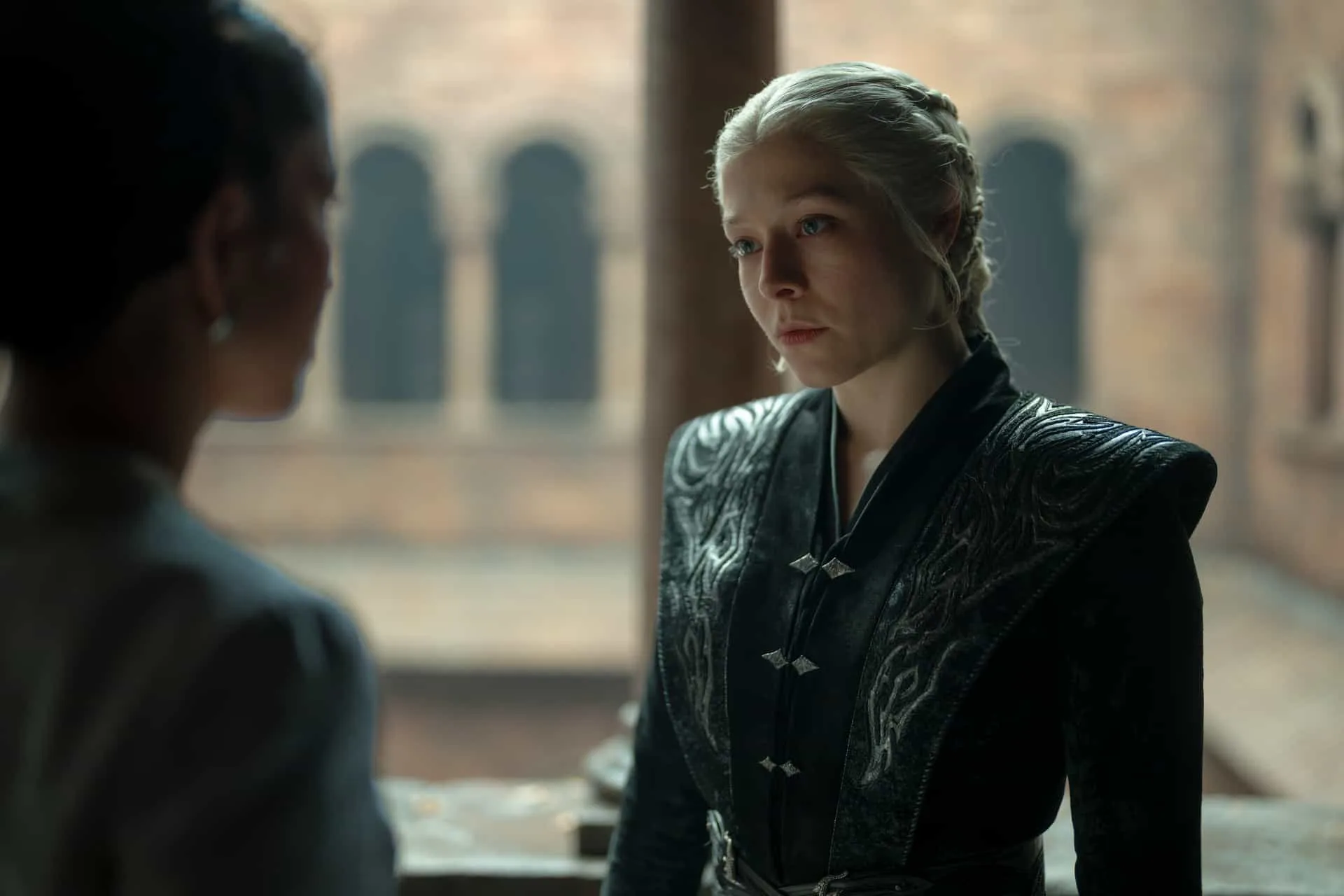
Prophecy becomes a hostage negotiation when Rhaenyra wakes Helaena and asks for reassurance. The queen wants knowledge of the future, yet the scene reveals a simpler hunger: she wants the future to agree with her. Helaena refuses the role. When Rhaenyra grips her arm, she recoils and asks if commanding so many dragons has altered her half-sister. The question lands with particular force because Rhaenyra has already answered it through her behavior.
House of the Dragon Season 3, Episode 7 turns the Targaryen claim to rule into a category error. The family treats proximity to dragons as proof of fitness, then treats every dragon’s action as a message addressed specifically to them. Power becomes a language whose grammar they invent after each sentence. Rhaenyra and Aegon stand at opposite ends of the hour, each searching for a sign that their authority belongs to the natural order. The episode’s sharpest idea is that the natural order has never agreed to participate.
Rhaenyra’s conduct after taking King’s Landing makes Helaena’s question harder to dismiss. Her Master of Coin recognizes that he has become a public sacrifice for failures he cannot repair. The queen rejects counsel, limits access to petitioners, and responds to news of Sheepstealer with impatience rather than thought. Emma D’Arcy keeps this deterioration controlled, presenting it as an intensification of familiar traits. Rhaenyra’s pauses shorten. Her listening weakens. Her face hardens whenever advice arrives without admiration attached.
That distinction matters. The dragons magnify an old appetite for certainty. Rhaenyra wants Mysaria’s affection, Helaena’s prophecy, Daemon’s obedience, and her council’s agreement to perform the same service: confirmation. Her authority now operates like a hall of mirrors, each reflection expected to return the image of a rightful queen. Anything that refuses the assignment becomes treachery.
The Riverlands confrontation gives this argument its physical form. Caraxes, Syrax, Seasmoke, and Sheepstealer enter the same space, and human intention rapidly loses its claim over the scene. Riders shout commands. The dragons answer according to impulses that remain their own. Scale matters here, yet the sequence’s real terror comes from uncertainty. Every rider is seated on an immense creature whose loyalty has been mistaken for submission.
The staging carries genuine pressure because the human figures appear small inside the conflict they created. The scene also exposes a weakness the episode cannot fully hide. Rhaena and Sheepstealer have received too little intimate development for their crisis to carry all the grief assigned to it. Their bond has been presented largely through secrecy, pursuit, and consequence. The sequence understands the political meaning of a rider losing control better than the emotional meaning of this rider losing this dragon.
The limited groundwork shifts the set piece toward political meaning. The Targaryens speak of “their” dragons in the same tone used for armies, castles, and heirs. The possessive is doing heroic administrative work. A dragon may accept a rider, protect one, abandon one, or burn people around one. None of those acts creates property in the ordinary sense. The entire dynasty rests on pretending otherwise.
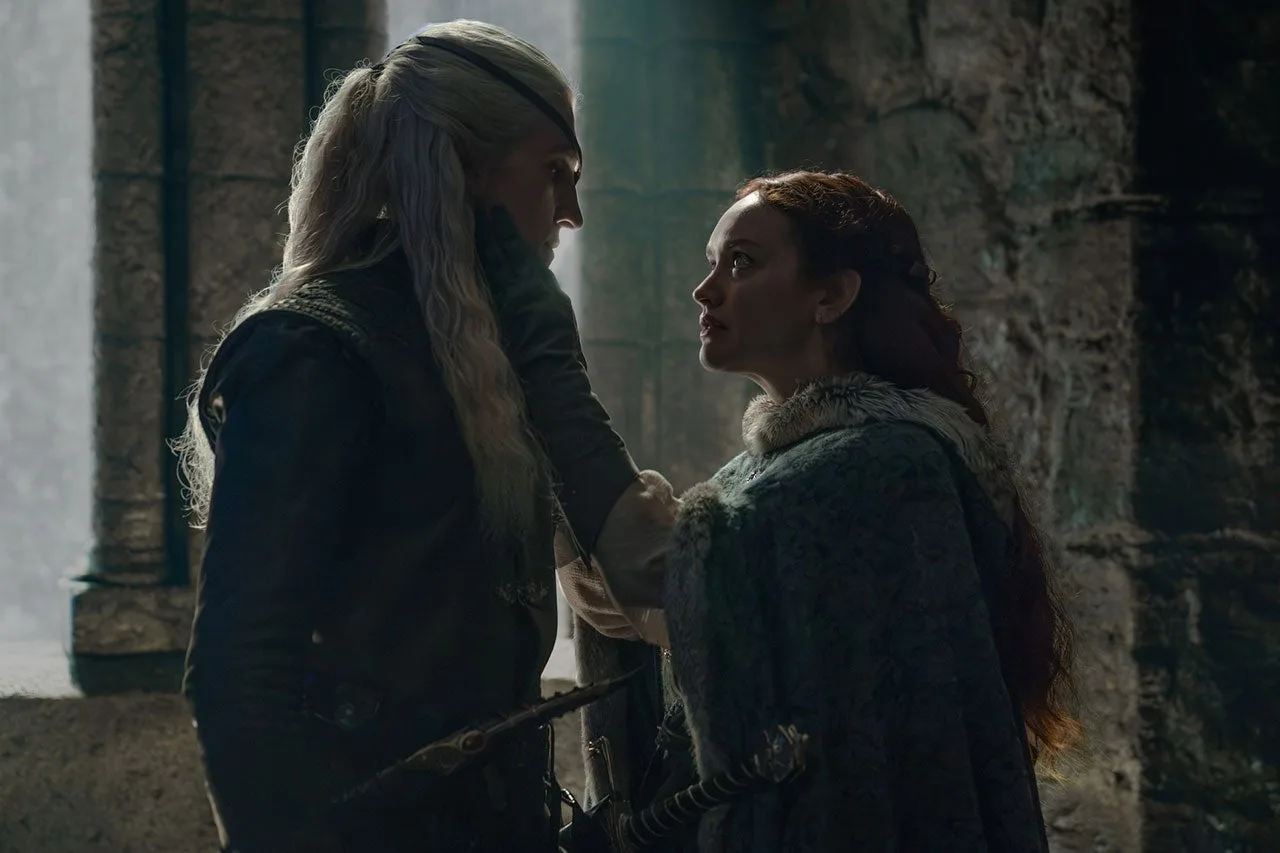
Aegon’s story approaches the same delusion from below. Injured, displaced, and close to flight, he asks Tyland what kind of man he has become. Tom Glynn-Carney plays the question without fishing for innocence. Aegon seems to know the answer may be ugly. His uncertainty has weight because the episode refuses easy moral cleansing. He remains vain, cruel, frightened, and wounded. He also understands that disappearance would erase the final fragment of identity left to him.
When escape closes, Aegon names himself. The declaration begins as theater, then hardens into conviction. Glynn-Carney lets pain shape the speech rather than interrupt it. Each phrase feels dragged through a body that has already paid for the crown and still cannot explain why it wants one. For a few seconds, agency belongs to him. He chooses the name, the claim, and the risk.
Then Sunfyre arrives.
The dragon’s return transforms Aegon’s declaration from desperate performance into apparent revelation. Soldiers burn. Aegon laughs with the manic relief of a man who has received an answer from the gods and has no intention of checking the handwriting. Here the episode finds its cruelest symmetry. Rhaenyra asks Helaena to certify her destiny. Aegon receives an accidental certification from fire. Both convert uncertainty into entitlement.
Ormund’s recruitment of Ulf grounds the same idea in ordinary politics. He offers drink, respect, and extravagant promises to a man who has been humiliated by Rhaenyra and Daemon. Ulf’s defection turns a dragon advantage into a liability through resentment rather than sorcery. The Blacks may possess the larger arsenal, yet possession proves fragile when riders feel disposable. Ormund understands something the royals keep forgetting: people carrying power still need reasons to remain loyal.
This gives Team Green’s distant campaign a clarity missing from Harrenhal. Aemond continues to mistake dependence on Alys for command, while Alicent’s attempt to poison him leads back toward the same cycle of manipulation, collapse, and recovery. Olivia Cooke, Ewan Mitchell, and Gayle Rankin give those scenes tension through clipped delivery and watchful silence. The plot around them has started circling its own premise. Aemond believes he rules the room; Alys controls its temperature. The episode has made that point several times.
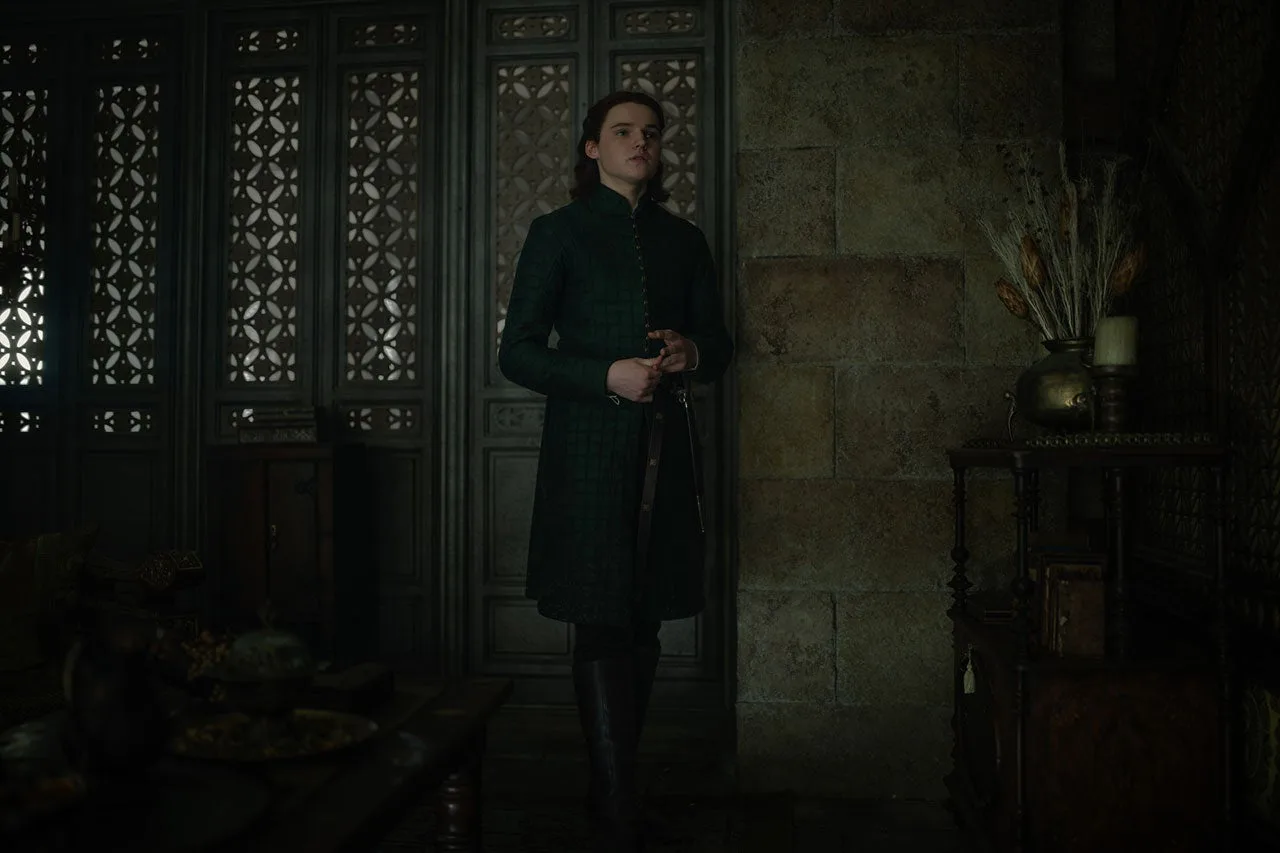
Repetition becomes the hour’s main cost. Its ideas are coherent, yet several characters are asked to restate them after the stronger evidence has already arrived. Rhaenyra’s paranoia, Aemond’s dependence, and Alicent’s desperation all belong to the same study of power without control. Their scenes do not carry equal force because only some of them change the political board. Ulf changes sides. Aegon reveals himself. The dragons attack. Harrenhal remains Harrenhal, which may be its curse and is certainly becoming its production schedule.
The strongest performances keep the philosophy attached to bodies. D’Arcy lets Rhaenyra’s need for reassurance appear in the speed of her anger. Glynn-Carney makes Aegon’s renewed certainty feel born from injury rather than restored confidence. Phia Saban gives Helaena’s refusal its own quiet authority; her withdrawal from Rhaenyra says that knowledge can resist being turned into policy. None of these characters understands power in the same way, yet each scene shows power demanding an interpretation.
Sunfyre’s return supplies the most dangerous one. Aegon sees recognition, rescue, and perhaps divine approval. The dragon may have recognized its rider. It may have answered danger. It may have chosen violence because violence was there. The political meaning belongs entirely to Aegon. The action does not.
“The Dragon in Winter,” the seventh episode of House of the Dragon Season 3, premiered on August 2, 2026, and is available to stream on Max as well as through HBO’s cable network and on-demand services. Set during the height of the Targaryen civil war known as the Dance of the Dragons, the episode follows Queen Rhaenyra attempting to secure predictions from her captive sister Helaena while political betrayals and a massive dragon battle shift the balance of power.
Where to Watch House of the Dragon Season 3 Episode 7 Online






Full Credits
Title: House of the Dragon – Season 3, Episode 7: “The Dragon in Winter”
Distributor: HBO, Max
Release date: August 2, 2026
Rating: TV-MA
Running time: 60 minutes
Director: Nina Lopez-Corrado
Writers: Philippa Goslett, Zenzele Price, Ryan Condal, George R. R. Martin
Producers and Executive Producers: Ryan Condal, George R. R. Martin, Miguel Sapochnik, Sara Hess, Vince Gerardis, Alan Taylor, Ron Schmidt, Jocelyn Diaz
Cast: Emma D’Arcy, Matt Smith, Olivia Cooke, Ewan Mitchell, Tom Glynn-Carney, Phia Saban, Steve Toussaint, Fabien Frankel, Sonoya Mizuno, Matthew Needham, Jefferson Hall, Bethany Antonia
Director of Photography (Cinematographer): Catherine Goldschmidt, Pepe Avila del Pino
Editors: Tim Porter, Selina MacArthur, Crispin Green
Composer: Ramin Djawadi
The Review
House of the Dragon - Season 3, Episode 7: "The Dragon in Winter"
Episode 7 gives the season one of its sharpest studies of Targaryen power, joining Rhaenyra’s need for prophetic approval with Aegon’s ecstatic reading of Sunfyre’s return. Emma D’Arcy, Tom Glynn-Carney, and Phia Saban keep the political argument rooted in gesture and fear. Thin groundwork for Rhaena and Sheepstealer, plus another circular visit to Harrenhal, weakens parts of the hour. The episode still turns dragon spectacle into a precise warning about rulers who mistake recognition for obedience.
PROS
- Rhaenyra and Aegon symmetry
- D’Arcy and Glynn-Carney’s performances
- Helaena’s quiet resistance
- Dragon power as political argument
- Ulf’s grounded defection
CONS
- Thin Rhaena-Sheepstealer groundwork
- Repetitive Harrenhal plotting
- Uneven subplot momentum