

























Flying cars remain distant in the city views of April X. Down where Baxter conducts his business, the vehicles look familiar, and technological progress arrives chiefly as second-hand artificial organs. Michel K. Parandi’s science-fiction thriller gives its future a suggestive vertical arrangement: freedom of movement overhead, bodily necessity for sale below. The distance within these establishing shots matters. Baxter can see the future without enjoying its apparent privileges, a useful visual position for a man whose livelihood depends on keeping other people’s machinery running.
The Bucharest locations, brutalist buildings, and nighttime photography give that separation a persuasive physical setting. Later, polished high-rises provide another register of criminal power, moving Baxter’s struggle into spaces remote from his precarious domestic life.
Drones add the suggestion that someone is always watching. Yet observation remains an atmospheric threat rather than a clearly functioning instrument of authority. We can sense surveillance without understanding its relationship to the business conducted beneath it. The city’s appearance promises a system of control that the drama only intermittently makes legible.
Baxter, played by Connor Storrie, trades artificial organs while living with his twin sister April, played by Lilly Krug. A heart transaction goes wrong, leaving him indebted to crime boss Klein, and April disappears following his entanglement. Five years later, Baxter still works for the man whose operation has trapped him, still hoping to recover his sister. Evidence of an April lookalike renews the pursuit. This is fertile noir territory: obligation masquerading as employment, loyalty sustaining dependence, a man seeking escape through further dealings with the source of his trouble.
His participation in the organ trade also gives the search a moral difficulty that the film handles too lightly. Baxter earns money from a world in which bodies are divisible assets; his private catastrophe occurs when someone he loves becomes subject to its transactions.
That connection need not make him secretly monstrous. It should make his attachment uncomfortable. Storrie supplies nervous conviction to Baxter’s recurring belief that he can repair the situation, and grief to the stubbornness beneath it. The performance makes his dependence credible, but the screenplay gives that dependence little opportunity to alter his understanding of his own work.
Parandi and co-writer Jack Coulton lean heavily on Baxter’s voice-over, which repeatedly tells us how firmly April’s absence occupies him. Repetition can convey obsession, but here it often supplies an emotional instruction where a choice might have done richer work.
The early supermarket food fight offers a different means of establishing intimacy, letting the siblings share unruly pleasure before the disappearance. Its sudden levity sits awkwardly against the surrounding criminal menace. We receive an assertion of closeness without learning enough about April’s particular wants to carry her absence as something distinct from Baxter’s anguish.
April’s ability to record dreams and memories should complicate that imbalance. Her interior experience can survive outside her body, become accessible to others, and contribute to the manufacture of copies. The premise makes an intimate trace into transferable property.

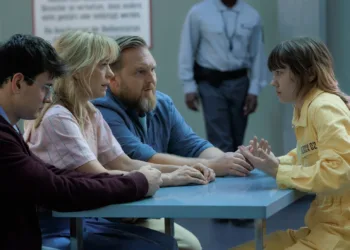
When Baxter encounters a woman with April’s appearance who does not acknowledge him, recognition ceases to be reciprocal. He sees a sister; the woman does not automatically confirm the relationship. Here the film’s visual evidence becomes ethically unstable. The face that seems to promise reunion cannot establish who is looking back.
That instability is the film’s richest proposition. Some of April’s memories coexist with other uploaded material, while an advertisement briefly presents clones through categories of assigned personality. Accommodation and volatility become product distinctions.
The sales logic assumes that a person can be assembled from remembered experience and behavioral specifications, with the inconvenient question of self-determination left outside the transaction. The volatile option is an especially curious piece of customer service. Still, the troubling element is the confidence with which an interior life can be packaged according to someone else’s requirements.
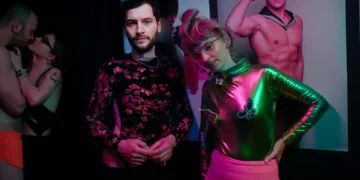
The investigation’s movement into an operation supplying cloned sex workers makes the consequences concrete. April’s likeness and recorded experience can be exploited repeatedly, and Krug’s multiple incarnations bring that replication into the cast itself. Yet the writing spends insufficient time distinguishing the copies’ interests from their significance to Baxter.
Recovering someone who resembles April is meaningful to him; it does not settle what that person needs. A copy’s shared memories might support attachment without establishing an obligation to resume the original’s relationships. The film raises that possibility, then hurries toward the next threat.
Its pacing problem is therefore sharper than simple confusion. An unspecified year and unnamed city do little harm to this kind of thriller; noir has often made disorientation productive. The trouble concerns information that changes the moral stakes of an encounter.
Dream recording, memory transfer, and personality assignment arrive with enough explanation to initiate another development, but too little dramatic testing to establish their consequences. The viewer is asked to fear for Baxter while continually revising the meaning of the person he seeks. Uncertainty needs something stable to put under pressure.
The five-year jump produces a related compression. A time marker establishes the length of Baxter’s debt and hope, but duration alone cannot explain how those forces have worked upon him. Later confrontations in the high-rises increase physical danger without giving comparable weight to the altered relationship awaiting him. The architecture supplies an imposing destination for his anger. What remains difficult to locate is the point at which his wish to restore the past encounters the interests of someone whose existence began through its copying.
The final confrontation with Tetris, who has been exploiting the April clones, provides an identifiable target for that anger. An exploiter can be confronted through action; recognizing a copied person requires a different kind of response. The closing exchange keeps further conflict available, while leaving this second task underdeveloped. Baxter’s search has been governed by what April’s face means to him. The woman carrying it may have memories he recognizes and wishes he cannot anticipate, including the wish to refuse the place his grief has prepared for her.
April X arrived in theaters following a festival run in late 2025 and mid-2026. The cyberpunk sci-fi thriller follows a desperate man traversing a gritty near-future urban landscape to track down his missing twin sister.
Where to Watch April X (2026) Online
Full Credits
Title: April X
Distributor: Vertigo Releasing, Sunrise Films, Rialto Distribution
Release date: August 2025 (Festival) / September 18, 2026 (United Kingdom)
Running time: 1 hour 35 minutes (95 minutes)
Director: Michel K. Parandi
Writers: Michel K. Parandi, Jack Coulton
Producers and Executive Producers: Lavi Star
Cast: Connor Storrie, Lilly Krug, Serban Pavlu, Dida Diafat, Tudor Chirila, Iulian Postelnicu
Composer: Matthew Atticus Berger
The Review
April X
April X gives exploitation a persuasive geography: futuristic freedom overhead, bodies for sale below. Storrie lends Baxter’s grief conviction, and the encounter with April’s likeness briefly unsettles the ethics of recognition. Yet the screenplay rushes past the copies’ independent interests, substituting criminal confrontation for the harder business of acknowledging another person. Its nighttime city is convincing; the moral life within it remains underwritten.
PROS
- Atmospheric locations and suggestive visual divisions.
- Storrie’s credible grief and nervous determination.
- Provocative tension between recognition and personal identity.
CONS
- Clone autonomy receives insufficient dramatic development.
- Repetitive voice-over substitutes explanation for revealing choices.
- The five-year jump compresses Baxter’s emotional development.
- The supermarket scene weakly establishes April’s individuality.