


















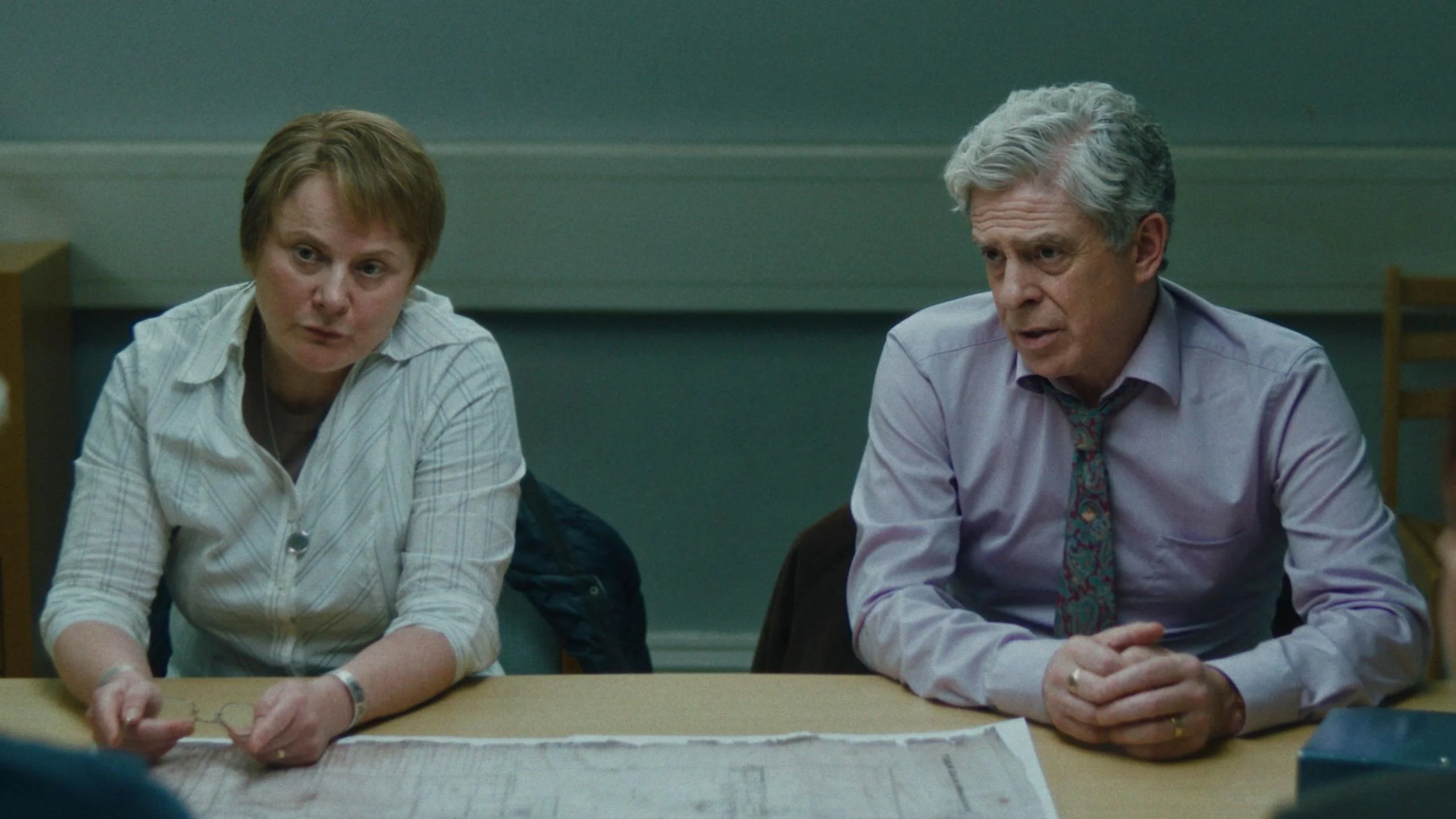

Catherine Corless reads the names of dead children in the back of a van, surrounded by graves. Beside her, the graveyard manager, John, helps her search for a burial record that might attach one of those names to a place. The list continues; the places cannot be found. Frank Berry allows the scene to retain the modest proportions of a practical inquiry, two people consulting information, until that ordinary task becomes almost unbearable. Each name has been preserved well enough to be spoken. The community has preserved no discoverable record of where the child was laid.
Elsewhere, the children return as sound: boots marching together, their regulated rhythm recurring through the film. Their presence reaches us through an order imposed upon them. The sound gives the past a physical insistence, but it carries little of the disorder we associate with children, their separate impulses, their unruly movement. Against this collective tread, Catherine’s reading restores the difficult particularity of a name. Berry’s sparing reconstructions and the marching motif make exclusion perceptible before the investigation has established its full extent.
The Lost Children of Tuam follows that investigation from Catherine’s enrollment in a local-history course in 2010. Played by Monica Dolan, she chooses the former St Mary’s mother and baby home for an essay. The Bon Secours order operated it in County Galway between 1925 and 1961, housing unmarried mothers and their children. Catherine obtains 796 death records, with causes including infectious illnesses and malnutrition, yet cannot locate corresponding burial records. Rebecca Lenkiewicz’s screenplay, adapted from Dan Barry’s New York Times article, stays close to the labor of turning this discrepancy into a question the authorities must answer.
The research takes place at a kitchen table. Maps and certificates enter a household already occupied by meals, family, and the work of a small livestock farm. Editors Colin Campbell and Nathan Nugent repeatedly return to this domestic existence between discoveries and the growing activity of the press.
The returns give the investigation a duration that its approximately eighty-minute running time cannot literally contain. Cattle still need tending. Daily life continues to make demands upon someone whose understanding of the town is changing, and the familiar rooms begin to hold knowledge that makes familiarity itself uncomfortable.
Dolan makes Catherine’s persistence feel costly without filling the screen with demonstrations of pain. Her initial shyness in the classroom survives her growing public authority; the voice becomes firmer, the stance more insistent, while attention remains something she has to endure.
She does not acquire the ease of a person who has discovered a talent for command. When her husband Aidan, played with gentle warmth by Andrew Bennett, brings an empty briefcase to a meeting with the nuns, his attempt to look businesslike briefly exposes how unprepared ordinary people can feel before an institution accustomed to being obeyed.
That domestic tenderness sits beside a memory which denies Catherine the comfort of complete innocence. As a child, she offered a girl from the home a stone concealed in a sweet wrapper. The cruelty depends upon the other child’s expectation of kindness.
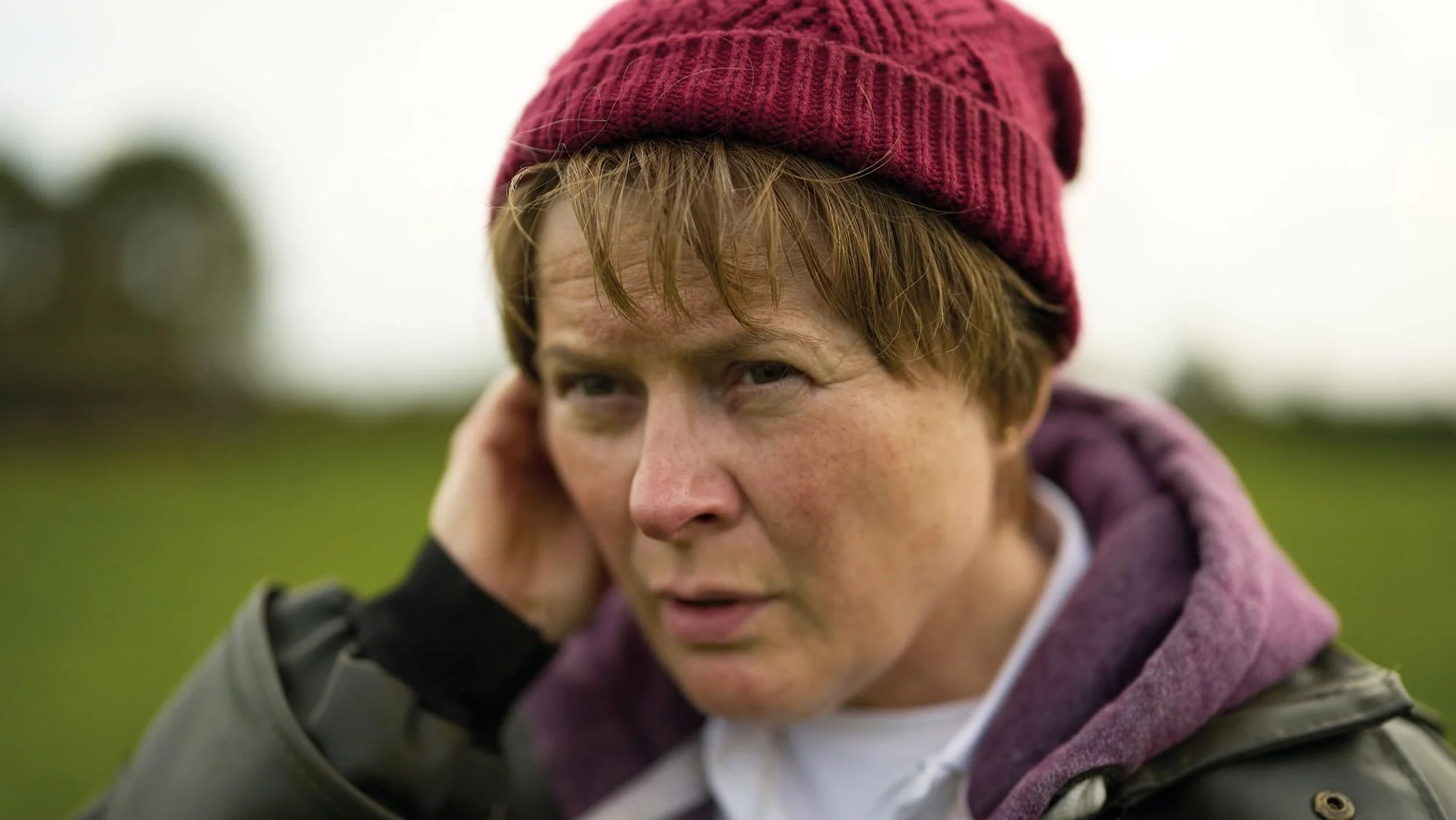
Aidan’s recollection of the label “home babies” places such behavior inside a communal vocabulary, a way of recognizing children that already contains their rejection. Catherine’s own mother was born outside marriage, but proximity to that history did not prevent her from joining the schoolyard humiliation. The film leaves these incompatible facts beside one another.
Here its economy becomes a limitation. The childhood recollections are brief, and Catherine’s family life is largely encountered between stages of the inquiry. We can feel the shame attached to the prank, but the screenplay gives limited space to how that memory lives within the adult woman, or how recovering the children’s history alters her understanding of her own. The progression through documents, interviews, and official responses is clear and absorbing. It also makes her persistence easier to follow as action than to inhabit as an inward conflict. A little further attention to that conflict could have deepened the film without displacing its subjects.
Institutional resistance has a different texture. Ruth McCabe’s Sister Bridget meets questioning with a glare that makes the request itself seem offensive. Deirdre Dunlea’s Sister Joan supplies courtesy which brings Catherine no closer to an answer. Berry preserves the distinction between their manners while showing the same inquiry stranded before both.
The schoolgirl with the sweet wrapper and the religious order with its authority belong to the history of exclusion at radically different levels of responsibility. The film’s widening attention to the town does not dissolve that difference. Those entrusted with the children’s care remain answerable for what happened under their supervision.
A test excavation confirms human remains on the former home’s grounds. Survivors give the investigation a living presence beyond its certificates, including those played by Ian McElhinney and Elaine Free. Catherine is learning what has already shaped the lives of people she meets.
Recordings of testimony, broadcast material, and footage of the state apology bring public acknowledgment into contact with the dramatized inquiry. Hannah Peel’s melancholy score remains restrained through this accumulation. The voices have room to reach us without being absorbed into a grand musical expression of sorrow.
Near the end, Catherine addresses supporters and survivors about a proposed audience with the Pope. Berry keeps the room intimate and attends to the reactions of those listening. Her growing influence remains attached to these people, in this limited space, with her discomfort still visible.
The staging gives public action a human scale. Nearby in the film’s final movement, an archival image of a blue child’s shoe brings the investigation back to the size of the bodies its documents describe, interrupting the scale of reports and apologies with something painfully small.
The closing gathering at the grotto permits a warmer light and the shelter of a circle. People occupy together a place burdened by what the investigation has uncovered. There is tenderness in their assembly, and the film allows it to exist without asking the survivors to appear healed. The location remains difficult; gathering there requires staying with its history. For those who once knew the children through a label, the work of recognition now involves standing beside people who can remember what that label allowed others to overlook.
The Lost Children of Tuam premiered in July 2026 before its theatrical release in September. The powerful drama dramatizes the harrowing true story of amateur historian Catherine Corless and her relentless investigation into the hundreds of children buried in unmarked graves at an Irish mother and baby home.
Where to Watch The Lost Children of Tuam (2026) Online
Full Credits
Title: The Lost Children of Tuam
Distributor: Element Pictures
Release date: July 11, 2026 (Galway Film Fleadh) / September 25, 2026 (Ireland)
Running time: 1 hour 26 minutes (86 minutes)
Director: Frank Berry
Writers: Rebecca Lenkiewicz
Producers and Executive Producers: Liam Neeson, Jules Daly, Chelsea Morgan Hoffmann, Andrew Lowe, Ed Guiney, Martina Niland
Cast: Monica Dolan, Andrew Bennett, Ian McElhinney, Tom Delahunty
Director of Photography (Cinematographer): Kate McCullough
Editors: Colin Campbell, Nathan Nugent
Composer: Hannah Peel
The Review
The Lost Children of Tuam
Frank Berry makes the search for burial records carry the weight of lives a town learned to exclude. Monica Dolan’s restrained performance and the recurring tread of children’s boots give that exclusion a painful physical presence. The procedural focus leaves Catherine’s private reckoning underdeveloped, yet the film carefully preserves the distance between acknowledgment and repair. Its final gathering permits tenderness while keeping the children’s irreversible losses in view.
PROS
- Dolan conveys growing resolve without erasing Catherine’s shyness.
- Names and marching boots give historical exclusion concrete form.
- Domestic warmth sustains the investigation’s emotional weight.
- Public acknowledgment avoids a false promise of healing.
CONS
- Brief childhood recollections limit exploration of Catherine’s guilt.
- Family scenes leave her private life comparatively underdeveloped.