




























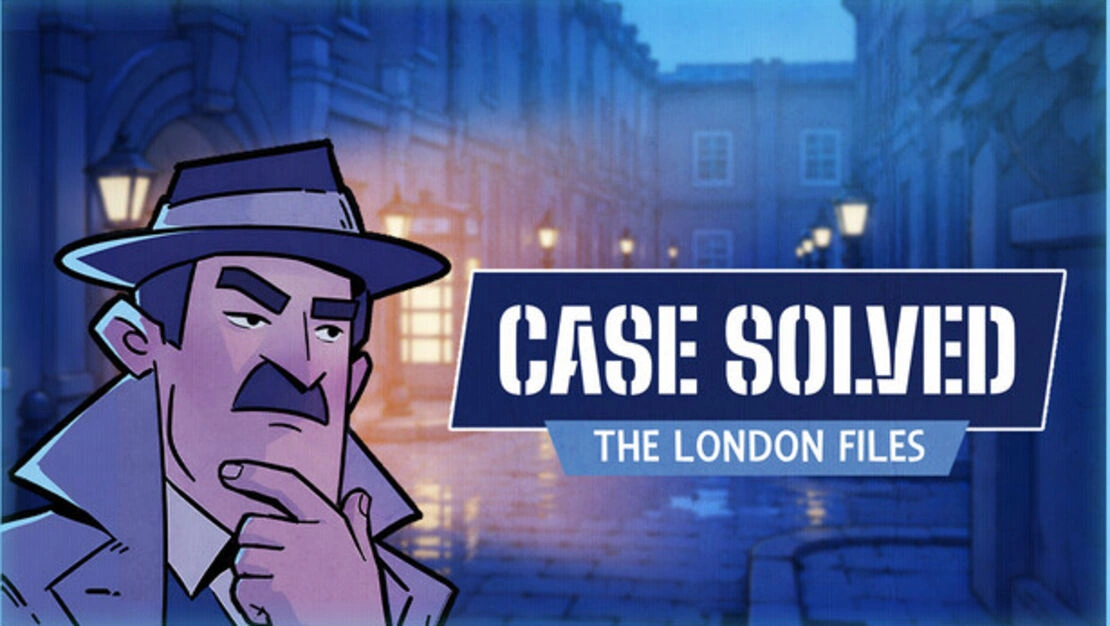

The rain-soaked streets, jazz accompaniment, and cardboard-cutout suspects suggest a detective adventure, yet Case Solved: The London Files has little interest in letting players behave like Sherlock Holmes. Its detective carries no notebook full of branching theories. Suspects cannot be pressured into changing their stories. Crime scenes contain no elaborate chains of physical evidence. The real investigative tool is a logic grid.
Developed by Minimol Games and published by SpecNext Ltd, this 2026 puzzle game presents three murder cases across a romanticised version of 1960s London. Each case is divided into five stages, with every stage functioning as a closed puzzle that has one provable solution. The noir setting provides the fiction, while a structure based on Einstein’s Riddle supplies the rules.
That places the game closer to Logic Town and traditional zebra puzzles than narrative mysteries such as L.A. Noire. The detective imagery may attract players who enjoy interrogations and elaborate crime stories, but the design is built for people who find pleasure in proving that the man with the watch could not have arrived third.
Gathering the Evidence
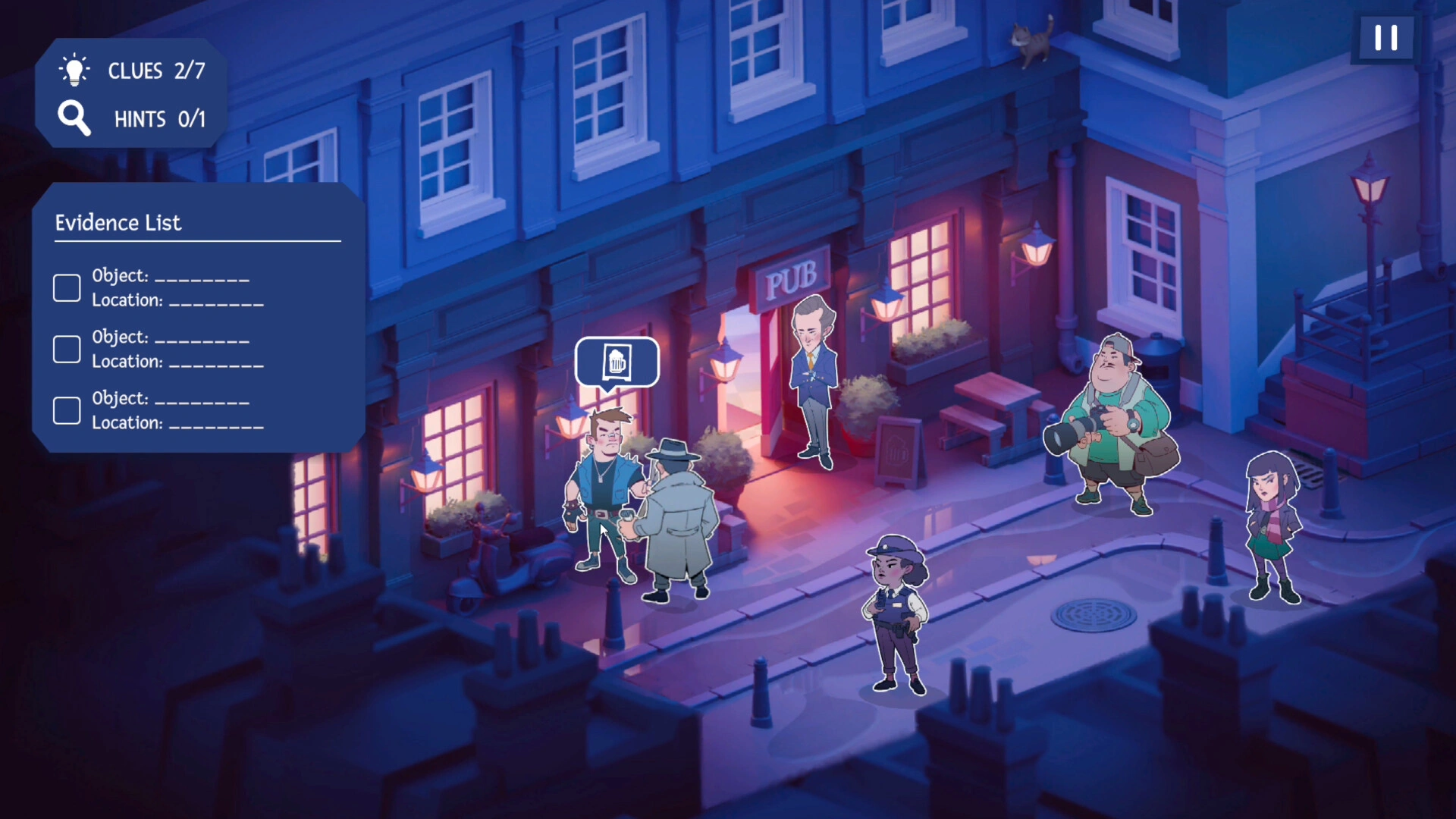
Each stage begins with a compact crime scene populated by suspects or witnesses. Speaking to a character produces a statement that points toward an object somewhere in the environment. Clicking that object adds the relevant information to the deduction board. Once every clue has been collected, the board becomes available and the actual puzzle begins.
The search sequences remove several conveniences common to hidden-object games. The cursor does not change when it passes over evidence, objects do not sparkle, and players cannot zoom into the hand-drawn backgrounds. These restrictions initially imply that close observation will matter. In practice, the scenes are small, and only a limited number of objects can be selected. A missing clue usually requires clicking through the remaining props rather than studying the environment from a fresh angle.
This makes evidence collection feel like preparation for the deduction board instead of an investigation with its own logic. The difference becomes clearer beside games such as Duck Detective, where examining an object can deepen a character joke or reshape the player’s understanding of a scene. Here, the object primarily exists to transport another statement into the puzzle.
Also Read






The interface keeps this routine manageable. Dialogue is easy to advance, the detective moves between characters without fuss, and completed stages can be replayed from the case screen or main menu. Automatic saving suits the relaxed structure. Full controller support is available on Steam, though the repeated selection of suspects and categories feels most natural with a mouse.
The Pleasure of Elimination
The deduction board gives The London Files its identity. Each puzzle asks players to connect several categories, including suspects, locations, disguises, carried objects, motives, and arrival order. A single confirmed fact removes possibilities elsewhere, and those exclusions gradually form a chain.
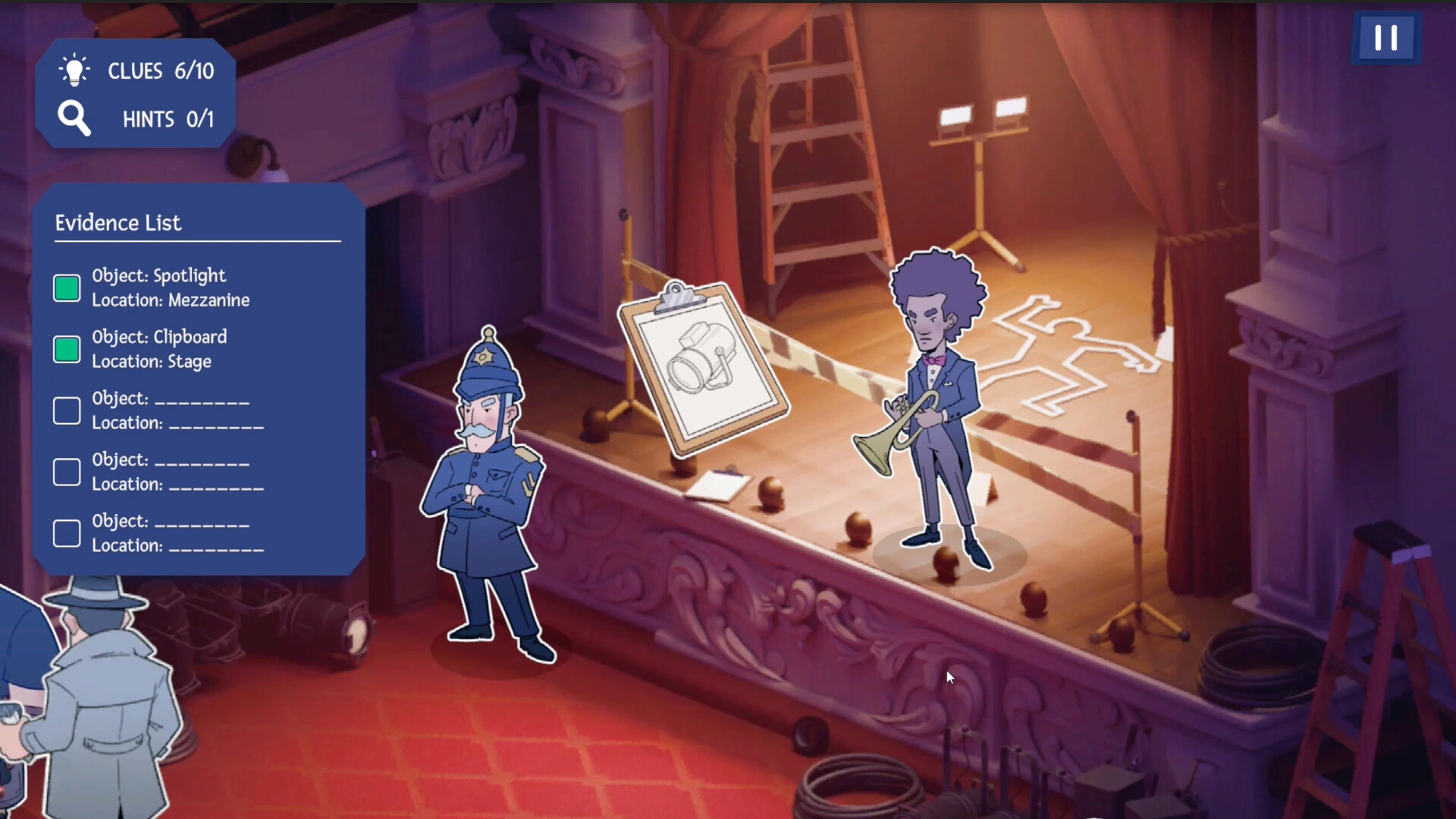
One stage establishes that Kessler is in the stalls carrying the libretto, Drake is in the box, and Bramwell wears the cape. Another statement says the masked person is in the foyer. Drake and Kessler already occupy different locations, while Bramwell cannot wear both the cape and mask, so Thewlis must be the masked figure in the foyer. That placement leaves Bramwell in the wings, which identifies him as the person carrying the watch.
The deduction is straightforward when written in sequence. On the board, it feels rewarding because each answer has been produced through elimination rather than discovered through a lucky selection. Early stages teach this rhythm using obvious relationships. Later puzzles add longer arrival sequences, conditional statements, and clues that remain useless until several other categories have been settled.
Veterans of grid-based logic games will recognise the progression. The opening puzzles ask players to fill clear gaps, while later stages require them to hold several incomplete chains in mind and search for the one fact that connects them. There are no timers or score penalties, so difficulty comes from complexity rather than pressure. A stubborn puzzle can sit open for twenty minutes without the game treating patience as failure.
That trust depends on accurate clue presentation. Reports of an incorrect or inconsistent clue in one stage matter greatly here. An action game can survive a misplaced texture. A closed-logic puzzle cannot casually misstate its own evidence, since the player’s confidence rests on the promise that every result can be demonstrated.
Cozy Cases and Classified Files
The hand-drawn presentation gives the game a softer personality than its murders suggest. London appears through warm colours, quiet interiors, theatre spaces, wet streets, and painted backgrounds. Characters resemble movable pieces placed onto these scenes, creating the impression of a tabletop mystery assembled for an evening session.
Gentle jazz supports the same pace. Piano melodies, rainfall, and restrained city ambience leave room for concentration instead of announcing every discovery as a dramatic revelation. Character dialogue can be accompanied by invented-language murmurs similar to The Sims. The effect gives conversations a playful rhythm, though the repeated sounds may distract during clue-heavy exchanges. They can be disabled in the settings.
The main campaign lasts roughly two to four hours, depending on how quickly its 15 stages are solved. Its cases provide distinct locations and casts, but the writing rarely gives suspects enough depth to compete with the puzzles surrounding them. Players are likely to remember a difficult arrival-order problem before they remember the person accused at its end.
Classified mode extends the stronger half of the design. Codes hidden in the game, its menus, the Steam page, and Minimol Games’ external posts unlock 42 additional puzzles. These cases discard environmental searches and move directly to clues and deduction, with difficulty ratings reaching level five. The format strips away the detective routine, yet it brings the game closer to the precise logic-puzzle collection it has been all along.
The Review
Case Solved: The London Files
Case Solved: The London Files borrows the suspects, rain, and jazz of a noir mystery, then places a logic grid behind the detective’s desk. Its environmental searches rarely demand much observation, and thin character writing keeps the three cases from becoming memorable mysteries. The deduction board fares far better. Later stages build satisfying chains from locations, objects, disguises, and arrival orders, while the 42 unlockable Classified puzzles extend the game’s strongest mechanic. For players who enjoyed Logic Town and prefer patient elimination to dramatic interrogations, this is a compact, clever casebook.
PROS
- Satisfying deduction chains
- Clear difficulty progression
- Relaxed, timer-free puzzles
- Charming hand-drawn London
- Extensive Classified challenges
CONS
- Superficial evidence searches
- Limited character development
- Brief main campaign
- Occasional clue inconsistencies