

























![Kingdom Hearts Collection [I-III] Review](https://gazettely.com/wp-content/uploads/2026/10/Kingdom-Hearts-Collection-I-III-1-360x180.webp "Kingdom Hearts Collection [I-III] Review: KHII Holds Steady as Newer Entries Fluctuate 37")





At nineteen, this Sherlock Holmes has not yet become the cold machine of observation that popular culture keeps polishing into myth. Young Sherlock begins with bruises, bad decisions, and a petty crime that lands him in trouble, then sends him to Oxford under Mycroft’s stern watch. From there, a stolen artifact and a murder pull him into his first true investigation, and the series quickly announces its preferred shape. This is no neat procession of weekly cases. It is an eight-episode tale of conspiracy, inheritance, danger, and self-creation.
What gives the series its pulse is the sight of genius in an unfinished state. Sherlock arrives gifted, impulsive, vain, curious, and still vulnerable to the reckless thrill of proving he is the smartest person in the room. The show leans into period texture, youthful adventure, and restless mystery mechanics, yet its real hook lies elsewhere. James Moriarty enters as companion rather than nemesis, and that choice hangs over the season like a promise with a bruise hidden inside it. The question is plain from the start. Can this series make the making of Sherlock feel worth watching, instead of treating youth as a decorative preface to greatness?
A Mind Still Learning Its Own Shape
The strongest idea in Young Sherlock is that brilliance, in youth, can look a lot like instability. Sherlock is sharp enough to see patterns others miss, yet he lacks the discipline that would turn perception into method. He acts before he settles. He follows instinct with the hunger of a convert. He pushes at the world like someone offended by its refusal to explain itself. That gives the character a messy vitality. It also leaves him morally blurred, sometimes sincere, sometimes performative, and occasionally hard to pin down.
There is real fascination in that. We are used to meeting Sherlock at the far end of self-construction, after habit has calcified into identity. Here, the habits are still forming. He is closer to a young man improvising a self than to a completed icon. The series understands that growth can be ugly. Intelligence does not make a person coherent. It can sharpen confusion. It can deepen arrogance. It can turn loneliness into performance.
Hero Fiennes Tiffin carries this unstable version of Sherlock with a persuasive mixture of charm and abrasion. He never plays the role as a statue of intellect. He gives the character warmth, petulance, flashes of boyish daring, and a social awkwardness that feels less clinical than wounded. He is watchable even in the moments where the writing leaves Sherlock shifting in strange directions. At times that unevenness reads as the point. A young person under pressure often becomes several people in quick succession. At other times, the characterization feels less like development and more like script-level uncertainty.
That uncertainty extends to the detective element itself. Sherlock has insight, certainly, and the series gives him moments of visualized thought that suggest a mind struggling to order chaos. Yet he is defined less by pure deduction than by motion. He chases, he reacts, he lunges toward revelation. The tension between detective and action hero sits at the center of the show. At its best, that tension feels generative, as if the future Holmes is being forged through failed drafts of himself. At weaker points, spectacle steals attention from observation, and the famous intellect becomes secondary to the machinery of pursuit.
Still, the idea remains potent. The distance between this impulsive boy and the man he may become gives the series its most haunting dimension. Greatness here is not presented as destiny. It is assembled in fragments, some noble, some ugly, some still wet with grief.
Friendship at the Edge of Ruin
The emotional life of the season rests on the bond between Sherlock and James Moriarty, and the show is wise to place that bond near the center of everything. Their first meeting carries the electric charge of recognition. Each sees in the other an intellect worth testing. Each senses kinship. Each misreads the danger contained in that kinship. This is where Young Sherlock finds a more human scale than its conspiracy plot can always sustain.
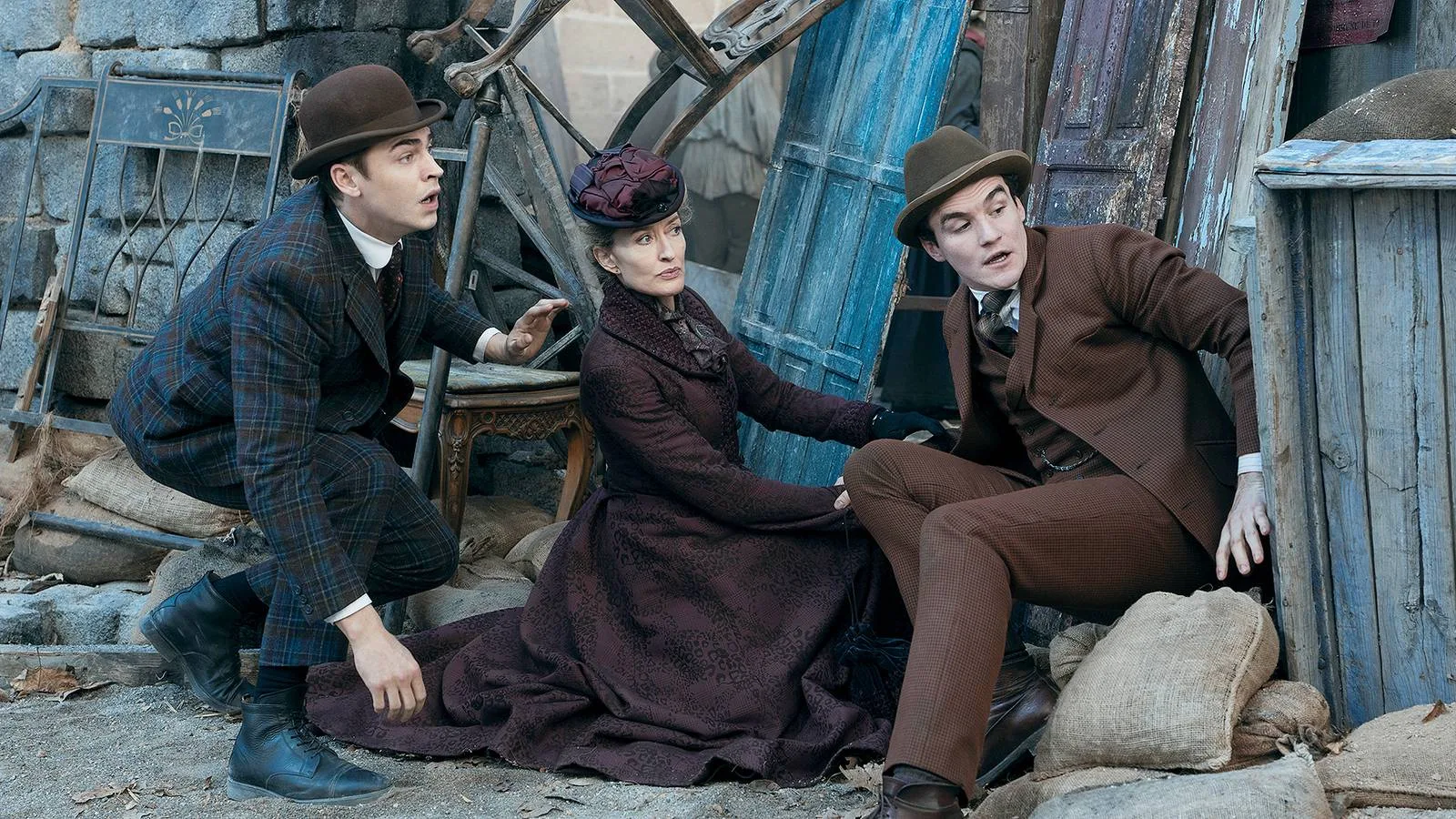
Dónal Finn gives Moriarty a sly magnetism that keeps the character alive in every scene. He is charming without seeming harmless. He smiles like a man who already knows rules are optional. There is wit in him, and mischief, and a low flicker of threat that never has to announce itself. The performance works because it does not treat Moriarty as a symbol waiting for his cue. He feels immediate. A person first, a fate second. That choice gives the series a melancholy undertow, since the audience knows the friendship carries its own funeral procession somewhere in the distance.
Their dynamic is rich with asymmetry. Sherlock comes from comfort, protection, and family name, even if he resists the shelter these things provide. Moriarty rises from a more precarious station. Class tension shadows their intimacy. So does the difference in their moral instincts. Sherlock wants justice, or thinks he does, even while his behavior can be self-serving. Moriarty seems more willing to bend law and propriety if they obstruct desire or truth. The season plants these early fractures with a welcome lightness. It does not rush toward open hostility. It lets affection breathe. That restraint gives the later implications more ache.
The Holmes family deepens the series, even as it sometimes clutters it. Mycroft serves as guardian, supervisor, and annoyed older brother, a figure of control standing before Sherlock like a version of adulthood that has accepted compromise. Silas and Cordelia bring a heavier emotional weather. Through them, the show ties Sherlock’s intellect to family wounds, old secrets, and the lingering grief attached to Beatrice. Loss sits quietly beneath the season’s movement. It is one of the few elements that lends genuine existential weight to the material. A detective story is always a confrontation with absence. Here, absence begins at home.
The supporting cast helps sustain the world. Princess Shou’an arrives as a compelling foil, meeting Sherlock in intellect and presence rather than orbiting him as mere adornment. Lestrade’s appearance gives the series a glimpse of future alignment. Bucephalus Hodge and Edie widen the frame without draining focus. Even when the plot sprawls, the ensemble keeps the drama from collapsing inward. Faces matter in this world. So do the hidden motives behind them.
The Expanding Circle of the Mystery
As a piece of serialized storytelling, Young Sherlock begins on firm ground. The Oxford setting provides a strong dramatic enclosure, and the early combination of theft, murder, suspicion, and personal jeopardy gives the season clean momentum. Sherlock is implicated, the stakes feel immediate, and the case seems large enough to matter while still intimate enough to hold shape. These early chapters understand the old seduction of the mystery form. A clue is never just a clue. It is an invitation into disorder.
The series then keeps widening its circle. What starts on campus reaches into buried histories, family trauma, political movement, international travel, and a conspiracy of increasing size. This constant escalation creates propulsion. Each episode offers another layer, another danger, another corner of the labyrinth of motive. That quality makes the season very easy to keep watching. It understands the seduction of one-more-episode television.
Yet escalation has a price. The farther the story travels from its initial crime, the more its structure begins to strain. The Oxford material, the Holmes family drama, and the larger international plot do not always feel like parts of a single organism. They can feel like neighboring series stitched into one body. The season asks the audience to accept that Sherlock’s first major case must somehow contain half a lifetime’s worth of dramatic magnitude. At moments, that ambition is exhilarating. At others, it feels inflated, as if the show mistrusts the power of a smaller mystery.
This affects tone as much as plot. Early irreverence gives way to darker conspiracy drama, and the shift can be bracing. Youthful adventure turns somber. Banter shares space with grief. The movement has its own fascination, since adolescence itself often feels like a sequence of abrupt tonal shifts. Still, the series does not always modulate these changes with confidence. Characterization can wobble under the weight of so many expanding demands.
And yet I hesitate to dismiss that messiness outright. There is something fitting in a young Sherlock story that cannot entirely master its own sprawl. It mirrors the boy at its center, brilliant and overreaching, hungry for form and still captive to excess. The season may lose clarity, though it rarely loses motion. For a streaming mystery, that counts for a great deal.
Smoke, Velvet, and Restless Motion
Guy Ritchie’s influence hangs over Young Sherlock even in episodes he does not direct. The series moves with a quicksilver energy. Dialogue snaps. Action bursts into frame with force. There is grit in the textures, a faint grin in the staging, and a refusal to let Victorian material ossify into museum glass. That energy keeps the show alive. It prevents the period setting from sinking into respectable lifelessness.
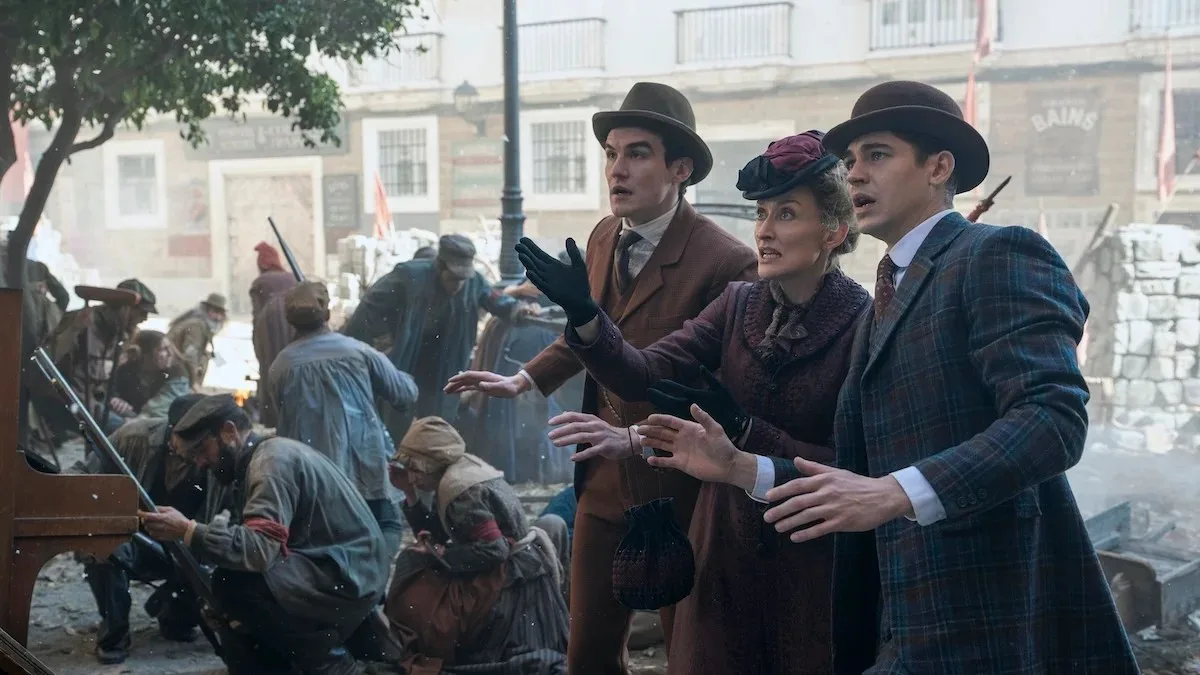
The visual world is richly assembled. Oxford carries the air of old institutions guarding rot behind ceremony. Costumes and interiors lend density to the setting without smothering it in prestige-pageantry. As the season grows larger, the world grows with it, opening into bigger spaces and more expansive set pieces. The production has confidence in scale. It wants adventure, and often gets it.
The action is staged with real flair. Quick cutting, active camerawork, and sudden physical danger give the series a muscular rhythm. This is not the kind of detective drama that sits politely in drawing rooms waiting for revelation. It lunges. It scrambles. It sweats. The problem, at times, is that the visual excitement can overwhelm the detective identity of the material. Sherlock Holmes has long existed as a fantasy of pure cognition, a man who can impose order on the world through thought. Young Sherlock often prefers momentum to method. That choice gives the series immediacy, though it also makes it feel more generic in some stretches than its premise deserves.
Its relationship to Holmes mythology will likely determine the depth of any viewer’s patience. The show uses familiar names, familiar ghosts, and pieces of established lore, then reshapes them freely. Taken as a faithful rendering, it will frustrate many. Taken as a loose remix, it has more room to breathe. I found it easier to meet the series on those terms. Its pleasures come from character chemistry, mood, velocity, and the dark shimmer of futures already written in outline.
That leaves Young Sherlock in an interesting place. It is messy, ambitious, fun, and often out of focus. It stumbles in the act of trying to turn origin into destiny. Still, the bond between Sherlock and Moriarty gives it a live wire that keeps sparking through the clutter. By the end, the season has not fully decided what shape this young Holmes should take. It has, however, made that uncertainty worth watching.
Young Sherlock is a highly anticipated mystery-action series that premiered on Prime Video on March 4, 2026. Directed by Guy Ritchie, the eight-episode series serves as an origin story for the legendary detective, finding a 19-year-old Sherlock Holmes (played by Hero Fiennes Tiffin) at Oxford University. Rather than the polished genius of later years, this version of Sherlock is raw, undisciplined, and disgraced, forced to solve his first murder case to clear his own name. The series takes viewers on a globe-spanning adventure from 1870s England to international locales, unravelling a conspiracy that introduces him to his future nemesis, James Moriarty. You can stream the entire first season exclusively on Prime Video.
Where to Watch Young Sherlock Online




Full Credits
Title: Young Sherlock
Distributor: Prime Video
Release date: March 4, 2026
Rating: TV-MA
Running time: 60 minutes
Director: Guy Ritchie, Anders Engström, Tricia Brock
Writers: Matthew Parkhill, Steve Thompson, Andy Lane
Producers and Executive Producers: Matthew Parkhill, Guy Ritchie, Ivan Atkinson, Simon Kelton, Simon Maxwell, Dhana Rivera Gilbert, Colin Wilson, Marc Resteghini, Harriet Creelman
Cast: Hero Fiennes Tiffin, Zine Tseng, Dónal Finn, Joseph Fiennes, Natascha McElhone, Colin Firth, Max Irons, Numan Acar, Ravi Aujla, Holly Cattle, Simon Delaney, Adam James
Director of Photography (Cinematographer): Maja Zamojda, James Friend
Editors: James Herbert, Eddie Hamilton
Composer: Dan Levy
The Review
Young Sherlock
Young Sherlock is lively, messy, and frequently absorbing. Its plotting can sprawl, and its idea of Sherlock does not always hold a steady shape, yet the series keeps finding energy through atmosphere, momentum, and the charged bond between Sherlock and Moriarty. It misses some of the precision one hopes for from a Holmes story, though it still delivers a strong sense of curiosity and promise.
PROS
- Strong Sherlock and Moriarty dynamic
- Hero Fiennes Tiffin and Dónal Finn are engaging
- Stylish action and visual flair
- Serialized mystery keeps pulling forward
- Rich period atmosphere
CONS
- Plot grows too large
- Deduction sometimes gives way to spectacle
- Family material can feel crowded
- Characterization can feel uneven







