






























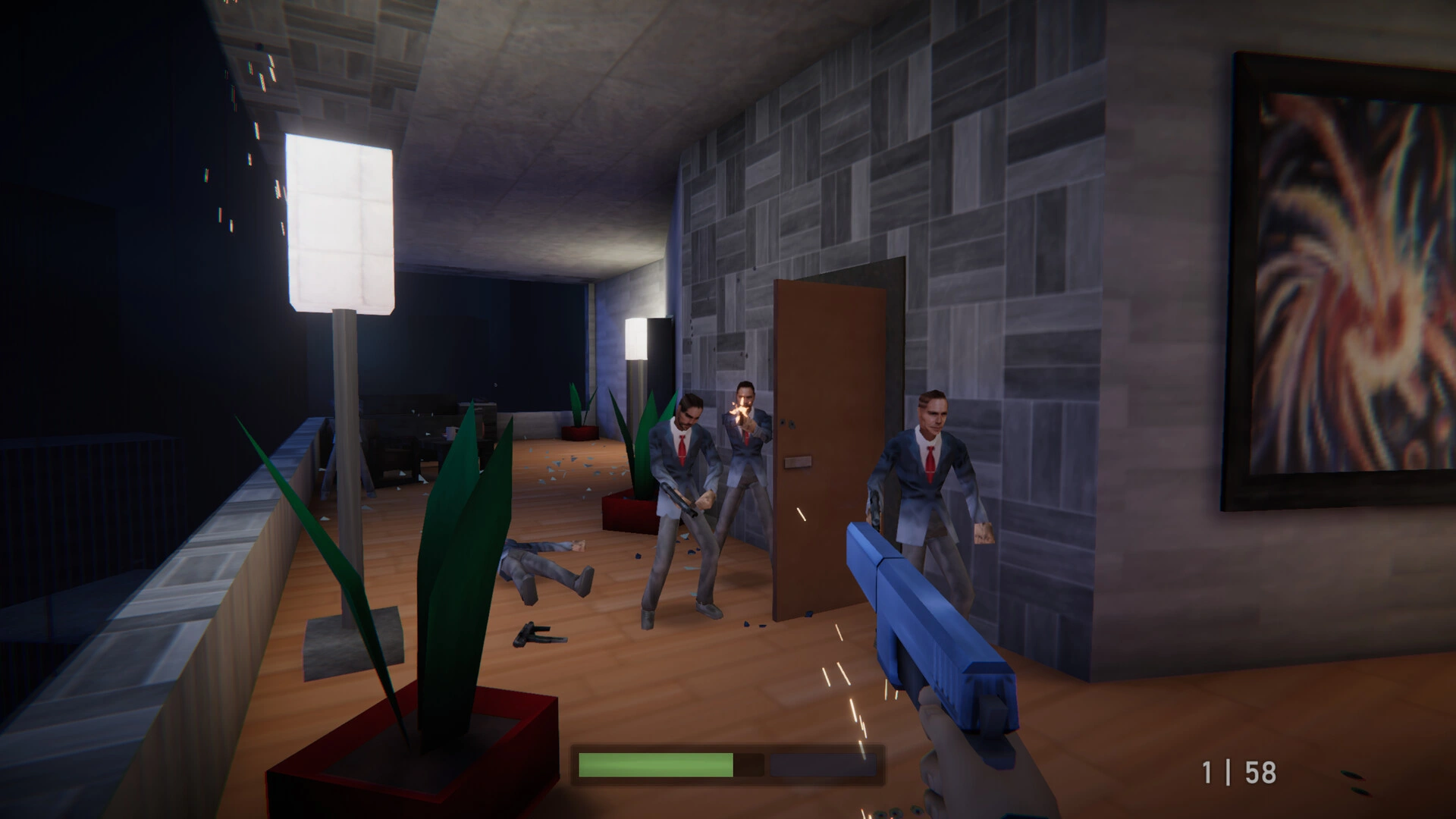
Replicant D6 has rebuilt the physical memory of GoldenEye 007 with almost unnerving accuracy. Push into a room, keep a guard near the center of the screen, and John Walter’s pistol tilts toward the target with the same generous auto-aim that helped Nintendo 64 players survive firefights with one analog stick. Guards roll aside, stagger according to where bullets land, rush forward when they get close, and occasionally turn a clean encounter into slapstick chaos.
That familiarity defines Agent 64: Spies Never Die. Walter is an aging secret agent pulled back into action when Dominic Pulp, an old enemy presumed dead, steals a keepsake belonging to Walter’s late wife. His daughter is tangled in the espionage plot too, yet the game spends little time developing either relationship. Text-driven cutscenes, wobbling low-poly characters, and deliberately stiff animation communicate the essentials before another mission begins.
The story functions like connective tissue between levels, which becomes harder to ignore when two boss encounters repeat nearly the same rocket-launcher fight against airborne targets. GoldenEye rarely depended on narrative sophistication either, but its mission briefings gave each operation a sense of place and purpose. Walter often feels like he is clearing stages because the level-select screen says another one exists.
The Golden Gunplay
The shooting fares much better. Auto-aim tracks targets without eliminating player input, and manual aiming remains useful when guards funnel through doorways or when a distant headshot can remove someone before a room erupts. Weapon behavior carries enough distinction to matter. SMGs chew through enemies at close range, assault rifles handle distance better, and sniper rifles demand deliberate aiming rather than relying on the same generous tracking.
Mouse and keyboard translate this strange old control philosophy surprisingly well. Controller play is rougher. Manual aim can snap back toward the center when the stick is released, while sensitivity settings never entirely erase the awkwardness.
Mission objectives expose a larger problem. One early operation asks Walter to break door locks, retrieve an equipment case, plant a tracker on a helicopter, and reach an elevator. The tracker is already sitting in his inventory. Completing the objective means walking to the helicopter, selecting the correct item, and pressing the interaction button.
Later assignments follow the same pattern through hacked terminals, photographs, disguises, and key objects. An undercover gallery mission briefly changes the rules by punishing Walter for displaying a weapon. Once its item-based tasks are finished, the disguise has served its purpose and the level slides back into gunfire.
Stealth suffers from similar uncertainty. Silenced weapons exist, yet enemy awareness can behave strangely enough that planning around sound becomes unreliable. A distant silenced kill may alert somebody nearby while a louder firefight leaves another guard strangely unconcerned. GoldenEye allowed players to learn patrols, alarms, and alternate approaches. Here, stealth often feels like a suggestion attached to a shooter built for clearing rooms.
Old Rules, New Frustrations
Some of Agent 64’s refusal to modernize works in its favor. Missions have no checkpoints. Health does not regenerate. Body armor is scarce, and dying near an exit sends Walter back to the start. There is no map waiting in a corner of the interface either.
Those rules sound harsher than they usually feel because stages are compact enough to learn through repetition. Failed attempts become route knowledge: which doorway hides another guard, where armor sits, which objective can be handled first. The difficulty system also follows its ancestor by adding objectives as the setting rises, so replaying a mission can meaningfully change what the player must accomplish.
Cyphers turn that natural replayability into obligation. Finishing missions awards them according to difficulty, and later acts require minimum totals before they unlock. Players who clear the campaign on easier settings eventually have to revisit earlier missions and complete tougher versions simply to continue Walter’s story.
Hidden masks, Challenges, and demanding par times extend the same philosophy into unlocks. Some par goals encourage precise routing that feels closer to speedrunning practice than ordinary campaign progression. Repetition makes sense when a player chooses mastery. Making it the admission price for the next act is far harder to defend.
Four Controllers in Spirit
The generous side of that old-school philosophy appears outside the campaign. Agent 64 includes co-op, local split-screen, online play, Arena matches, Challenges, modifiers, alternate rules, and the obligatory big-head mode. It remembers an era when multiplayer menus were expected to contain enough switches to start arguments before the match had even loaded.
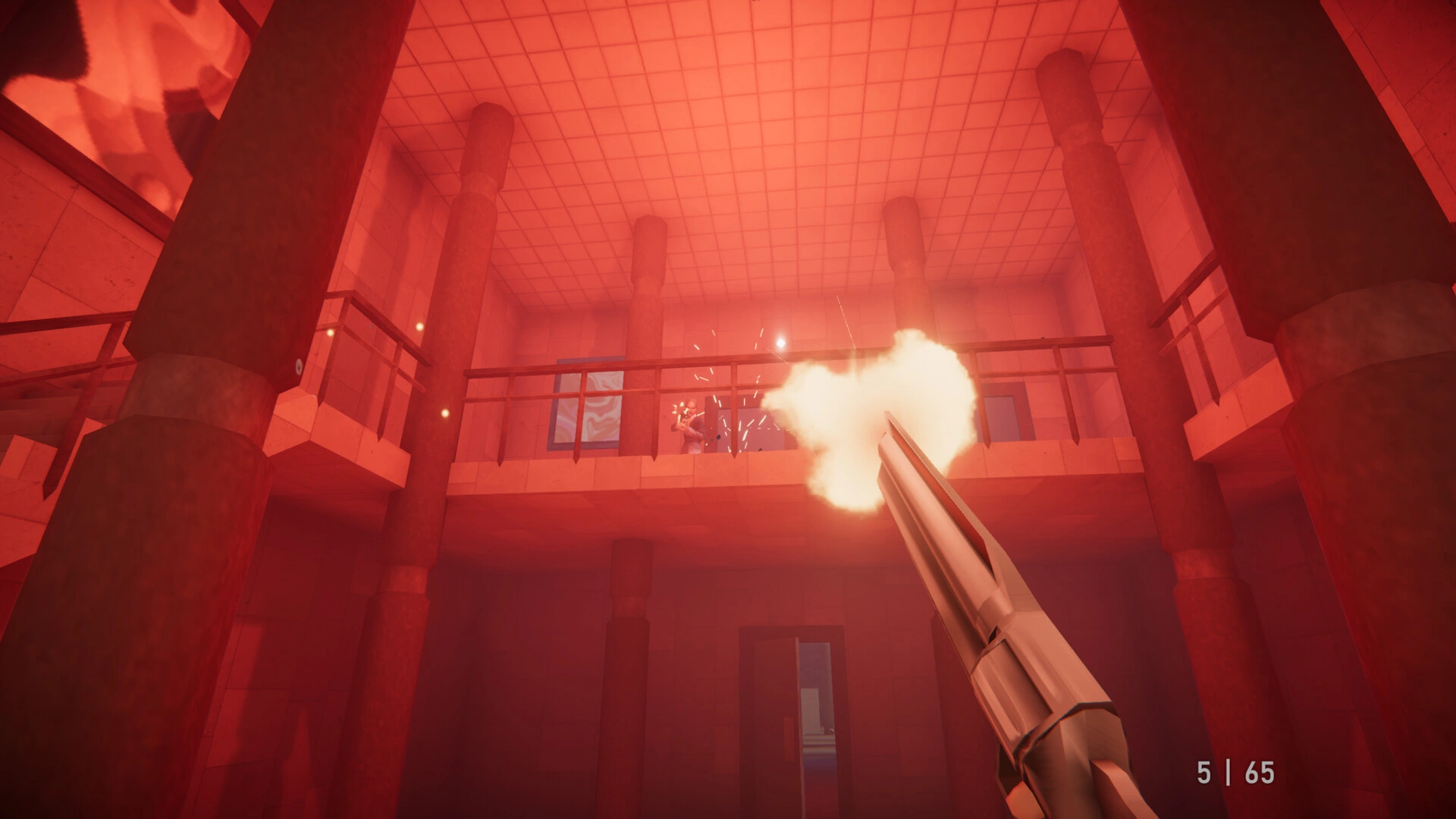
Arena lets players adjust weapon sets, score limits, timers, and stranger modifiers. Challenges push the silliness further, including scenarios where players fight waves of karate-chopping enemies while contesting a zone. These modes suit Agent 64’s exaggerated movement and quick kills better than several campaign missions do.
The reused campaign maps create uneven results. Some spaces become entertaining arenas with useful routes and sightlines. Others are too large for small groups, while cramped layouts can produce cheap encounters when players spawn almost beside one another. Locking maps and modifiers behind other activities also makes multiplayer feel unnecessarily thin before enough content has been earned.
Visually, Replicant D6 rarely misses the reference. Faces look pasted onto angular heads, weapons carry chunky polygonal silhouettes, and the CRT filter recreates the blurred softness of games seen through period displays rather than simply drawing obvious scanlines across the image. The music reaches for the same spy-thriller swagger, yet the images do most of the historical impersonation.
Agent 64 can reproduce the way GoldenEye looked, aimed, moved, and filled a multiplayer menu. Its campaign maps reveal the tougher inheritance: creating spaces that make those systems sing.
The Review
Agent 64: Spies Never Die
Agent 64: Spies Never Die understands GoldenEye 007 at the level of movement, auto-aim, chunky models, enemy reactions, and multiplayer excess. Its weaker campaign reveals where imitation stops working: linear maps replace GoldenEye’s exploratory spaces, stealth rarely develops into a dependable system, and cypher requirements force repetition into an already thin story. Arena modes, co-op, Challenges, and absurd modifiers give the package real longevity, especially for players chasing the N64 feeling rather than its exact design virtues.
PROS
- Excellent N64-style auto-aim
- Strong visual recreation
- Packed multiplayer options
- Entertaining Challenges and modifiers
- Satisfying enemy reactions
CONS
- Linear campaign maps
- Shallow mission objectives
- Unreliable stealth systems
- Frustrating cypher gating
- Thin story and repetitive bosses