

















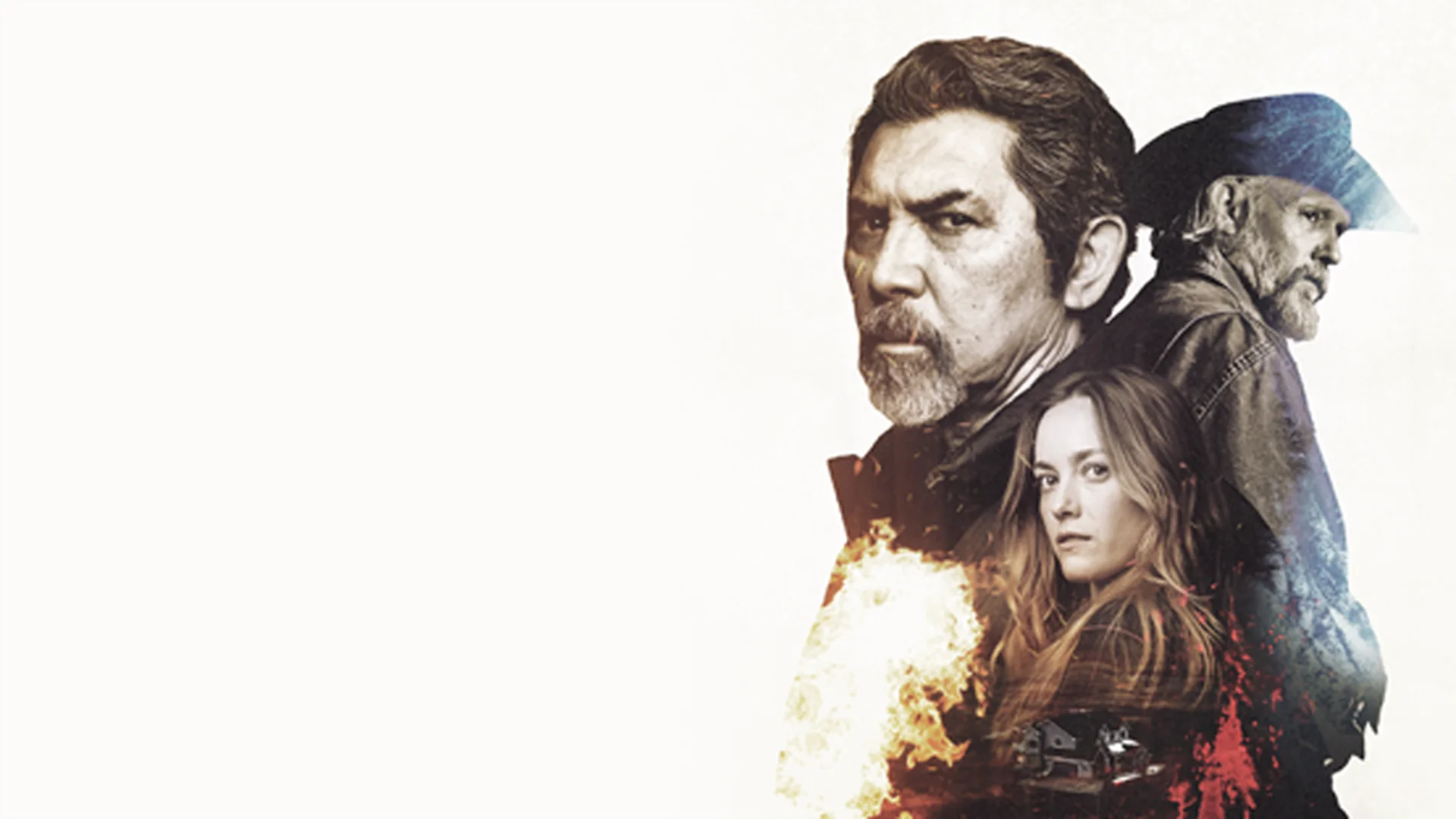

Hassie returns to her family ranch pregnant, estranged, and carrying several years of unresolved history with her terminally ill father, Sawyer. The premise gives Casa Grande an unusually dense inheritance for a feature-length continuation of a streaming series. Juan Pablo Arias Munoz, working from a script co-written with Sherell Jackson, has to bring newcomers up to speed on racism, class prejudice, ICE misconduct, Hassie’s time on the run, and her relationship with Latino ranch hand Mael before the current land dispute can fully take shape.
The screenplay handles that logistical problem through direct exposition. Characters frequently explain what happened rather than allowing old grievances to surface through gestures or unfinished conversations. It keeps the story legible for anyone who missed the Freevee series, yet it also makes certain exchanges sound like reports from a previous season.
What remains interesting is the cultural tension underneath those explanations. Sawyer’s gradual acceptance of Hassie and Mael places the ranch inside a familiar American contradiction. Land represents family permanence and belonging, while the family controlling it has previously decided who deserves to belong there. His terminal illness makes that contradiction harder to avoid. Sawyer can reconsider the prejudices that damaged his relationship with his daughter, but time offers him very little room to prove the change.
Madison Lawlor plays Hassie with enough guardedness to keep those encounters from turning into easy reconciliation. John Pyper-Ferguson gives Sawyer the physical weariness required of a man trying to settle property and emotional debts at the same time. Their strongest scenes depend less on what the dialogue explains than on the uncomfortable distance between them.
Who Gets to Own the Land?
The proposed sale to neighboring rancher Roy pushes Casa Grande toward thriller territory, yet the conflict has deeper roots in the American Western tradition. Ranch stories have long treated land ownership as proof of independence, identity, and family continuity. Here, the ranch becomes unstable precisely because those ideas no longer fit neatly together.
Roy wants what Sawyer owns. Hassie wants to stop the sale. Sawyer is approaching death. The property becomes the place where personal history, money, race, and inheritance collide. Lou Diamond Phillips understands that Roy works better as a man who can walk into a room without announcing himself as the threat.
Also Read





His most effective moments come when charm and pressure coexist, especially opposite Kate Mansi’s Hunter. Phillips can make an apparently reasonable conversation feel transactional without resorting to exaggerated villain behavior, while Mansi gives Hunter an alert, abrasive energy that keeps their exchanges from becoming simple plot delivery.
The script is less patient. Roy’s narrative purpose becomes clear early, which weakens the suspense once the film begins escalating toward its third act. The audience rarely has to reconsider what he wants or what role he will play in the struggle over the ranch. A conflict built around ownership might have benefited from murkier motives, particularly since the film is already dealing with questions of who has historically been permitted to claim land, family, and legitimacy.
The Landscape Carries Its Own History
For a production working within visible budget limits, Casa Grande achieves considerable scale through location. Northern California is recreated through Nevada’s Carson Valley, where ranch houses sit against wide mountain views and open stretches of land. Those spaces give the central dispute an immediate physical logic. Hassie is fighting for something the camera can actually make valuable.
The locations also place the film in conversation with decades of American ranch cinema. Traditional Westerns often turned open land into freedom. Here, the same landscape feels financially precarious and culturally contested. The ranch may represent continuity to Hassie, an asset to Roy, unfinished responsibility to Sawyer, and a place once structured by the prejudices that affected Mael’s acceptance.
That tension gives the scenery narrative purpose rather than reducing it to tourism photography. Some shots still lose texture through the digital image. Mountains that should dominate the frame can appear flatter than their scale suggests, and certain exterior scenes lack the richness that would make the land feel tactile.
Yet Arias Munoz repeatedly understands where to place his characters. Small figures against broad property lines make the ownership struggle visually legible. The family can argue about history indoors, but the exterior shots keep reminding us exactly what that history is attached to.
Familiar Thriller Machinery
The film becomes less distinctive when its family melodrama gives way to conventional suspense construction. Once Roy’s intentions are established and Hassie commits herself to preventing the sale, later turns become increasingly easy to anticipate. The third act raises the immediate danger without finding a corresponding complication in the characters.
That predictability matters because the earlier material suggests richer possibilities. Sawyer is trying to repair a relationship while dying. Hassie has returned after years away with a child on the way. Mael’s place within the family carries the residue of racial and class hostility. Each of those elements could make ownership emotionally unstable in several directions.
Instead, the screenplay frequently organizes them around a cleaner external threat. Roy becomes the person everyone can oppose, which simplifies problems that were initially much harder to separate. Phillips remains watchable because he resists playing every confrontation at maximum intensity, and Lawlor keeps Hassie’s determination from becoming merely procedural.
The most revealing moments occur when the thriller briefly retreats and the ranch becomes contested for reasons no contract can settle. Sawyer can decide who receives the property. He cannot decide what the family remembers about the way people were treated there.
Casa Grande was released in select theaters and on digital platforms on May 1, 2026, and is also available to stream on Amazon Prime Video. The western drama follows a prodigal daughter who returns to her family farm just as her ailing father faces a terminal diagnosis alongside intense pressure to sell their land.
Where to Watch (2026) Online
Full Credits
Title: Casa Grande
Distributor: ESX Entertainment, Amazon Prime Video
Release date: May 1, 2026
Rating: R
Running time: 1 hour 53 minutes
Director: Juan Pablo Arias Muñoz
Writers: Juan Pablo Arias Muñoz, Sherell Jackson
Producers and Executive Producers: Ali Afshar, Christina Moore, Daniel Aspromonte, Ava Rettke
Cast: John Pyper-Ferguson, Madison Lawlor, Christina Moore, Javier Bolaños, Kate Mansi, Daniel Edward Mora, Loren Escandon, Bruce Davison, Lou Diamond Phillips
Composer: Jamie Christopherson, Aaron Kaplan
The Review
Casa Grande
Casa Grande finds its strongest identity where family inheritance, class tension, and the mythology of American land ownership meet. The Carson Valley locations give the ranch dispute a physical scale the screenplay sometimes struggles to match, while Madison Lawlor and John Pyper-Ferguson make Hassie and Sawyer’s damaged relationship credible. Lou Diamond Phillips supplies welcome menace, yet Roy remains trapped inside a familiar property-thriller function. Heavy exposition and predictable escalation keep the drama from carrying the cultural and generational weight its setting invites.
PROS
- Strong central performances
- Impressive Carson Valley locations
- Accessible continuation of the series
- Phillips brings controlled menace
- Family conflict has cultural texture
CONS
- Heavy-handed exposition
- Predictable third act
- Thin supporting characters
- Familiar villain construction
- Digital imagery flattens some scenery