





























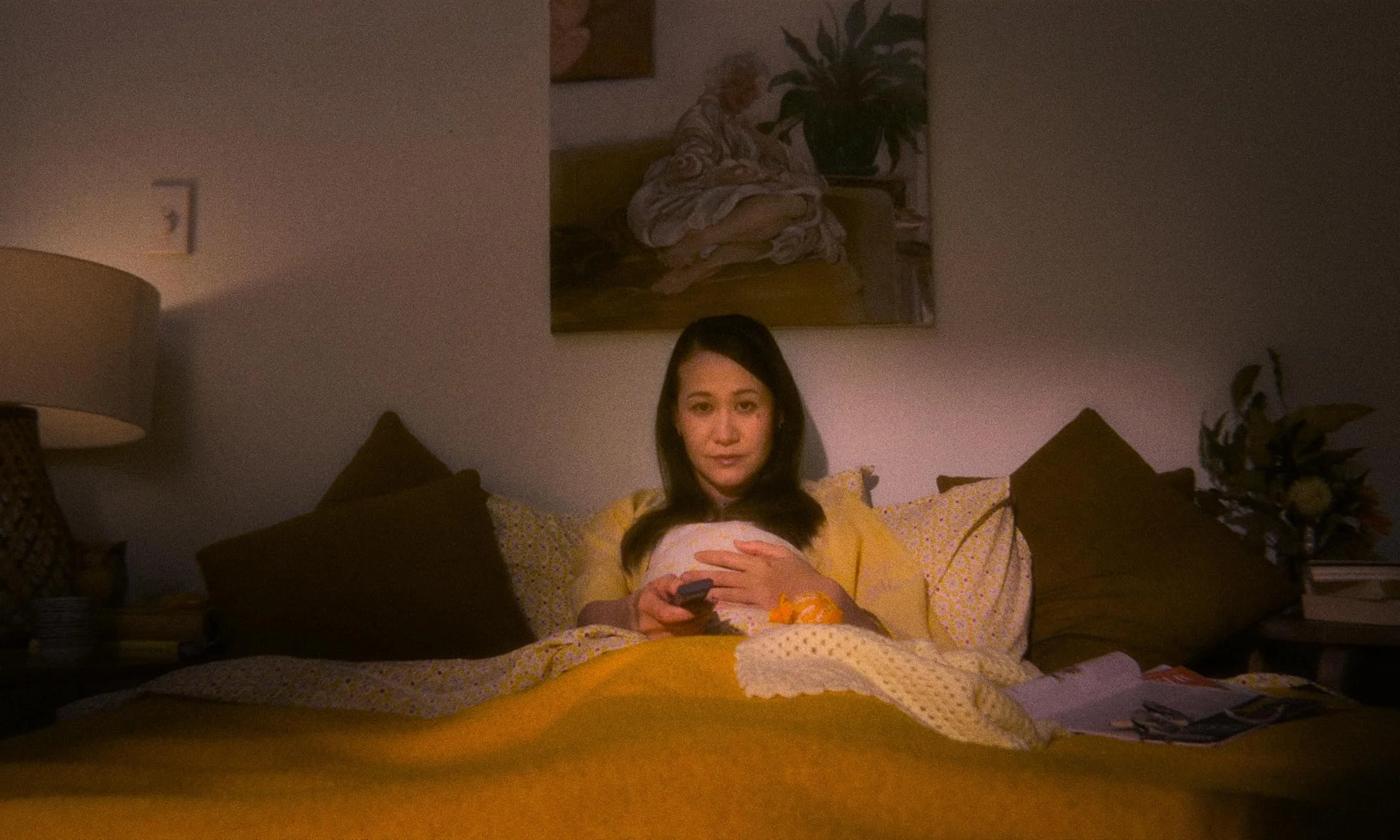

Food carries nearly every important emotion in Salt Along the Tongue. Mattia (Laneikka Denne) learns affection through meals, recipes, and quiet routines with her mother Mina (Dina Panozzo), so Parish Malfitano has something unusually intimate to corrupt once Mina dies. A spoonful of jam can summon comfort. A bite of falafel can become evidence that something inside Mattia has gone terribly wrong.
After Mina’s sudden death, Mattia is sent to live with her estranged aunt Carol, Mina’s twin sister, also played by Panozzo. Carol is louder, brasher, and far happier being watched. She hosts the fictional cooking series Cooking with Love, drinks freely, and pulls Mattia toward a community that seems almost aggressively social compared with the teenager’s withdrawn life.
Denne plays that withdrawal through small physical choices. Mattia often looks like she wants to shrink out of whatever room she has entered, which makes Carol pushing her onto the cooking show feel genuinely uncomfortable before it becomes restorative. The film never needs Mattia to deliver a grand speech about grief. Her discomfort during meals and her hesitant involvement with Carol’s crew do the work.
The Evil Eye Gets Hungry
Malfitano builds the supernatural threat around the malocchio, the Italian evil eye associated here with envy and jealousy. The opening ritual establishes the rules through action: salt crosses the floor, oil drops into water, blood enters the bowl, and a tomato becomes part of an invocation that ends with a woman collapsing at Petersham station.
The crucial idea is that possession does not automatically mean corruption. Mina’s spirit appears to inhabit Mattia partly to protect her, leaving the film with an interesting question about maternal love that refuses to obey death’s normal limits. Protection can become surveillance. Care can become intrusion.
That ambiguity is strongest during the fig-jam sequence. Carol recreates Mina’s recipe for Cooking with Love, turning the shoot into a public act of remembrance. Mattia tastes the jam and briefly reconnects with something familiar. Then she chokes. When the obstruction hits the floor, it is a dead fig wasp.
Malfitano has already explained the strange relationship between figs and the female wasps that die inside them, so the image lands with purpose. Motherhood, sacrifice, reproduction, food, and death become part of the same visual idea without requiring a character to decode it for us.
The Lebanese dinner pushes the concept further. Mattia bites into a falafel, reacts in disgust, and slowly pulls a wet strand of black hair from her mouth. The scene works because the food itself looks inviting. Malfitano understands that gastro-horror needs appetite before revulsion.
Women Carry the Past
Carol’s cooking crew gives the film a social dimension that keeps Mattia’s story from becoming a two-person family drama. At the bowling alley, Helen, Maggie, and Ola react to baked goods in Greek, Chinese, and Polish, slipping between languages without the scene stopping to translate their friendship into a lesson. It simply lets these women exist together.
That choice matters because Malfitano places Italian-Australian superstition inside a Sydney shaped by overlapping migrant cultures. Recipes and languages move between people as naturally as resentment moves through families.
Panozzo’s dual performance sharpens that idea. Mina and Carol share a face while occupying very different spaces in Mattia’s life. One is remembered through tenderness and absence. The other is physically present, messy, demanding, and capable of disappointing her. Casting the same actor makes grief feel slightly unstable. Mattia can leave one room and encounter her mother’s face again.
Carol’s relationship with Mattia works best when affection and frustration overlap. Pulling her niece into Cooking with Love can look insensitive, yet the show’s female crew gradually becomes one of Mattia’s safest spaces. Malfitano keeps repeating this pattern, where the same gesture can contain comfort and threat depending on who is looking.
The Camera Keeps Watching
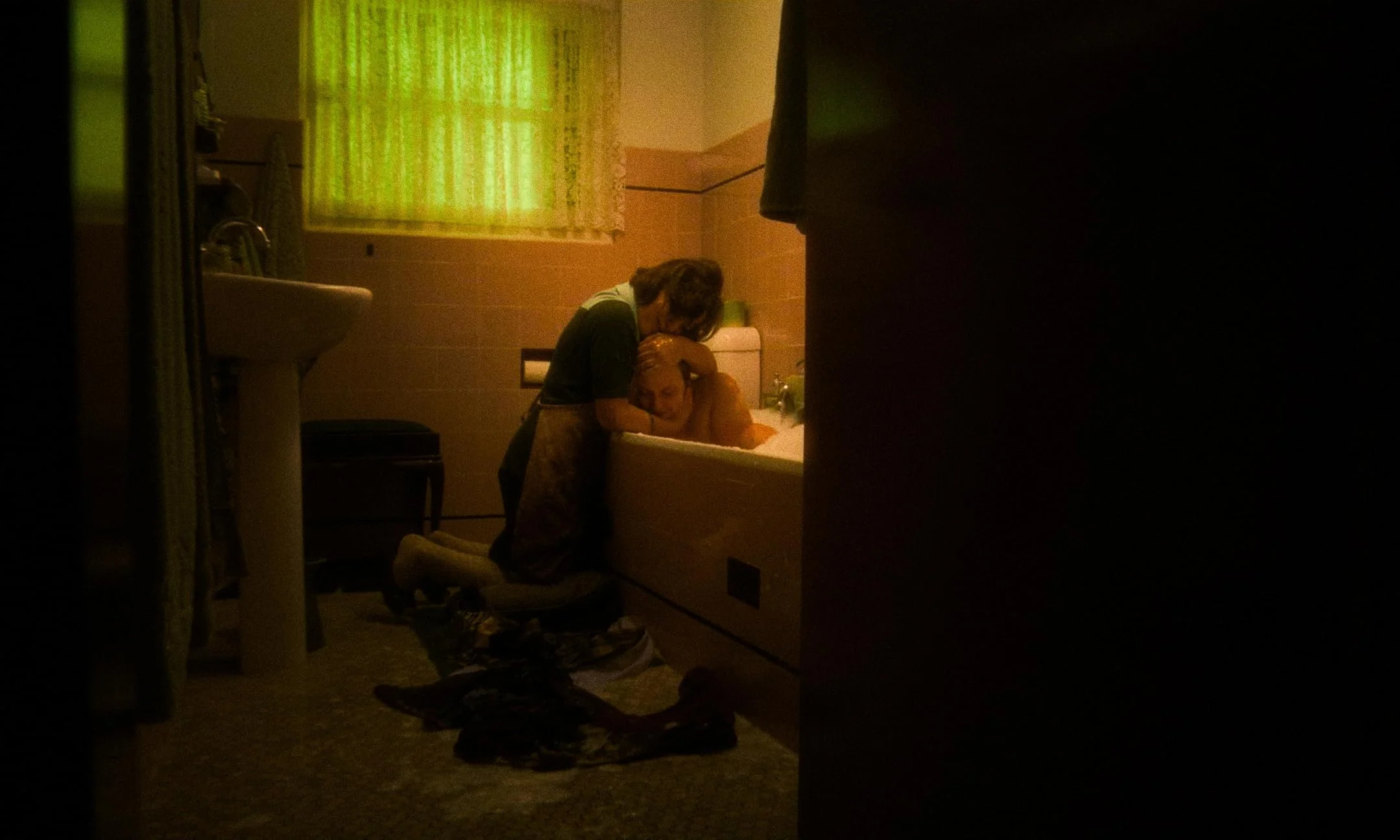
The film’s limited budget rarely feels like a restriction because Malfitano commits to texture instead of spectacle. Grainy imagery around the cooking-show material recalls older television, while saturated greens, yellows, purples, and reds push other scenes toward the heightened visual language of Italian giallo.
The smartest camera choice belongs to Mina’s unseen presence. When Mattia first arrives at Carol’s house, the camera observes her from an upper balcony. Later, it watches her bathing from down a hallway and through the bathroom entrance. These shots initially resemble the viewpoint of a ghost protecting her daughter. Hold them a little longer and they become invasive. That uncertainty does plenty of the horror work.
The body effects are used sparingly enough to retain their shock: damaged legs, bleeding cuticles, sudden hair loss, vomiting, seizures, levitation, and the impossible objects appearing inside food. Malfitano rarely treats them as isolated set pieces. They arrive inside kitchens, bathrooms, meals, and family gatherings, which makes the supernatural feel embedded in domestic life.
The film’s weakest stretch comes near the climax. After spending so much time building visual parallels between Mattia, Mina, and Carol, the final movement resolves several supernatural threads with less patience than the setup deserves. The mythology has enough density to support a longer reckoning, especially after the camera has spent so much time teaching us to question who is watching Mattia and why.
Still, the lingering image is not some elaborate exorcism. It is Mattia choking on her mother’s fig jam, briefly caught between wanting the past back and discovering that bringing it into the present carries a price.
Salt Along the Tongue made its digital and VOD debut via Yellow Veil Pictures on May 1, 2026, and is available to stream on platforms like AMC+ and Shudder. Directed by Parish Malfitano, the psychological horror film follows a grieving young woman who moves in with her late mother’s identical twin, only to find herself possessed by her dead mother through food as a shield against a dark presence.
Where to Watch Salt Along the Tongue (2024) Online










Full Credits
Title: Salt Along the Tongue
Distributor: Yellow Veil Pictures
Release date: May 1, 2026
Running time: 1 hour 53 minutes
Director: Parish Malfitano
Writers: Parish Malfitano
Producers and Executive Producers: Parish Malfitano, Alexandra Bourke
Cast: Laneikka Denne, Dina Panozzo, Mayu Iwasaki, Caroline Levien, Liz Lin, Olga Olshansky, Melissa Brattoni, Rita Kara
Director of Photography (Cinematographer): Steven Thacker
Editors: Parish Malfitano
The Review
Salt Along the Tongue
Parish Malfitano turns food, grief, and Italian superstition into a horror language that feels tactile and deeply personal. The fig-jam choking scene and the strand of hair pulled from Mattia’s mouth show how effectively the film transforms familiar acts of eating into channels for memory and possession. Laneikka Denne and Dina Panozzo keep the family conflict grounded while saturated lighting and prowling first-person camerawork give the supernatural material its bite. The rushed climax leaves several rich ideas underdeveloped, but the images linger.
PROS
- Inventive food-based horror
- Strong central performances
- Striking giallo-inspired cinematography
- Rich Italian-Australian cultural detail
- Memorable body-horror imagery
CONS
- Rushed final stretch
- Some mythology remains underexplored
- Limited traditional scares