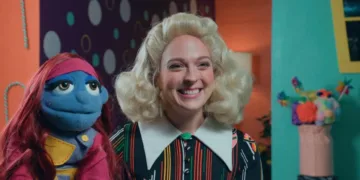










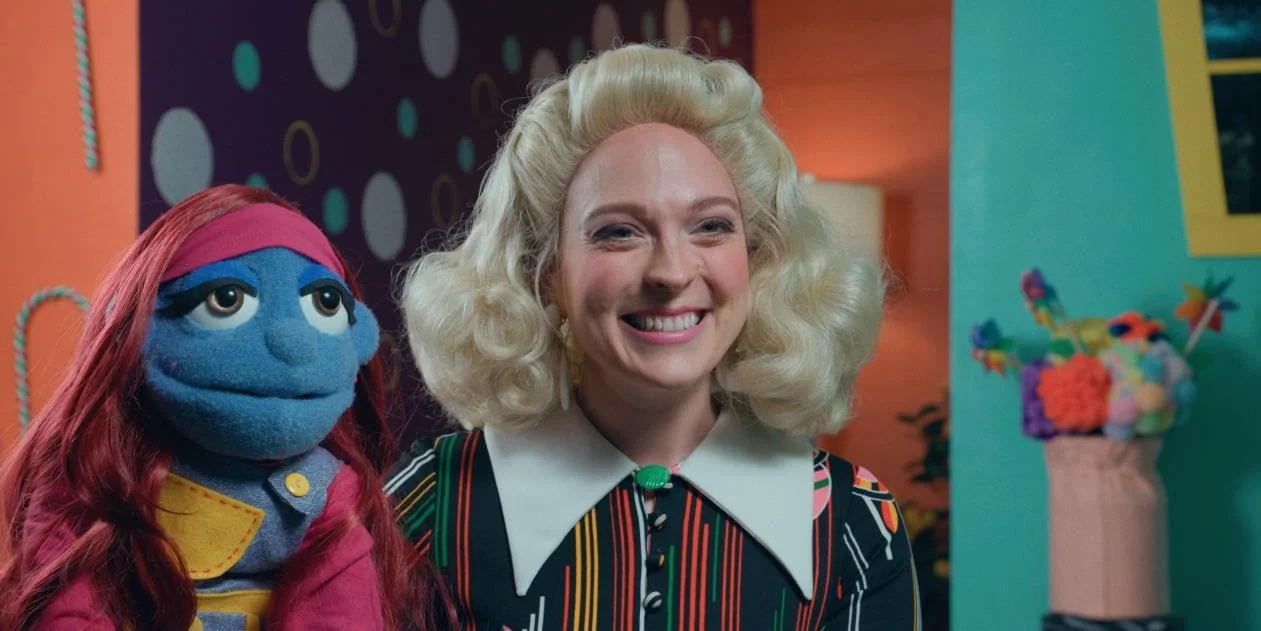

The smartest structural decision in The Fuzzies is also the one that exposes its biggest problem. Josh Funk and co-writer Dustin Vaught take the compact idea behind Funk’s 2020 short and build an entire mythology around it: former children’s TV host Shirley Drysdale, played by Gordy Cassel, dies under mysterious circumstances and leaves her secluded home to childhood friends Rose and Mick. Rose arrives with her girlfriend Mary, and what should be a weekend spent sorting Shirley’s possessions becomes an encounter with the murderous creations of The Sunny Smiles Show.
That setup gives Funk far richer material than a single trapped-room scenario. Shirley’s house can preserve decades of props, puppets, and memories, while Rose and Mick’s history with her provides an obvious path toward character drama.
The script takes too long to exploit either opportunity. Rose, Mick, and Mary spend stretches moving through rooms, cataloguing objects, and reacting to increasingly suspicious incidents without enough friction between them to sustain the pauses. The story has a sturdy spine. It simply keeps forgetting to put weight on it.
Felt, Blood, and Beautiful Bad Ideas
Funk’s direction becomes far more assured whenever the puppets take control. The creatures have the visual grammar of old children’s television: soft fabrics, broad smiles, crude shapes, and eyes designed to appear permanently delighted.
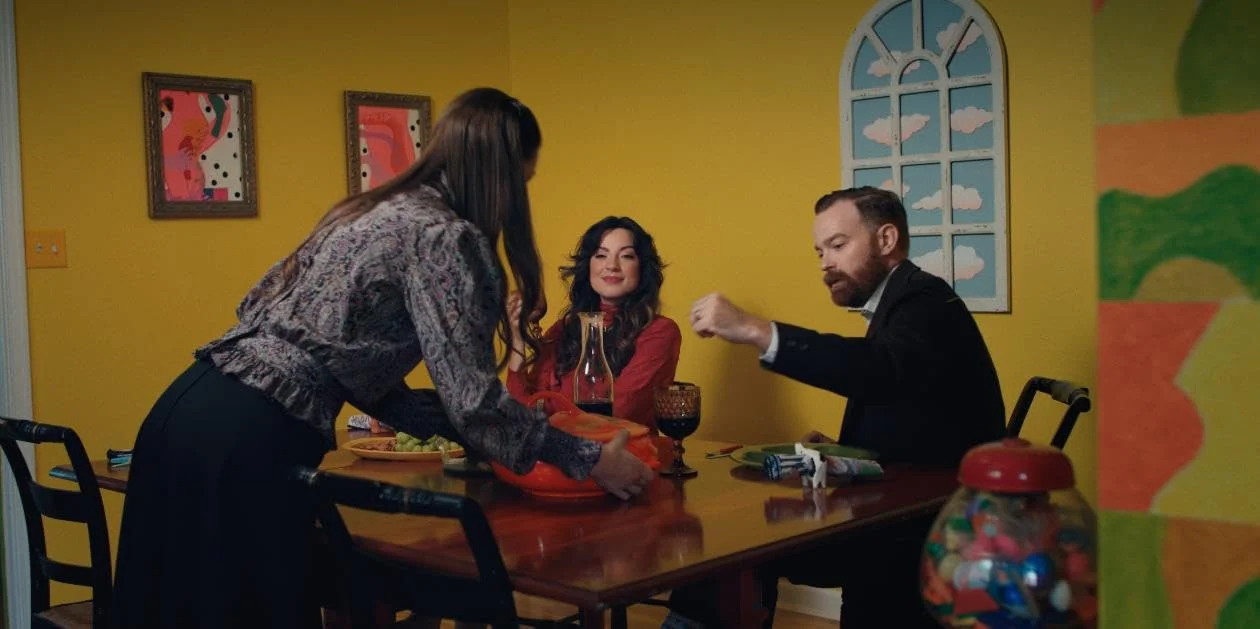
Placing them in threatening compositions does half the horror work before they even move. Funk frequently lets a puppet sit harmlessly in the background, then alters its position or sends it crawling into action once the audience has started treating it as decoration.
Also Read




The stop-motion is especially effective because it refuses smoothness. Movement arrives in jerks and skips, making the creatures feel handmade in a way digital animation would struggle to reproduce. That roughness becomes part of their personality.
One attack contains the film’s best visual joke. A character’s severed hands transform into felt replicas, complete with fuzzy blood spilling onto the floor. The gag is ridiculous, yet Funk stages it with enough conviction that the violence still lands. Human movement occasionally slips into the same stop-motion texture, suggesting that Shirley’s artificial world can physically rewrite anyone trapped inside it.
The estate gives those ideas room to spread. Bright colors, children’s-show props, eccentric rooms, and cheerful decorations make the house resemble a preserved TV set that nobody bothered to tell had been cancelled. Its isolation in the woods adds pressure without requiring elaborate geography. Doors, hallways, bathrooms, and display spaces can each become miniature stages for another puppet ambush. It is difficult to fear felt. Funk finds several convincing methods.
Nostalgia Starts Rotting
The film’s strongest thematic material comes from Shirley herself. Clips from The Sunny Smiles Show present the exaggerated grin and upbeat performance expected from a children’s host, yet Cassel lets discomfort creep through the polish. Her expression can look fractionally too fixed, as if the persona has continued after the person behind it has run out of reasons to smile.
That tension gives the puppets a purpose beyond creature design. Rose and Mick are returning to something they once associated with childhood comfort, only to discover that memory has preserved the surface and discarded the damage underneath. Shirley’s house functions in the same way. Everything looks lovingly maintained, yet the objects inside it have become hostile.
There is rich dramatic material here concerning friendship, fame, and the false safety of nostalgia. The screenplay only partially develops it. Rose and Mick share a past with Shirley, but their relationship seldom gains the specificity needed to make each revelation feel personal.
Mary is placed even further from the emotional history, which often leaves her functioning as another participant in the danger instead of an equal part of the drama. The result is an odd imbalance: the puppets have histories, visual identities, and behavioral quirks. Several humans receive less generous treatment.
The Feature-Length Problem
Expanding a successful short into a feature requires a new dramatic engine, not simply additional rooms for the original idea to enter. The Fuzzies occasionally looks caught between those two approaches. Its isolated sequences work beautifully. A puppet appears where it should not be. A harmless prop becomes threatening. A human body is converted into the visual language of children’s craft supplies. Each beat has a setup, escalation, and punchline.
The connective material is less precise. The mystery surrounding Shirley promises answers about her death, her television career, and the strange life of her creations, yet the film sometimes treats withholding information as a substitute for developing tension. Slow pacing can be useful in horror when every quiet stretch changes the audience’s understanding of a character or location. Here, some stretches simply postpone the next good creature sequence.
Funk does avoid an easier mistake. The horror-comedy never collapses into endless crude jokes or realistic splatter designed solely to shock. The handmade violence maintains a playful quality, and the brighter the environment becomes, the stranger the attacks feel. That tonal discipline keeps the film from turning its puppets into disposable punchlines. Whenever one of those fixed smiles emerges from the corner of a frame, the movie suddenly remembers exactly what kind of nightmare it wants to be.
The Fuzzies became available via video-on-demand platforms in May 2026. Directed by Josh Funk, the horror comedy follows a group of childhood friends who reunite at a secluded estate to mourn a peer, only to find themselves fighting for survival against grotesque puppets and sinister stop-motion creatures.
Where to Watch The Fuzzies (2025) Online








Full Credits
Title: The Fuzzies
Distributor: VOD / Amazon Prime Video
Release date: May 2026
Running time: 1 hour 27 minutes
Director: Josh Funk
Writers: Josh Funk, Dustin Vaught
Producers and Executive Producers: Josh Funk, Dustin Vaught, Baylee Toney
Cast: Rocío de la Grana, Baylee Toney, Dustin Vaught, Karen Leigh Sharp, Gordy Cassel, Seph Casani
The Review
The Fuzzies
The Fuzzies has a terrific visual imagination trapped inside a comparatively thin feature script. Josh Funk’s puppetry, stop-motion, felt gore, and cheerfully sinister production design keep finding inventive ways to corrupt children’s television imagery, especially when severed human hands become fuzzy props. Rose, Mick, and Mary are less developed, leaving stretches between attacks with too little dramatic pressure. The result feels like a short-film concept successfully expanded in craft, then stretched in story. The puppets earn their screen time. The humans occasionally seem to be borrowing theirs.
PROS
- Excellent practical puppetry
- Inventive stop-motion violence
- Memorable production design
- Strong horror-comedy balance
CONS
- Thin character development
- Sluggish narrative stretches
- Mystery lacks dramatic weight
- Human drama trails the creatures