






























Jim Bergerac talks about grief at an AA meeting while a woman is being murdered elsewhere on Jersey. The editing keeps moving between confession and violence, placing Damien Molony’s version of the detective inside a crime before he has officially returned to police work. Then Jim leaves the meeting, reaches for his hip flask and confirms what the scene has been quietly suggesting: recovery is currently something he can describe better than he can practice.
That immediately separates this six-part revival from the 1980s series starring John Nettles. The old Bergerac carried alcoholism in his history. This one is still losing arguments with the bottle six months after his wife’s death, sleeping in his car and watching his teenage daughter Kim move in with her grandmother because he cannot provide anything resembling stability.
The famous burgundy 1947 Triumph Roadster returns too, using the actual car associated with the earlier production, yet Jim is hardly roaring around Jersey in it. He sits in it, sleeps in it and stands beside it while it remains unusable. Nostalgia has rarely received such an efficient MOT failure.
Writer Toby Whithouse keeps enough familiar names and objects around to make the lineage clear, then changes their dramatic purpose. Even the classic theme is presented in a moodier form, dropping the jaunty associations for something better suited to this bruised interpretation. The revival’s first smart decision is refusing to pretend that getting Jim Bergerac back on the road should be easy.
Six Episodes, One Body
The biggest change concerns structure. Where the earlier show could move through individual mysteries, Season 1 spends all six episodes investigating the murder of Kate Wakefield, a young mother connected to one of Jersey’s wealthy families.
Jim is still on bereavement leave when he sees the case on the news and offers to return. His reasoning sounds plausible enough. He has extensive experience with violent crime, and police work might give him something useful to concentrate on. The trouble is that Jim has confused concentration with recovery.
Also Read






Kate was killed at the clifftop home connected to businessman Arthur Wakefield, played by Philip Glenister. Suspicion quickly spreads through the family. Arthur is imposing and guarded, his son Julien is withholding information, and Pippa Haywood’s Margaret clearly knows things she would prefer to keep private. Their secrecy gives the investigation enough fuel without making every furtive glance equivalent to a signed confession.
The stronger thread involves John Blakely. A decade earlier, Jim rescued an abducted victim and caught Blakely, earning a reputation for handling serious cases. Now Blakely has been released, and Jim becomes convinced that his old adversary may be connected to Kate’s death.
That history gives the fixation weight. Jim knows what Blakely is capable of, yet his certainty starts outrunning the evidence. Colleagues warn him away. He keeps going. A quality that once made Bergerac excellent at his job begins to resemble another dependency.
Stretching the murder across six hours helps here because Jim cannot simply solve something on Tuesday and arrive fresh for another corpse the following week. Every wrong assumption remains with him. Every suspect stays in circulation. A tabloid reporter, concealed Wakefield family business and other red herrings keep the guessing game moving without turning the mystery into a telephone directory of possible killers.
The plot still belongs comfortably beside Shetland, Vera, Ridley and plenty of other modern British crime dramas. Nobody has reinvented the fingerprint. The serialized format earns its keep by refusing to reset Jim along with the case.
Work Is Not Therapy
Molony has a difficult balancing act. Jim must look damaged enough that his colleagues are justified in questioning his return, yet capable enough that bringing him back makes sense. His best scenes find that balance through abrupt shifts in behavior. At the AA meeting, Jim can articulate pain with surprising delicacy. Around suspects, the softness disappears and his investigative instincts sharpen. With colleagues who challenge him, irritation comes quickly. Then Kim enters the room and the certainty drains away again.
Chloe Sweetlove’s Kim gives those scenes their sting. She has lost her mother and now has to watch her father behave like grief has granted him permission to become unreliable. Jim loves her, which makes his failures harder rather than easier to watch. He wants to resume being her father without completing any of the work that would make him dependable.
Police work offers him a convenient substitute. A murder has clues, interviews and suspects. Grief has none of those courtesies. Jim can chase Blakely across an investigation and call it persistence; sitting with Kim requires him to remain still long enough to hear what his behavior has done.
The series understands this distinction particularly well when Jim keeps prioritizing the case while insisting that solving it will somehow help repair his life. Kim sees the exchange taking place long before he does. One addiction has a hip flask. The other comes with a warrant card.
Molony never turns these contradictions into grand gestures. His Jim is at his most convincing when anger and desperation occupy the same scene, especially during moments when Kim needs a father and receives a detective instead. Being good at murder investigations is useful. It is a poor parenting strategy.
Charlie Has Had Enough
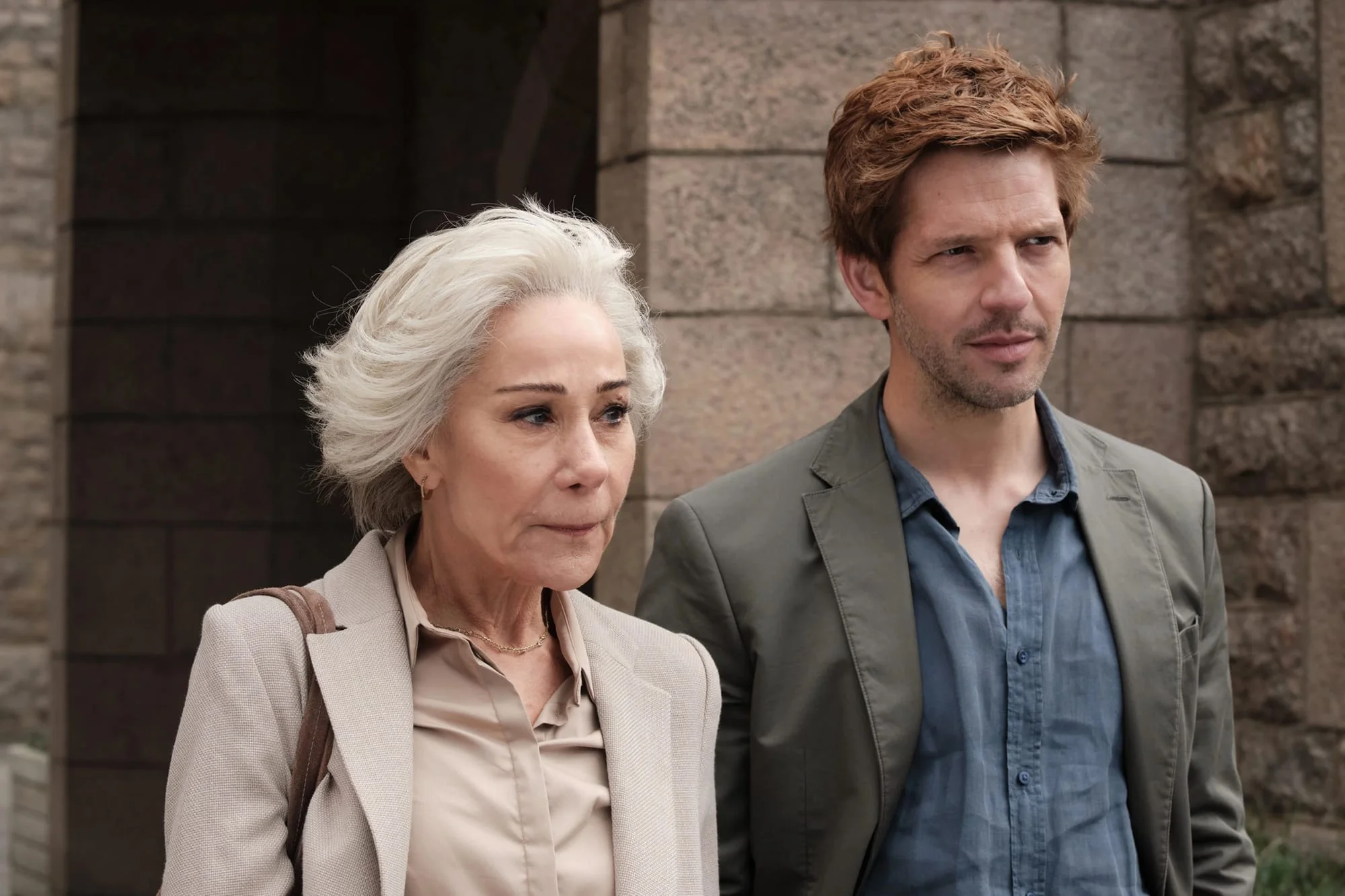
Zoë Wanamaker’s Charlie Hungerford is one of the revival’s sharper alterations. The original Charlie was Jim’s former father-in-law. Here, Charlie is his mother-in-law and the person currently offering Kim the stable home Jim cannot manage.
Wanamaker does not play her as a sentimental family mediator. When Jim asks if he can stay at her home, Charlie offers to “muck out one of the stables.” It is a brutal little line because Wanamaker gives it the weary rhythm of someone whose patience ran out several arguments ago.
Their relationship works because contempt never quite becomes the whole story. Charlie is furious with Jim, suspicious of his promises and protective of Kim, yet the three remain bound by the same bereavement. Jim drinks and works. Kim tries to create some kind of normal life. Charlie responds by becoming painfully practical.
Robert Gilbert’s Barney Crozier creates a different kind of friction. Crozier stepped into Jim’s position during his absence and has little enthusiasm for watching the celebrated detective wander back into the station and reclaim his old importance. He gives Jim menial assignments, interferes with his leads and repeatedly reminds him who currently has authority.
The rivalry has a solid dramatic purpose. Jim cannot return and immediately be treated like Jersey’s prodigal crime-solving prince. Gilbert gives Crozier enough insecurity to show why Bergerac’s presence bothers him.
The writing occasionally overplays it. Crozier can become so oily and obstructive that he feels less like a nervous colleague protecting his position and closer to the bloke whose desk drawer presumably contains a laminated certificate in workplace antagonism. Still, keeping Jim professionally frustrated prevents the series from granting him the recovery he thinks returning to work has already earned.
The Old Car, Different Engine
The revival handles its inheritance best when familiar details arrive with changed meanings. Charlie is still Charlie Hungerford, yet the gender and family relationship are different. Crozier remains part of Bergerac’s professional world, yet now functions as a rival. The Triumph is present, except Jim cannot properly use it.
Philip Glenister supplies an amusing historical connection too. He appeared briefly during the original show’s run and returns here decades later as Arthur Wakefield, one of the central figures in the murder investigation. The casting works without requiring anyone to recognize the footnote.
That approach matters because viewers coming to Bergerac fresh should not need an archaeological qualification in 1980s television. For them, the Roadster is simply Jim’s broken car. Charlie is simply his formidable mother-in-law. His alcoholism needs no previous version to explain it.
Older viewers get a second track running beneath those details. The sunny Jersey, weekly mysteries and recognizable iconography of the Nettles era have been passed through the current British crime-drama machine, where detectives tend to carry grief, therapy appointments and enough unresolved trauma to keep an HR department employed indefinitely.
There is some loss in that transformation. The revival has less of the breezy personality associated with its predecessor, and its damaged-cop framework hardly arrives untouched by decades of television precedent. Jim Bergerac now shares shelf space with a very crowded collection of brilliant investigators whose personal lives resemble insurance claims.
What saves the series from feeling like an old title pasted onto a standard crime drama is the care taken with those inherited pieces. Whithouse does not simply park the Triumph in frame so somebody can point at it. He makes its condition rhyme with Jim’s. The car can be repaired. Jim Bergerac spends six episodes finding out that people are less cooperative.
Bergerac premiered on U&Drama on February 27, 2025, and is available to stream on UKTV’s platform U. This modern reimagining of the classic detective series follows a troubled investigator on the island of Jersey as he battles personal demons while solving complex crimes.
Where to Watch Bergerac Season 1 Online

Full Credits
Title: Bergerac
Distributor: U&Drama, U
Release date: February 27, 2025
Rating: TV-MA
Running time: 60 minutes
Director: Colm McCarthy, Sean Spencer
Writers: Toby Whithouse, Brian Fillis, Polly Buckle, Catherine Tregenna
Producers and Executive Producers: Camilla Campbell, Jonathan Fisher, Toby Whithouse, Brian Clark
Cast: Damien Molony, Zoë Wanamaker, Philip Glenister, Robert Gilbert, Sasha Behar, Celine Arden, Luke Nunn, Pippa Haywood
Director of Photography (Cinematographer): Matt Gray
Editors: Crispin Green, Dominic Strevens
Composer: Ruth Barrett
The Review
Bergerac Season 1
Bergerac finds its footing by treating Jim’s return to police work as another symptom of his collapse. The AA meeting, the hip flask, the broken Triumph and his repeated failures with Kim give Damien Molony plenty to work with, while the six-episode murder lets his fixation become increasingly dangerous. Zoë Wanamaker gives Charlie the sharpest dialogue, and the Wakefield case keeps suspicion moving effectively. Barney Crozier occasionally feels drawn with a marker pen rather than a pencil, but this darker reinvention earns its badge.
PROS
- Damien Molony’s layered performance
- Strong Jim and Kim relationship
- Excellent Zoë Wanamaker
- Effective season-long mystery
- Smart use of legacy elements
CONS
- Crozier can feel cartoonish
- Familiar damaged-detective territory
- Some red herrings feel functional
- Darker tone loses some old-series charm