










Anna speaks to Maxim Bortnikov with a composure his circumstances hardly encourage. His spacesuit is failing, debris keeps obstructing his return to safety, and her guidance provides both a practical way forward and someone to listen to. Voiced by Anna Chipovskaya, the artificial intelligence in Oleg Urazaykin’s Free Fall makes technical instruction sound companionable. Their exchanges draw intimacy from an unequal arrangement: Maxim urgently needs help, and Anna gets to describe what help should involve.
Maxim’s occasional refusal to follow her advice prevents reassurance from settling into easy trust. He needs her competence without always accepting her direction, a distinction that gives their exchanges some human abrasion. The constant conversation has a less productive consequence, however: it leaves little room for isolation to register as silence. Space is immense and hostile, yet the communications link keeps filling it. The film gains a relationship while surrendering some of the desolation its premise promises.
Urazaykin establishes that predicament with brisk impatience. A solar flare unleashes a proton storm during maintenance outside the orbital station Delta, leaving Maxim stranded amid an expanding disaster. The opening allows little time to understand the surroundings before they begin coming apart.
That abruptness initially makes the action difficult to enter, though an extended explanation of station operations would hardly improve matters. The familiar space-survival premise supplies enough orientation to proceed. What requires attention is the relationship between a mechanic trying to keep his body alive and an intelligence that can interpret dangers he cannot safely navigate alone.
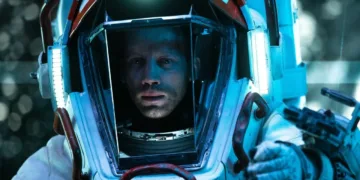
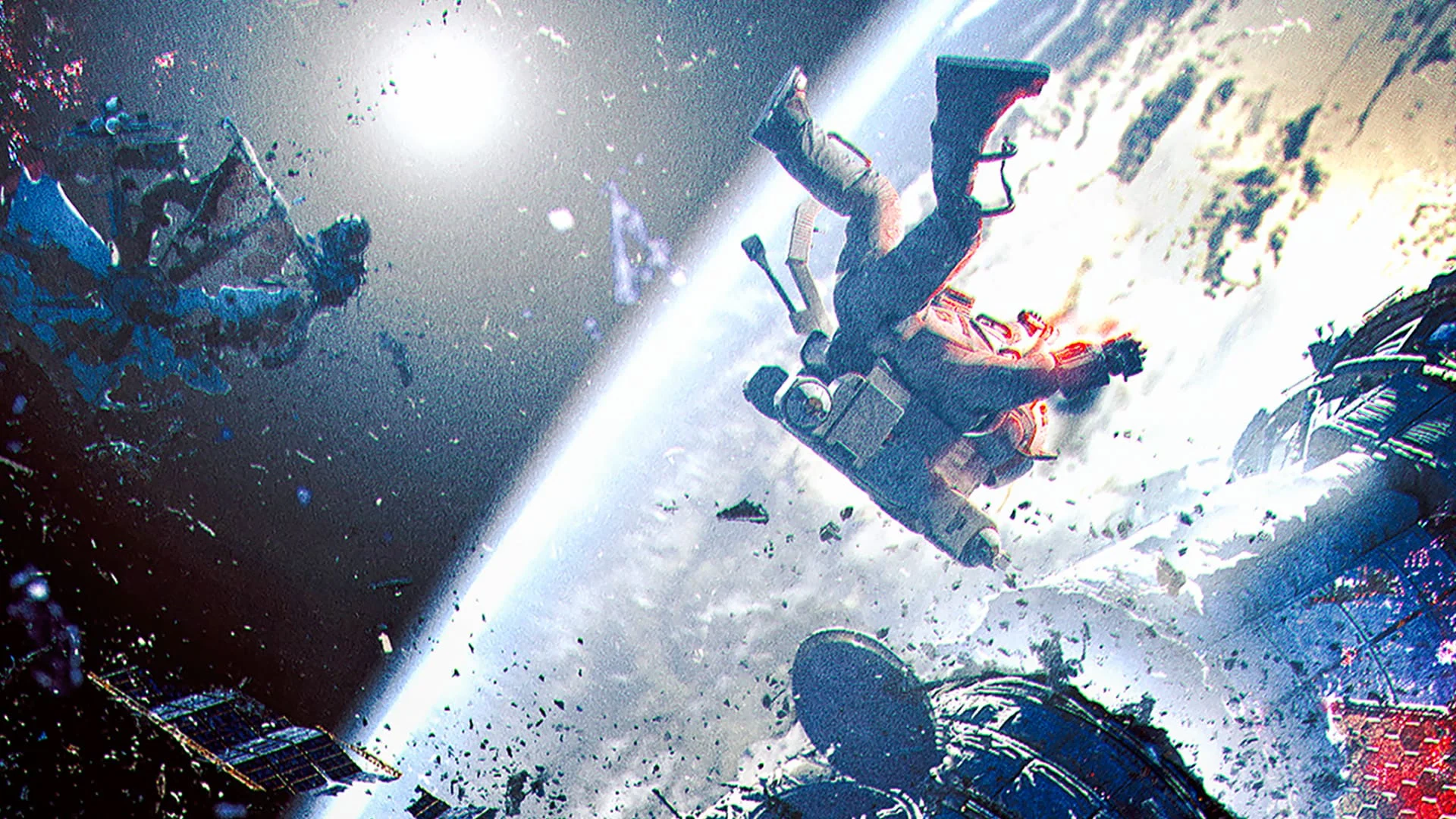
The spacesuit gives this dependence a persuasive physical form. It is shelter, transport, life support, and an increasingly unreliable enclosure. Shrapnel penetrates it; radiation scorches Maxim; coolant floods the equipment meant to protect him. Each assault brings the scale of the catastrophe down to something painfully local.
The void becomes frightening through what can happen inside a small manufactured boundary. Even the freedom to move is compromised when rotation turns his body into another object carried through the wreckage. The film is most effective when survival means restoring some basic control over that body.
Aleksandr Kuznetsov makes the restricted role credible without having much room to make Maxim distinctive. His face is intermittently visible, and the performance must communicate through exertion, alarm, frustrated responses, and the stubborn resumption of practical work.
He gives the ordeal enough physical conviction to sustain immediate concern. The screenplay offers fewer opportunities for that concern to become knowledge of a person. Maxim’s resistance to Anna helps because it introduces judgment into a role otherwise occupied by reacting. Those exchanges suggest a temperament more effectively than another impact or malfunction can.
The surrounding spectacle is exuberantly busy. Crowded information panels, mechanical equipment, bright orbital structures, and proliferating debris give this future a dense, industrial texture. Space has become a workplace with too many moving parts. Dynamic camera movement and extended shots carry Maxim through that congestion, making the environment feel capable of swallowing him.
The images also have limits: uncertain scale and overloaded compositions sometimes obscure the distances and routes on which suspense depends. Disorientation can communicate panic, but it becomes less useful when the viewer cannot understand what a successful maneuver would accomplish.
Sound reinforces the sense that Maxim experiences his surroundings through machinery. Electronic signals and distorted movement effects keep the technological environment active around him, while the restrained score becomes more prominent under pressure.
Anna’s voice belongs to that same environment, yet its soothing delivery gives it an apparent closeness the other signals lack. The distinction matters. A warning can report a problem; a voice can make the report feel like concern. Chipovskaya supplies the film with a persuasive version of that comfort without requiring a visible companion.
Across approximately 81 minutes, the action proceeds through instructions, attempted solutions, and renewed emergencies. Control the rotation, manipulate the equipment, find a passage through the debris, contend with the next failure. The resemblance to a game lies in this organization of attention. Each objective is immediately legible even when the wider situation is confused.
Deteriorating equipment also gives repetition a useful cumulative force: Maxim has fewer resources with which to meet the next demand. Yet the structure grows wearying when a completed task produces little beyond permission to begin another. Physical escalation cannot indefinitely substitute for a changing relationship or a consequential decision.
That limitation becomes more pronounced as the stakes extend beyond Maxim to other lives and a larger catastrophe. His threatened body has been made tangible through repeated damage; the people elsewhere remain comparatively abstract. Expanding the number of lives at risk does not automatically expand the drama.
The film needs those wider responsibilities to complicate the relationship it has built between the person suffering and the intelligence directing him. Instead, urgency frequently carries the discussion past the point where a difficult choice might acquire emotional weight.
The late attention to Anna’s self-awareness brings an ethical dimension into clearer view, but gives it little time to develop. Earlier friction has supplied a foundation: reassurance can coexist with mistrust, and useful guidance does not settle every question about the guide’s authority. Maxim has spent much of the film needing Anna to tell him how to proceed. Her ability to explain a procedure tells him considerably less about how she should weigh the life of the person carrying it out.
Free Fall arrives on digital and VOD platforms on October 27, 2026. Directed by Oleh Urazhaikin, the sci-fi space thriller follows an astronaut stranded in orbit with a damaged suit and dwindling oxygen, whose only lifeline is a voice on the radio.
Full Credits
Title: Free Fall (Russian: Svobodnoe padenie)
Distributor: Epic Pictures Group
Release date: October 27, 2026 (Digital / VOD)
Running time: 1 hour 21 minutes (81 minutes)
Director: Oleh Urazhaikin
Producers and Executive Producers: Not publicly specified
Cast: Alexander Kuznetsov, Anna Chipovskaya
Director of Photography (Cinematographer): Fyodor Rias
The Review
Free Fall
Free Fall makes technological dependence physically frightening and emotionally intimate. Kuznetsov gives its battered mechanic conviction, while Chipovskaya’s reassuring voice lends instruction the texture of care. The dense orbital spectacle sustains immediate suspense, though repeated objectives gradually exhaust the drama. Its questions about trust and authority deserve more development than the hurried finale allows. Surviving the next malfunction remains more compelling than the film’s attempt to decide what survival means.
PROS
- Tangible suspense built around a deteriorating spacesuit.
- Chipovskaya’s soothing, quietly authoritative voice performance.
- Vivid industrial imagery and convincing physical strain.
CONS
- Repeated objectives yield diminishing dramatic returns.
- Crowded compositions sometimes obscure spatial relationships.
- Anna’s late ethical development receives insufficient time.