




























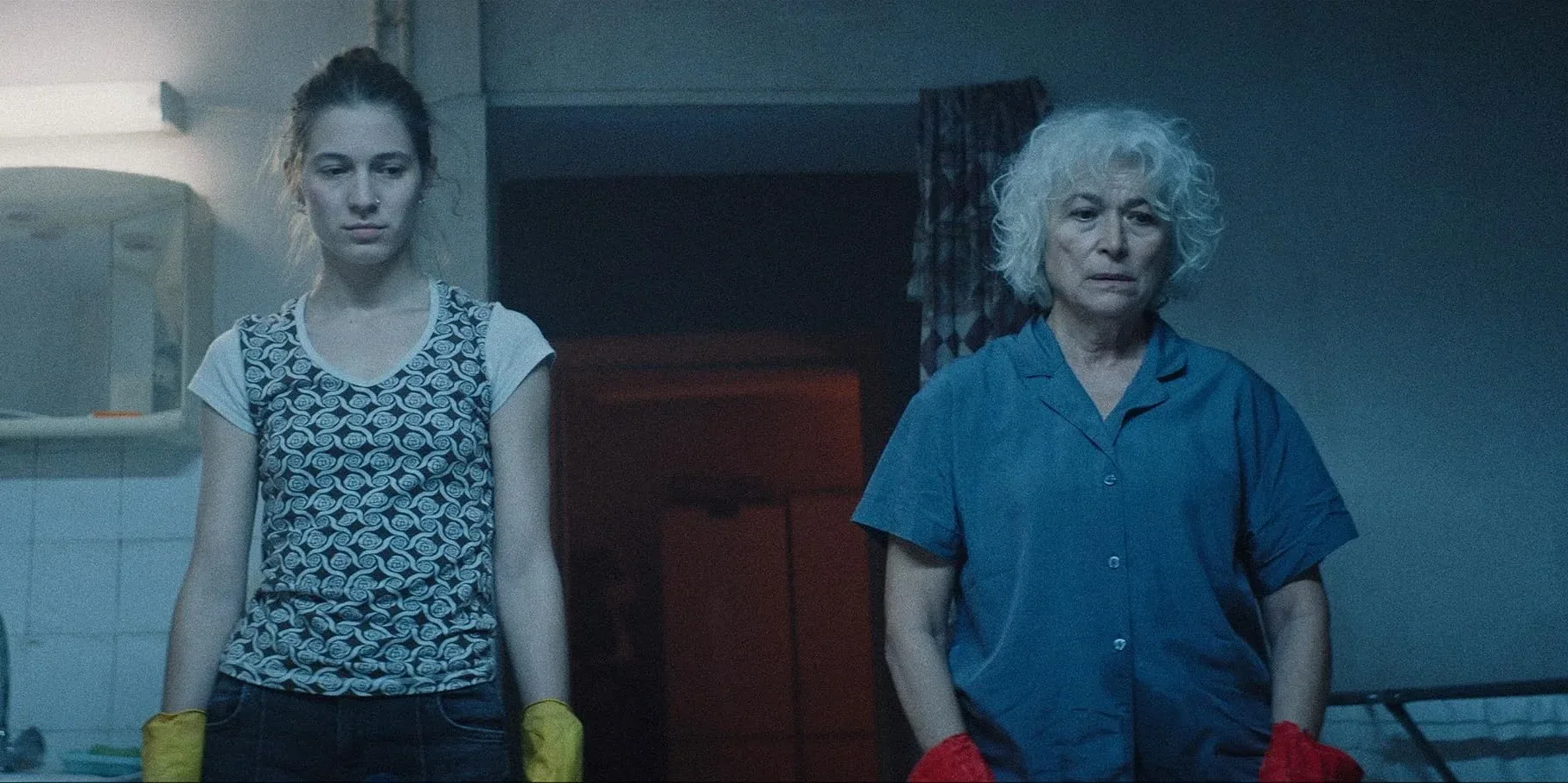

Freedom arrives for Vangelio in the least cinematic manner possible: her bedridden husband dies, and the woman who spent years feeding, cleaning and enduring him suddenly has nowhere she is required to be. Evangelia Andreadaki plays the immediate aftermath without the emotional punctuation a lesser film might demand. Grief is present, relief is present, resentment certainly has not gone anywhere. None of them wins.
Her sons offer little clarity. Yannis criticizes her with the confidence of someone who has inherited a family narrative without examining who wrote it, while Kyriakos proves somewhat more protective. Vangelio leaves Athens anyway, following an old desire for the sea to an off-season resort on Evia.
There she meets 23-year-old Vicky, played by Christiana Matelska Toka, who runs a shabby hotel and taverna under the eye of her alcoholic father, The American. Vangelio has escaped one abusive household and, with almost cosmic bad luck, booked herself into another. Call it the obedience afterimage: the authority figure disappears, yet the habits built around him remain visible.
Recognition Before Rebellion
The film becomes much sharper once Vangelio begins recognizing those habits in Vicky. The younger woman can be abrasive and outwardly resilient, then shrink almost imperceptibly when her father starts drinking and insulting her. His violence has become community furniture. Everyone knows where it is. Nobody moves it.
That complicity becomes explicit when the local police prove useless, socially bound to The American through friendship and family. Vicky therefore faces a particularly cruel version of captivity. The mechanisms supposedly available to rescue her belong to the same social structure protecting her father.
Alexis Alexiou and co-writer Afroditi Nikolaidou wisely build the connection between the women through ordinary encounters. Vangelio accompanies Vicky to buy a swimsuit. They fish. They trade pieces of their histories. In one of the gentlest moments, Vicky dances freely with another woman at a bar while Vangelio watches her. Andreadaki’s expression carries an unusual mixture of affection and recognition. She is watching a young woman briefly occupy a life without permission.
Also Read






I initially wondered if the generational mirroring was becoming too neat. Then The American’s escalating violence makes the difference between the women clearer. Vangelio has spent decades adapting to submission. Vicky still believes escape exists somewhere beyond the town, yet responsibility toward her father keeps pulling her back.
Toka makes that contradiction physical. Her posture around Vangelio loosens. Around her father, toughness turns defensive. Andreadaki works from the opposite direction, keeping years of anger compressed until intervention becomes unavoidable.
The Sea Does Not Promise Rescue
Evia should look like freedom. Simos Sarketzis photographs it like evidence. The resort is stripped of its summer identity by March weather. Empty beaches, shuttered businesses, marshland and worn buildings create a Mediterranean landscape without the Mediterranean fantasy. Water surrounds Vangelio and Vicky, roads lead outward, horizons remain visible. Movement seems available everywhere. Psychologically, both women remain stuck.
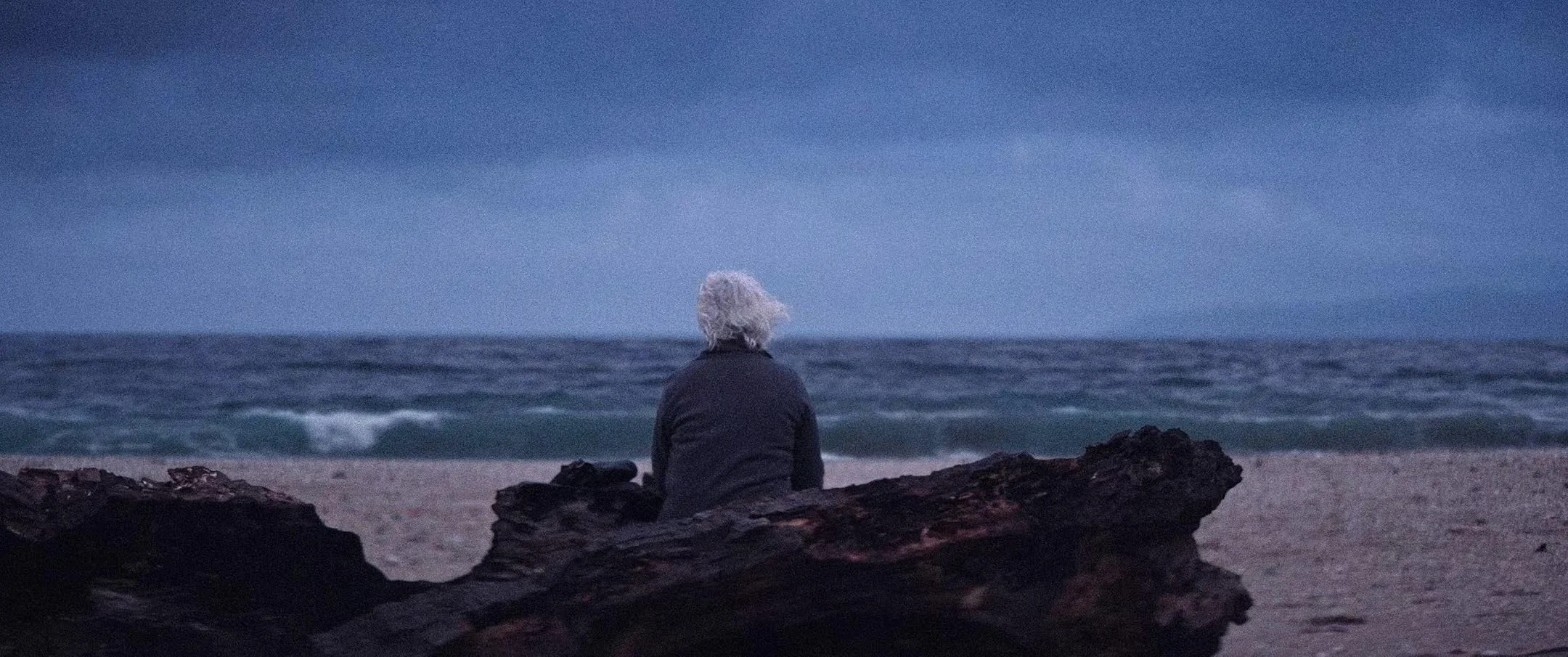
This is where Sea of Glass finds its strongest visual argument. The faded blues, greens and muddy browns make the coastline resemble glass worn down by years of contact with the tide. Flood-scarred terrain gives the setting the same quality Andreadaki gives Vangelio: damage has become part of the surface.
The title sharpens that relationship. Vangelio describes the sea as a mirror of broken glass, silent until one listens closely enough to hear it. Reflection becomes literal and thematic. Vangelio looks at Vicky and encounters an earlier version of her own captivity. Vicky looks at Vangelio and sees what endurance can become after several decades.
Maybe the sea symbolizes cleansing. That reading is available. I think Alexiou makes it less comforting than that. Water surrounds people who cannot wash history off themselves.
The sound design supports the idea beautifully. Wind and water reverberate through the nearly empty hotel, while Lefteris Moumtzis occasionally introduces synth tones that make the environment feel slightly detached from reality. Silence frequently carries the heavier burden. The film knows when a room should sound abandoned.
When the Slow Burn Catches Fire
Alexiou makes his influences easy enough to identify. The female alliance and eventual flight invite comparisons with Thelma & Louise. The isolated hotel, threatening men and accumulating violence belong comfortably to neo-noir. Family obligation, retaliation and irreversible consequence carry the shape of Greek tragedy.
Yet Sea of Glass is strongest when those traditions become local rather than decorative. The American’s power does not come from criminal sophistication. It comes from provincial familiarity. He drinks with the men who might otherwise restrain him. His violence persists because the town has absorbed it into normal social life.
The film takes roughly 130 minutes to tighten that trap, and patience occasionally becomes inertia. Vangelio’s arrival, Vicky’s routines and the repetition of her father’s cruelty establish the environment thoroughly, sometimes after the point has already landed. Then the narrative accelerates.
Once violence forces the women from passive recognition toward action, locations change, consequences multiply and Alexiou shifts closer to the road movie promised by his genre references. Strangely, the film becomes hurried precisely when its earlier deliberateness would be most useful. Several later developments need the breathing room granted so generously to the setup. Still, the imbalance exposes something fittingly uncomfortable. Physical escape happens quickly. Psychological escape does not.
Vangelio can leave her husband, Athens and eventually the hotel, yet the rules of her old life remain lodged inside her. Vicky faces the same problem from the opposite end of adulthood. Their alliance matters because neither woman rescues the other in any clean heroic sense. Each simply makes the other’s prison visible. Sometimes seeing the walls is the first genuinely dangerous act.
Sea of Glass world premiered at the Edinburgh International Film Festival on August 16, 2026. The country noir road movie follows two women in an off-season Greek seaside resort who form an unexpected alliance to confront their pasts and escape domestic oppression.
Full Credits
Title: Sea of Glass
Distributor: Weird Wave
Release date: August 16, 2026 (Edinburgh International Film Festival)
Director: Alexis Alexiou
Writers: Alexis Alexiou, Afroditi Nikolaidou
Producers and Executive Producers: Alexis Alexiou, Afroditi Nikolaidou, Tonia Mishiali, Victoria Mitreva, Elina Psykou, Vanya Rainova
Cast: Evangelia Andreadaki, Christiana Matelska Toka, Michalis Iatropoulos, Nikos Georgakis, Thanos Tokakis
Director of Photography (Cinematographer): Simos Sarketzis
The Review
Sea of Glass
Sea of Glass understands that leaving a cage and becoming free are separate events. Vangelio can travel to Evia after her husband dies, yet decades of obedience travel with her (trauma has excellent luggage). Her bond with Vicky gives Alexis Alexiou’s neo-noir its sharpest idea: abuse survives by teaching its victims to confuse obligation with love. Evangelia Andreadaki and Christiana Matelska Toka make that recognition painful and tender, while Simos Sarketzis turns the cold coastline into psychological territory. The 130-minute slow burn occasionally stalls, then the final act rushes where patience was needed.
PROS
- Andreadaki’s restrained performance
- Strong Vangelio-Vicky chemistry
- Haunting off-season Evia imagery
- Precise use of silence and water
- Rich ideas about inherited captivity
CONS
- Overextended early pacing
- Hurried final act
- Familiar neo-noir reference points