























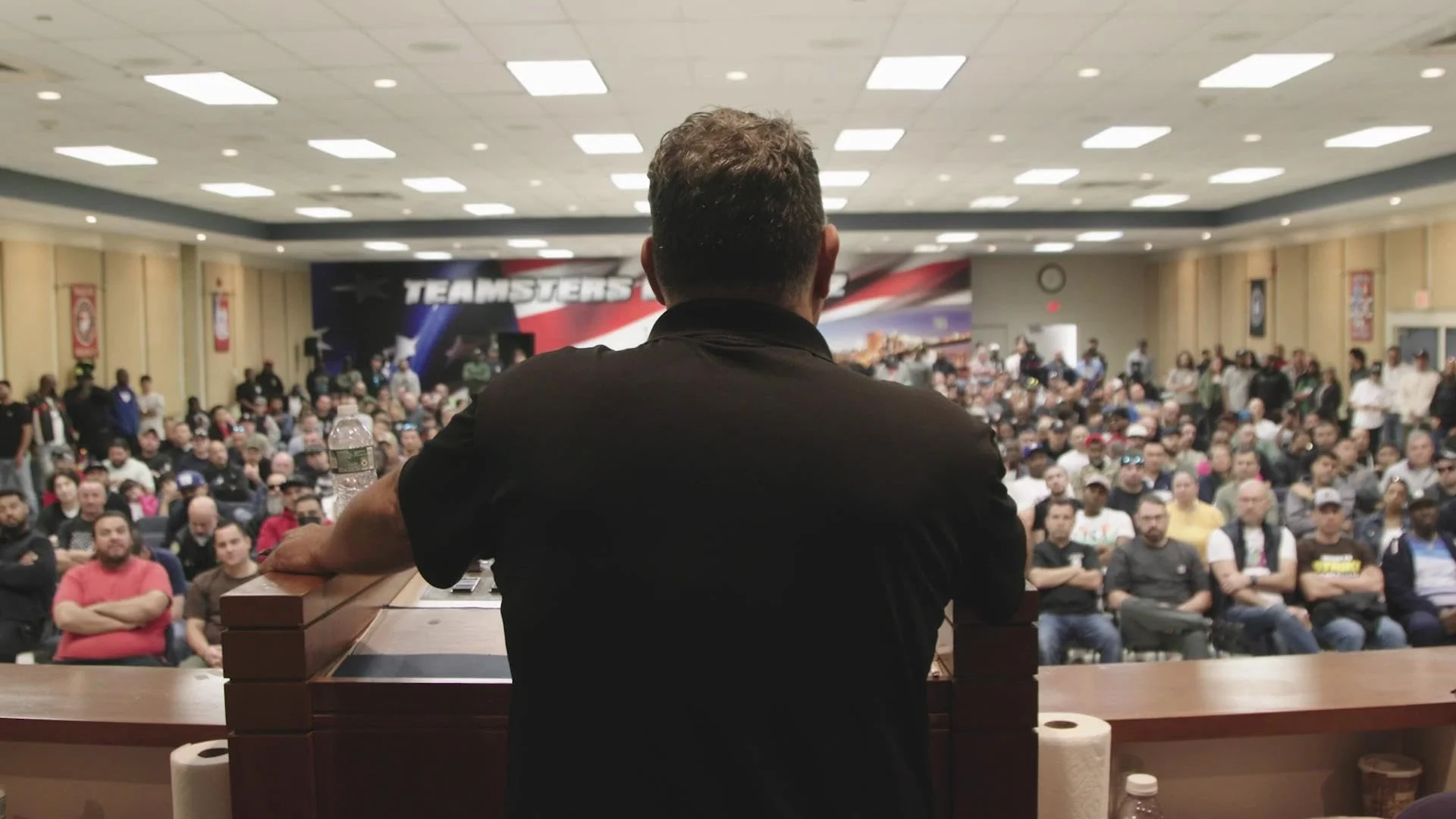

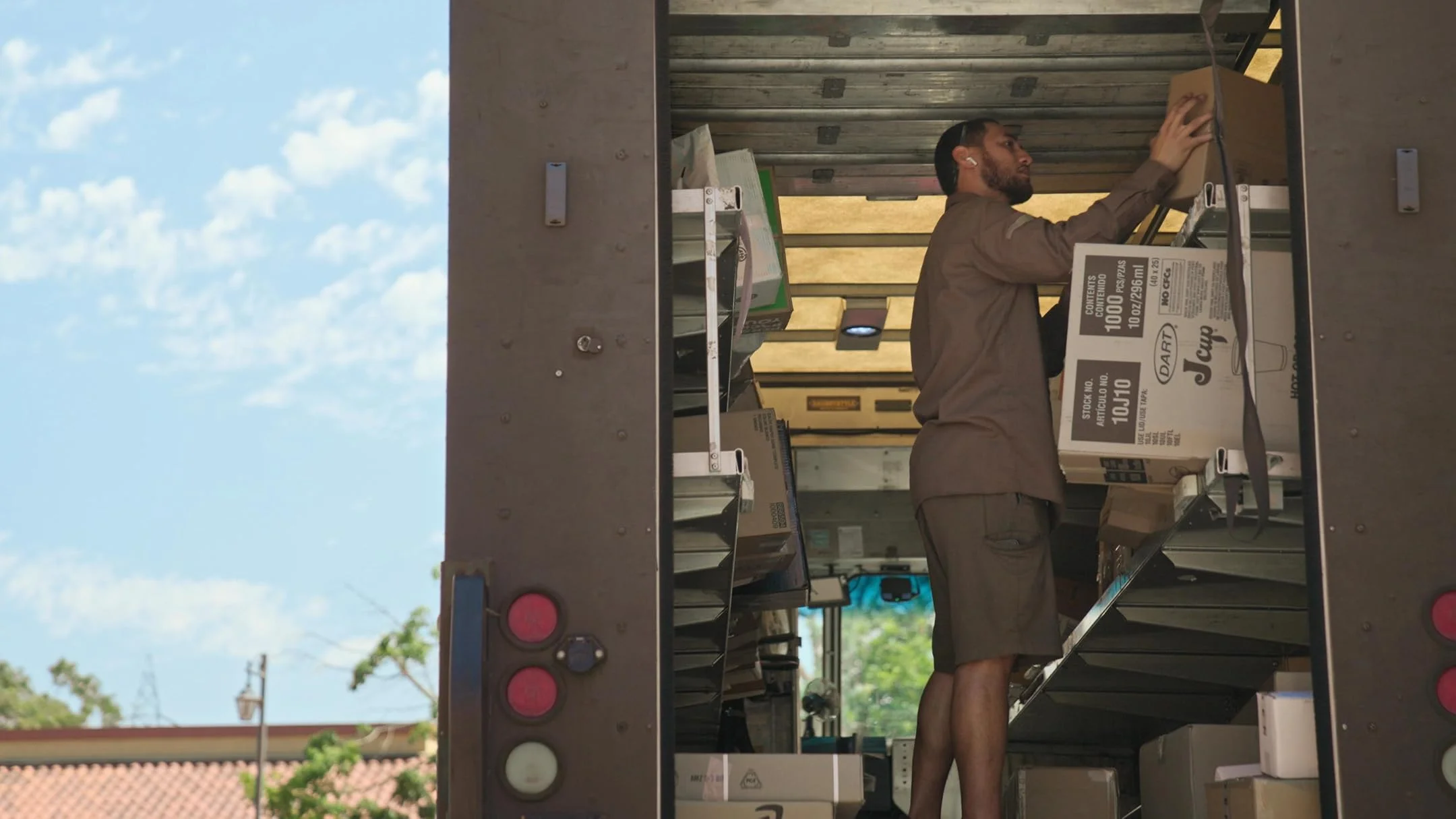
Yael Bridge turns contract negotiations into suspense without pretending the result is a mystery. Who Moves America follows UPS workers during the six months before their 2023 Teamsters contract expired, when roughly 340,000 employees were prepared to strike if bargaining failed. Bridge keeps the camera near the warehouse floor, local union halls, organizing sessions, and conversations where workers calculate what a walkout might cost them.
The issues are practical before they become political. Drivers talk about working in trucks without air conditioning. Part-time employees question how much a new agreement will improve their pay. Parents discuss child care and the financial danger of missing a paycheck. The film gains its energy from watching those concerns collide with the demand for collective action.
Bridge shoots much of this material observationally, skipping the usual procession of explanatory interviews. That choice makes the organizing feel immediate. It also means viewers learn how the union functions alongside some of the workers.
Learning the Meaning of a Union
One of the film’s sharpest moments comes when Louisville employees Nailah Webber and Angel Badu drive past a Teamsters office. Webber admits she has passed the building many times without knowing what happened inside. The remark quietly exposes one of the organizers’ biggest problems. Membership does not automatically create institutional memory.
Bridge reinforces that gap with archival material from the 1997 UPS strike. Many employees involved in the 2023 negotiations were children then, or had not been born. The older labor victory exists almost like inherited folklore, something organizers must translate into present-day stakes before asking workers to risk their income.
That becomes harder because the workforce is hardly uniform. Webber and Badu, working part time, may receive smaller gains than full-time drivers. Their reasons for supporting a strike cannot simply mirror those of workers higher on the pay ladder.
Justin Alo, a full-time driver in San Marcos, California, offers the other side of that equation. He understands that UPS remains a comparatively desirable delivery job partly because earlier union members fought for stronger conditions. His organizing work carries an awareness that a contract can benefit workers who have not arrived yet.
Bridge finds a wonderfully strange visual detail during one of these conversations: employees meet in a coffee shop where robots deliver plates. She does not underline the image with narration. She does not need to. A discussion about protecting labor happens while automation quietly rolls past the table.
Access Creates the Tension
Bridge’s access is the film’s greatest filmmaking asset. Her camera enters UPS warehouses, Teamsters meetings, organizing sessions, and preparations for picketing. Instead of hearing workers later explain how stressed they were, we watch them argue about money, family responsibilities, bargaining demands, and the consequences of voting no.
Editors Thomas Niles and consulting editor Viridiana Lieberman shape those months into a steady tightening of pressure. Meetings that could easily become procedural footage gain momentum because each one moves the workforce closer to the contract deadline. A familiar historical outcome still carries tension because the film concentrates on decisions made before anyone in the room knows how negotiations will end.
The same method creates the documentary’s clearest limitation. UPS leadership remains largely outside the frame, and formal bargaining sessions are mostly inaccessible. Teamsters president Sean O’Brien becomes visible closer to the final stretch, yet national leadership receives far less attention than local workers.
That imbalance keeps the perspective firmly with the rank and file, which suits Bridge’s interest in organizing from below. It also leaves parts of the corporate strategy underdeveloped. We see how workers interpret UPS’s position far better than we see how executives construct it.
Bridge also gives relatively little biographical history to individual subjects. That protects the collective focus, though a few workers can feel briefly sketched when their personal financial fears enter the discussion. The camera knows them primarily through the fight.
What Collective Power Looks Like
The strongest stretch of Who Moves America tracks the movement from organizing to decision. Workers prepare picket lines, distribute resources, attend meetings, debate proposed terms, and consider rejecting agreements that fail to satisfy enough of the membership. Solidarity here is messy labor of its own.
That distinction matters. Bridge avoids presenting a union as a machine where everyone automatically agrees. Part-time and full-time employees want different things. Some fear missing wages. Others worry about accepting too little. Organizers have to persuade people who may gain unevenly from the same contract.
Near the end, one worker describes the relief that arrives after the new five-year agreement is approved. He says a huge burden has lifted and that he can finally sleep properly. After months of numbers, votes, deadlines, and bargaining language, that simple admission gives the victory its clearest human scale.
The film’s political argument sits inside that exhaustion. Collective bargaining requires workers to consider conditions they may never personally enjoy, just as the benefits Justin Alo inherited came from employees who fought decades earlier.
Bridge makes that transfer of memory visible, from the 1997 strike footage to younger workers learning what their union can actually do. That is where Who Moves America is most persuasive. A contract may have an expiration date. The work of teaching people why collective power matters does not.
Who Moves America premiered at the True/False Film Festival on March 6, 2026, before arriving in theaters via 8 Above. The documentary follows UPS workers across the United States as they build solidarity and navigate tense contract negotiations ahead of a potential historic strike.
Full Credits
Title: Who Moves America
Distributor: 8 Above
Release date: March 6, 2026 (True/False Film Festival) / September 9, 2026 (Theatrical)
Running time: 1 hour 27 minutes
Director: Yael Bridge
Writers: Yael Bridge
Producers and Executive Producers: Yael Bridge, Jeremy Flood, Yoni Golijov, Mars Verrone, Steven Bognar, Astra Taylor, Carrie Lozano
Cast: Sean O’Brien, Justin Alo, Antoine Andrews, Angel Badu, Antonio Rosario, Nailah Weller
Director of Photography (Cinematographer): Erick Stoll
Editors: Thomas Niles
Composer: Osei Essed, Santiago Arias-Rozo
The Review
Who Moves America
Who Moves America finds suspense in a labor fight whose outcome many viewers already know. Yael Bridge’s observational access makes union meetings, warehouse conversations, and strike preparation feel immediate, while workers such as Nailah Webber, Angel Badu, and Justin Alo give the contract dispute a human scale. The film’s limited access to UPS leadership narrows the picture, yet its focus on rank-and-file organizing proves persuasive. What sticks is the patient demonstration of solidarity as work: learning, arguing, risking, voting, and refusing to let memory disappear.
PROS
- Remarkable workplace access
- Strong rank-and-file perspective
- Effective 1997 strike context
- Tense editing around negotiations
- Clear focus on solidarity
CONS
- Limited UPS leadership perspective
- Sparse worker backstories
- Narrower scope than the subject allows