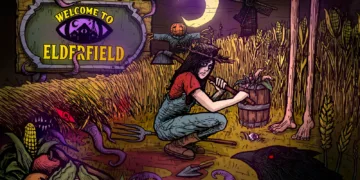





















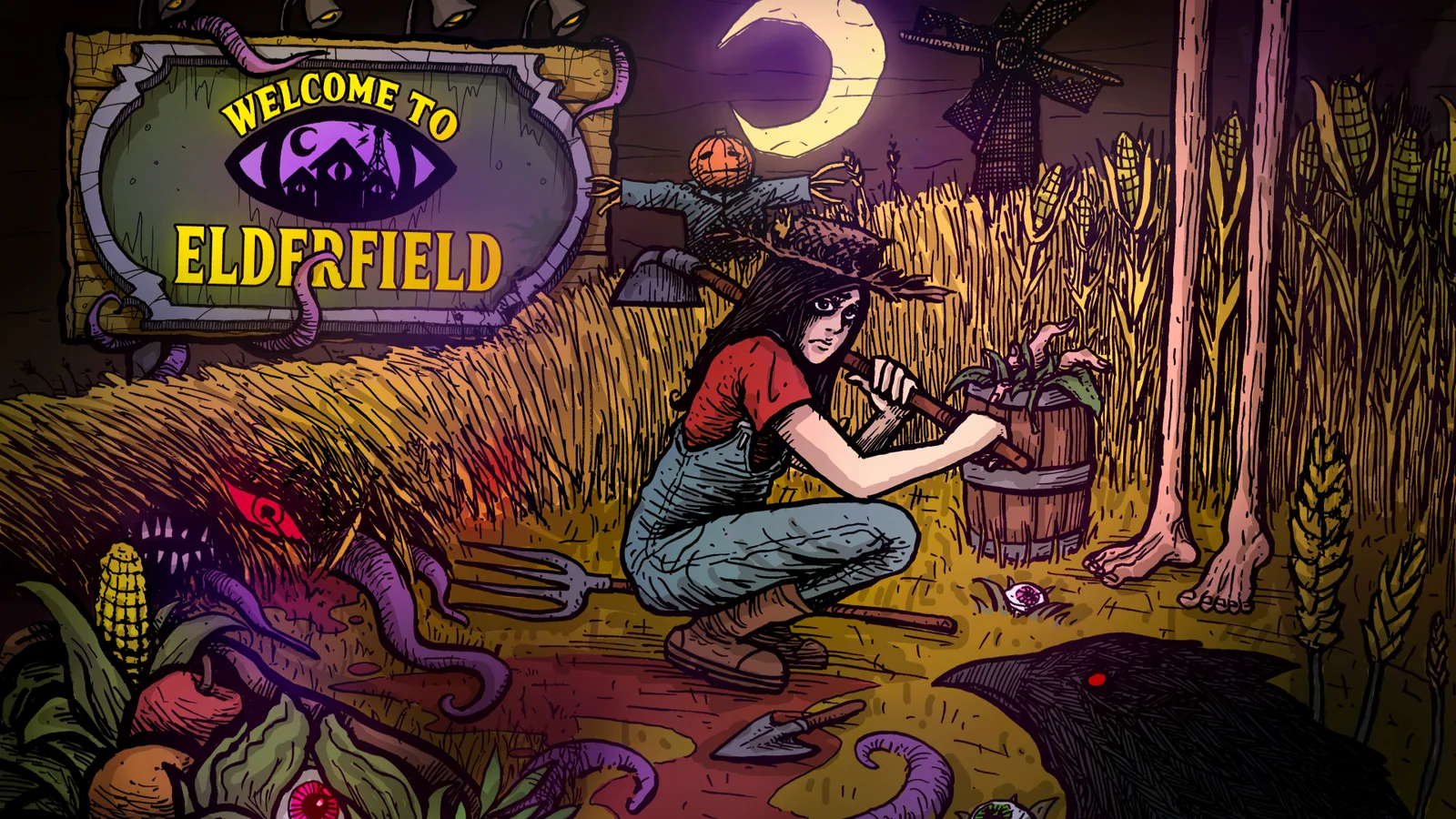

The strangest thing Welcome to Elderfield does is take the social grammar of the farming sim and leave nearly every rule intact while poisoning the assumptions underneath it. You wake in town with no clear memory of a life elsewhere, meet residents who seem to know you without quite remembering why, and discover that the roads leading out simply stop. Then somebody gives you farm work.
That structure immediately recalls Stardew Valley, yet the resemblance operates like a cultural disguise. Crops, livestock, errands, neighbors, seasonal routines, and gradual property improvement promise the familiar fantasy of rebuilding a small life through repetition. Elderfield keeps those rituals while importing the fatalism of Lovecraftian horror. Sleeping can hurt you. Gathering materials can attract monsters. Even the local mall is infested. The result is a life sim where domestic stability feels temporary from the moment you begin constructing it.
Nothing Strange to See Here
Elderfield becomes most distinctive when its residents refuse to react properly to their own reality. Your neighbor Dave is a cat. Nobody appears particularly interested in explaining this. Farmer Hans sheds his skin, then discovers that his bones have grown so extensively that he can barely move around his house. The surrounding concern centers largely on practical matters such as preparing his meals. Edwin later remarks that he had to put his skin back on because nobody would employ a skeleton.
That last joke lands because the grotesque has been translated into the language of ordinary labor. Elderfield’s supernatural society often feels less like classical cosmic horror than a small American town whose civic rituals have survived after reality itself has become unreliable.
One quest captures the game’s peculiar tonal logic perfectly. You construct an effigy wife for a lonely man. The figure comes alive, declares its love, and the pair are apparently happy together. A horror story might turn the resurrection into punishment. A fairy tale might frame it as miraculous. Elderfield simply marks the job complete.
The visual design supports that uncertainty. Character portraits lean toward distorted storybook illustration, while enemies sometimes recall the bodily exaggeration associated with Junji Ito. Dark lo-fi music stays subdued enough that supernatural events can sit beside farm work without announcing which mood the player should adopt.
Some of that unease fades through repetition. Daily television reports eventually recycle supernatural events, and seasonal celebrations leave relatively little permanent change behind. Elderfield can make abnormality routine so effectively that it occasionally neutralizes its own horror.
Roll the Dice, Swing the Hammer
Its combat systems carry greater weight than the farming-sim exterior initially suggests. Many interactions contain an element of chance. Search garbage, loot a corpse, examine a haunted ATM, or go to sleep and a dice roll may reshape the outcome. That randomness turns mundane decisions into small calculations.
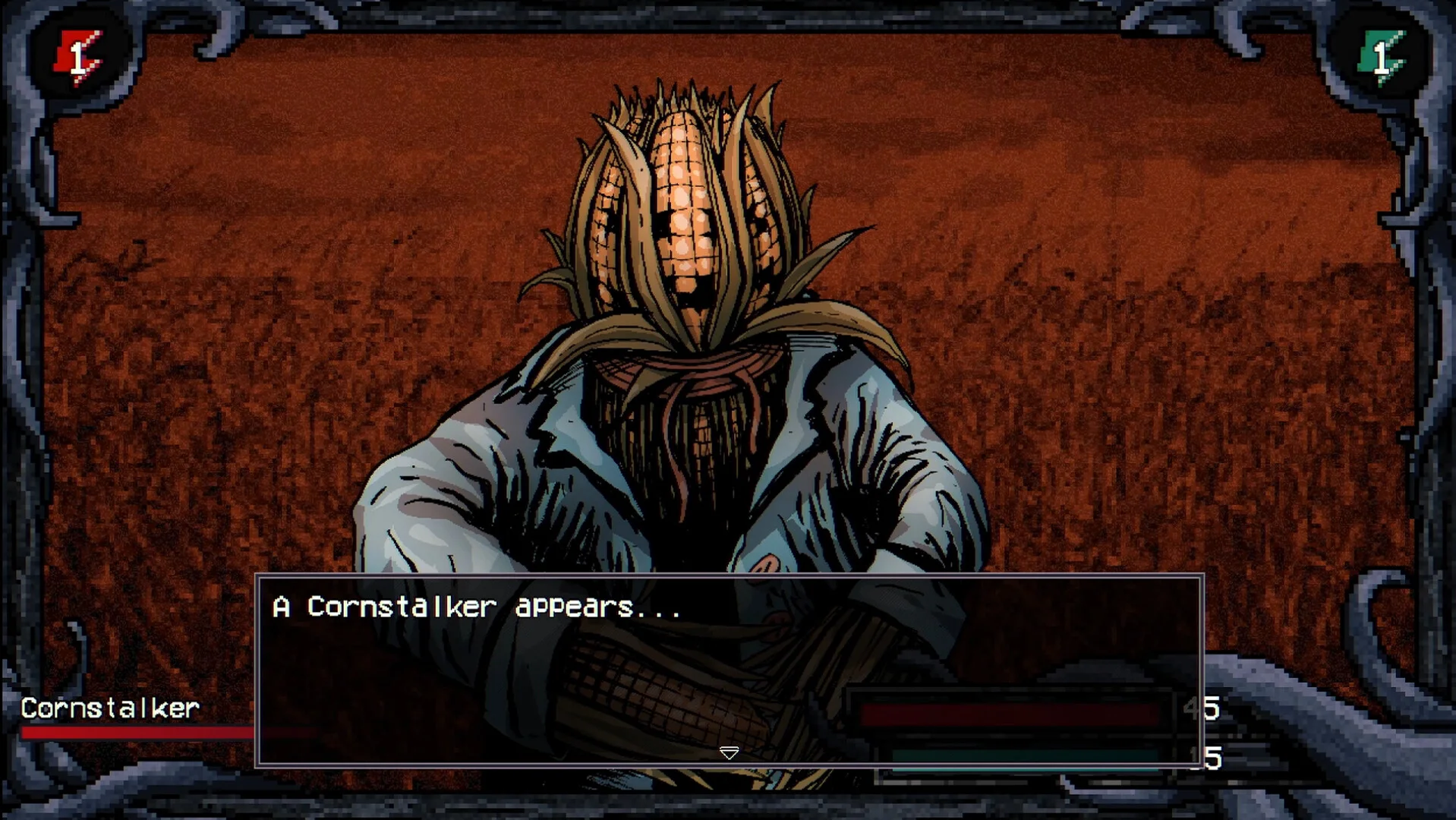
The question is rarely how much energy remains, since Elderfield avoids the conventional stamina meter and equipment degradation common to the genre. The pressure comes from health, curses, enemies, resources, and the possibility that the next interaction goes badly.
Turn-based battles suit that design beautifully. Each pause gives you time to measure healing supplies, spell costs, enemy strength, and the risk of continuing deeper into hostile territory. Early encounters can be punishing, especially when frequent battles, debuffs, and unlucky rolls overlap. Stronger equipment gradually shifts that balance until previously dangerous enemies become manageable.
Progression has several satisfying intersections. Melee builds conserve resources, while magic offers considerable power with greater dependence on MP. Loyalty to the old god Kaal can eventually open a restricted door in a mine, where a maul increases attack while reducing spell costs. A religious choice becomes an equipment decision, then changes how subsequent battles feel.
There are thoughtful conveniences too. Tools work directly from the inventory. The bed allows manual saving without forcing sleep. Taking a bath restores health and cleanses curses, though doing so respawns monsters. A free warp spell returns you home with the same enemy-reset consequence.
Crafting is less polished. The interface lacks a simple maximum-craft command and fails to show your material totals clearly while selecting quantities. For a game so invested in resource planning, asking the player to memorize inventory counts feels strangely primitive.
Build the Farm, Break the Seal
Farming matters because Elderfield refuses to let it become decorative busywork. Each plot must first be treated with Cleansing Balm, livestock demand regular attention, and particular crops matter when the Tax Man arrives with a two-week requirement. Failure imposes a sizable attack penalty until the next tax period, tying agricultural mistakes directly to combat efficiency.
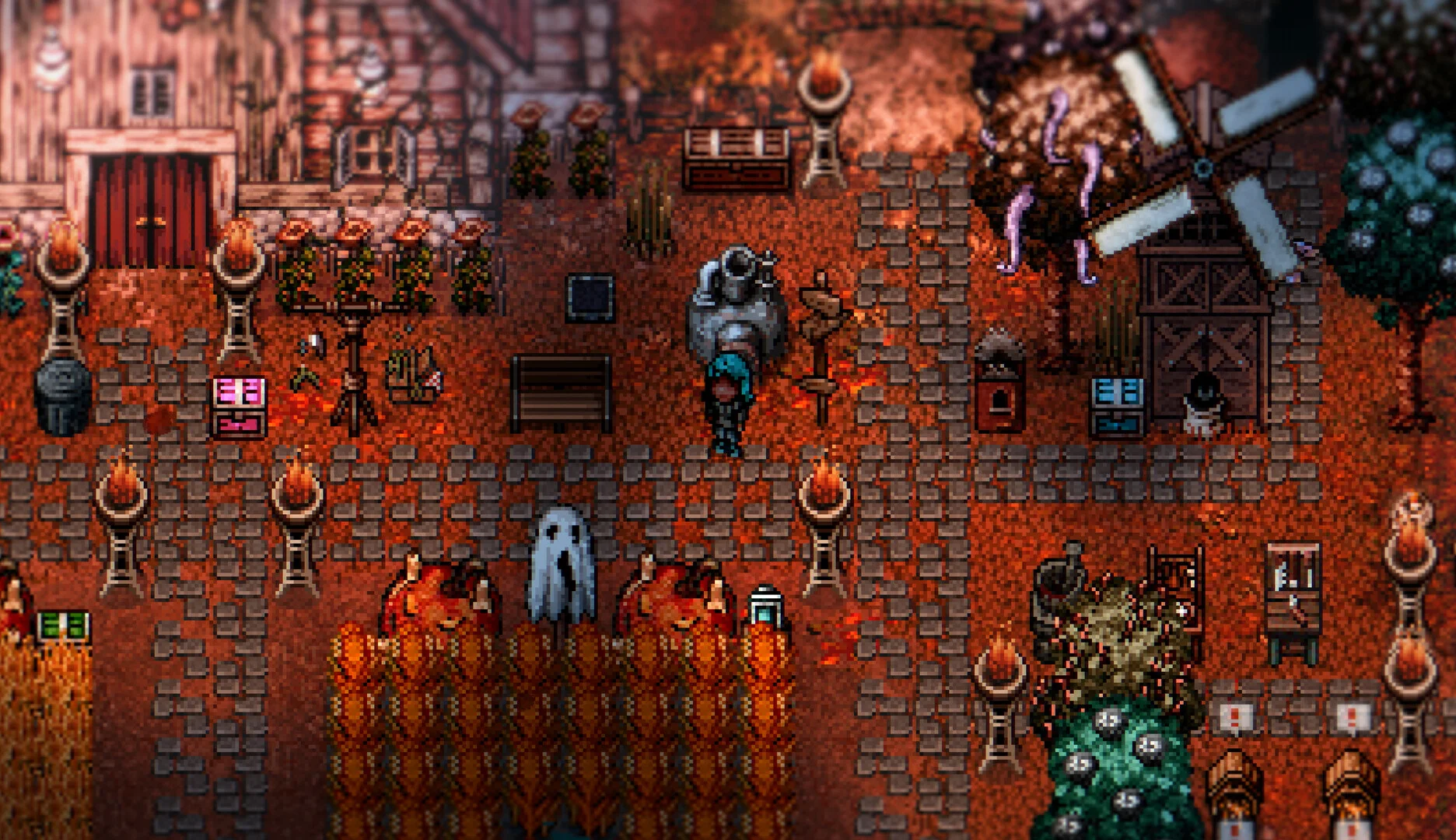
Farm and ranch products eventually contribute toward breaking the seal on the Stone Tower, the structure connected to the central mystery. That connection gives routine production a role similar to material gathering in a dungeon-focused RPG. Growing crops is part of character progression.
Exploration follows the same principle. Major areas are often linked to eccentric community groups. The Local Joggers Club knows the routes through the dark woods, so helping them becomes part of reaching deeper territory. Elderfield repeatedly translates recognizable small-town activities into RPG gatekeeping systems, one of its funniest and smartest design choices.
The relationship mechanics never reach the same level. Romance candidates reveal little meaningful development as heart meters rise, while gift-giving depends heavily on experimentation. Completing tasks connected to characters often produces no relationship gain and little later acknowledgment. You can spend considerable effort learning which present moves a meter while discovering less about the person receiving it.
That imbalance says something revealing about Elderfield. Its town is memorable because systems, monsters, crops, gods, deadlines, and bizarre civic customs constantly interact. Many of its people remain static inside that machinery. After dozens of strange encounters, the inventory screen can carry a stronger sense of history than the romance menu.
The Review
Welcome to Elderfield
Welcome to Elderfield grafts the rhythms of the American farming sim onto Lovecraftian horror and the resource logic of a turn-based RPG, and the collision frequently works. Daily crop routines sit beside dice-driven danger, cults, curses, and skeletons worrying about employment. Combat, equipment, and religious allegiance give its world mechanical texture, while the thin romance system exposes how much stronger Elderfield is as a place than its residents are as people. Its strangest accomplishment is making domestic routine feel faintly contaminated.
PROS
- Excellent cozy-horror atmosphere
- Substantial turn-based combat
- Strong equipment progression
- Memorable supernatural absurdity
- Farming feeds the central mystery
CONS
- Shallow romance progression
- Repetitive supernatural events
- Frustrating crafting interface
- Uneven early-game difficulty