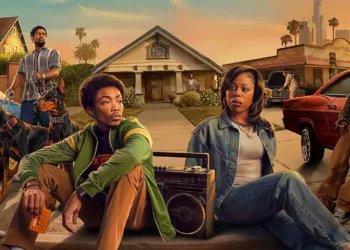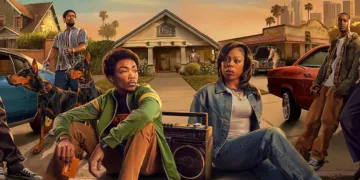










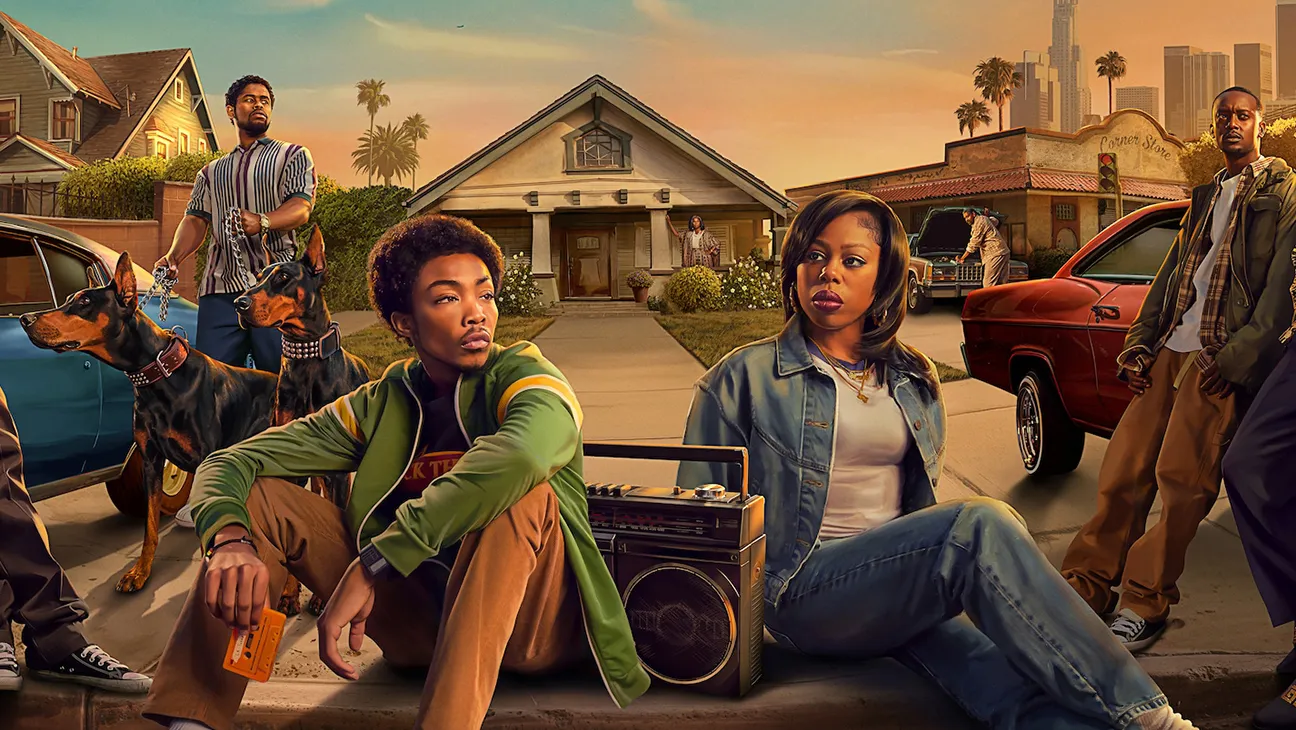

Lamar Kinsey’s beat hits the room before the series has fully explained what kind of show it wants to be. He is standing in a trap house, playing music for Artillery, a wounded rapper with bandages across his body and enough street presence to make Lamar’s lack of self-preservation look almost impressive. Artillery starts rapping. His friends pick up the words. The track bleeds into Larrance “Rance 1500” Dopson’s score, and suddenly The Drop: A Snowfall Saga has found its dramatic grammar.
Music creates the excitement. Everything surrounding it creates the danger.
That distinction is what allows FX’s first Snowfall spinoff to feel like a continuation instead of an attempted resurrection. Snowfall built its momentum around the expansion of crack cocaine through 1980s Los Angeles. The Drop picks up around 1990, after much of that destruction has already happened, and shifts its attention toward West Coast hip-hop. The neighborhood remains scarred by drugs, gangs, police violence and old reputations. The new hustle simply comes with recording studios.
Wanda Bell, played again by Gail Bean, understands this better than anyone. She is clean now, separated from Leon Simmons and working at a used-car dealership while trying to push her way into the music business. Her past addiction still defines how other people see her, which gives Bean an interesting contradiction to play. Wanda has survived one economy built around appetite and now throws herself into another with almost frightening intensity.
Bean never treats recovery as a personality transplant. Wanda can be sharp, impatient and reckless in her ambition, especially once she realizes her cousin Lamar has the production talent she needs. Watching her pitch ideas, study opportunities and push against people who underestimate her gives the character a forward momentum the series badly needs. She knows what a good record sounds like before several executives around her know why they should care.
Leon, meanwhile, is harder for the show to place. Isaiah John brings the same bruised maturity that made him such an important part of Snowfall, and his work at a legal clinic gives him a credible post-crime existence. Yet the new plot rarely requires him with the same urgency that it requires Wanda. Legacy earns him a seat at the table. The writers are still deciding what he should order.
The fresher energy comes from Lamar, played by Asante Blackk. Lamar is talented enough to recognize possibilities nobody else hears and socially oblivious enough to walk directly toward situations everybody else recognizes as dangerous. Blackk handles those two qualities beautifully. He can sit almost completely still, processing the room through a stare, then explode into anger or excitement with little warning.
His relationship with his brother James gives that eccentricity stakes. Peyton Alex Smith plays James as a young man forced into middle age by responsibility. Once known on the streets as Jay Loco, he has tried to leave gang life behind, yet protecting Lamar keeps requiring precisely the instincts he is supposed to abandon. The irony is viciously efficient: Lamar’s talent might provide the family with a future, and keeping him alive threatens to drag James backward.
The Kinsey household gives those conflicts weight. Mykelti Williamson and Nicki Micheaux, as Big Daddy and Mama G, treat music with suspicion rooted in family history rather than sitcom-style generational grumbling. Their scenes around the family table let arguments breathe long enough for old wounds to surface. Nobody is simply standing between Lamar and his dream because television requires obstacles. They are afraid of what ambition has already cost this family.
Episode five pushes that history to the foreground by pausing the present-day story for a flashback involving Lamar and James’s mother, played by Denée Benton. As a structural move, it is awkward. The season has already opened several active storylines, so abandoning them for most of an hour should kill the momentum. Strangely, the episode works.
Benton gives the brothers’ family history enough emotional force that the detour clarifies rather than merely decorates them. Her character’s talent and mental struggles change the meaning of Big Daddy and Mama G’s protectiveness, while giving Lamar’s relationship with music a darker inheritance. It is one of the season’s best hours, which presents the writers with a slightly embarrassing problem: the show becomes stronger when it temporarily stops moving its main plot.
The music rarely has that issue. Dopson’s production and Jason “Problem” Martin’s lyrics give Lamar and Artillery material that sounds connected to the period rather than assembled by a modern writers’ room pretending cassette tapes solve everything. Buddy, playing Artillery, helps enormously. He performs with the looseness of someone who understands how a rapper occupies a room, and the series repeatedly becomes electric whenever a song is being built rather than merely discussed.
The soundtrack reaches through funk, soul and West Coast rap, with tracks from artists including DJ Quik and Compton’s Most Wanted alongside One Way and Harold Melvin & the Blue Notes. The chronology occasionally gets flexible, including music from much later periods, but the sonic identity remains strong because the songs are tied to character and atmosphere.
The camera joins in. One shot places us inside a cassette deck as Lamar inserts a tape. Car interiors are filmed from odd angles that make familiar conversations visually restless. The Los Angeles exteriors favor warm oranges, crisp blues and bright daylight instead of burying every morally complicated television drama beneath gray shadows. Apparently crime-adjacent prestige TV can survive exposure to sunlight.
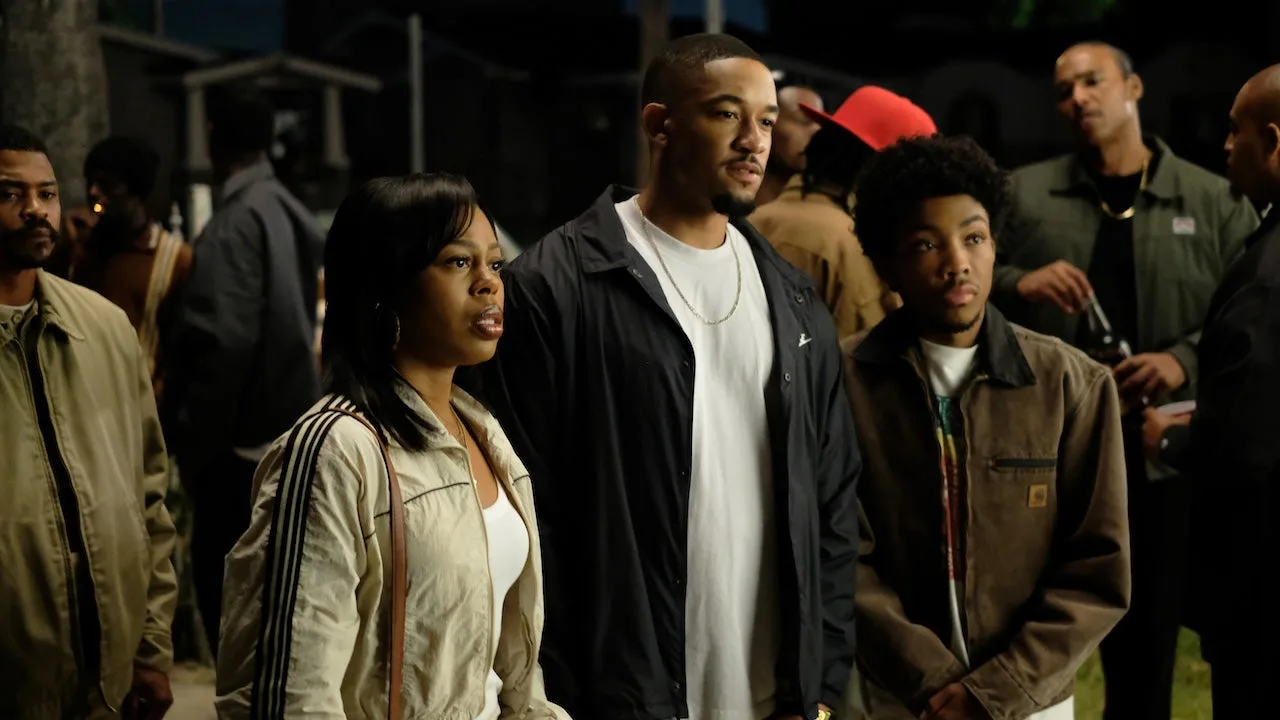
The business material is less graceful. Wanda’s work with Darryl “DG” Grant at Macroscope Records gives the series a useful route into questions of ownership, exploitation and who gets paid once corporate America discovers Black music is profitable. Brandon Mychal Smith gives DG enough swagger to keep those scenes moving, yet arguments pitting hip-hop against grunge occasionally sound like executives have been handed Wikipedia entries from the future.
The same problem affects the season’s larger structure. Snowfall had an automatic engine because Franklin Saint’s expansion kept generating consequences. The Drop has several strong characters moving through an interesting moment in music history, but the destination remains hazy. Artillery is talented, charismatic and dangerous by association, yet the series has not established what his rise is building toward. Wanda wants into the industry. Lamar wants to make music. James wants out of the streets. All three goals work individually. They have not yet locked together tightly enough to create inevitability.
That leaves The Drop in an unusual position for a franchise spinoff. Its weakest element is the thing spinoffs are normally supposed to provide: a clear reason to keep the machinery running. Its strongest elements are everything television franchises usually struggle to manufacture, including a convincing world, characters with unfinished lives, a distinct musical identity and performances capable of pulling attention away from the original series. The beat is already there. The season is still figuring out where to drop it.
The Drop: A Snowfall Saga premiered on September 8, 2026, on FX and is currently available to stream on Hulu (and on Disney+ internationally). Set in 1990s Los Angeles shortly after the events of Snowfall, this spin-off series follows fan-favorite characters Wanda Bell and Leon Simmons as they attempt to leave their troubled past behind and build a new life in the midst of the emerging West Coast hip-hop boom.
Where to Watch The Drop: A Snowfall Saga Online

Full Credits
Title: The Drop: A Snowfall Saga
Distributor: FX, Hulu, Disney+
Release date: September 8, 2026
Rating: TV-MA
Running time: 56–60 minutes per episode
Director: Alonso Alvarez, Ben Younger
Writers: Malcolm Spellman, Dave Andron, Lex Edness, Sal Calleros, Safura Fadavi, Michael Kastelein, Emil Pinnock, Nichelle D. Tramble
Producers and Executive Producers: Malcolm Spellman, Dave Andron, Thomas Schlamme, Julie DeJoie, Michael London, Trevor Engelson, Paul Garnes, Eric Amadio, Sal Calleros, Lex Edness, Safura Fadavi, Michael Kastelein, Toni Natalizio, Leah Benavides Rodriguez, Carlito Rodriguez, Amy Myrold, Evan Silverberg, Jason Cherella, Ayla Montgomery, Annie Rader
Cast: Gail Bean, Isaiah John, Asante Blackk, Peyton Alex Smith, Simmie “Buddy” Sims III, Mykelti Williamson, Nicki Micheaux, Brandon Mychal Smith, Isidora Goreshter, Eric Balfour, Richard Portnow, Zaire Adams, Demetrius Grosse, Quincy Chad
Director of Photography (Cinematographer): Luc Montpellier
Editors: Daniel Gabbe, Brody Gusar
Composer: Larrance “Rance” Dopson, Jeff Russo
The Review
The Drop: A Snowfall Saga
The Drop: A Snowfall Saga finds a convincing new rhythm without simply replaying Snowfall. Its strongest material comes from Wanda’s ambition, Lamar’s volatile talent, James’s divided loyalties, and music scenes that actually feel alive. The season is less certain about Leon, its record-label politics, and the larger direction tying these stories together. Even the disruptive flashback episode works better than it should, which says plenty about the strength of the characters. The world is ready. The dramatic engine still needs tuning.
PROS
- Asante Blackk gives Lamar unpredictable energy
- Gail Bean makes Wanda a credible lead
- Music creation scenes consistently spark
- Strong family dynamics around the Kinseys
- Bright, expressive Los Angeles photography
CONS
- The season lacks a firm narrative destination
- Leon feels loosely connected to the main plot
- Record-label debates can become overly explicit
- Several storylines compete for limited space