



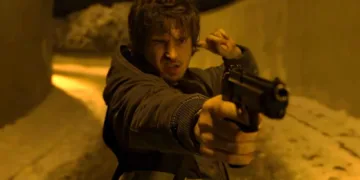

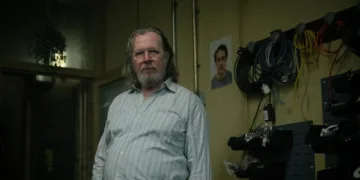






















Laughton University is arranged like an argument before it becomes a battlefield. Farrah and her protesters have the student union, Clay Saunders has a speaking event built around his warnings about radical Islam, a fall carnival fills the grounds with civilians, and Ibrahim’s men quietly turn that same campus into a grid of firing positions. Kyle Rankin keeps placing ideology into physical space until the geography becomes moral shorthand. By the time the terrorists reveal themselves, nearly everyone has already been assigned a side, a weakness, and a lesson they are expected to learn.
That design gives Run Hide Fight: Infidels a clean dramatic engine. Saunders, a former Delta Force captain, arrives at Laughton seven years after losing a fellow soldier during an operation against ISIS leader Asad al-Madhi. The dead man’s son, Devlin, is now a student there, more concerned with Lizzy and his friends than his father’s unfinished history. Ibrahim, al-Madhi’s son, exploits the campus protest to seize the university and announce his own caliphate. Hostages are separated, dissenters are killed, and Devlin joins his abrasive roommate P.J. and campus security guard Terrence in trying to fight back.
The setup should turn the campus into a pressure chamber. Student unions, carnival grounds, dorms and security positions create natural routes, blind spots and choke points. Rankin rarely converts that potential into sustained spatial tension.
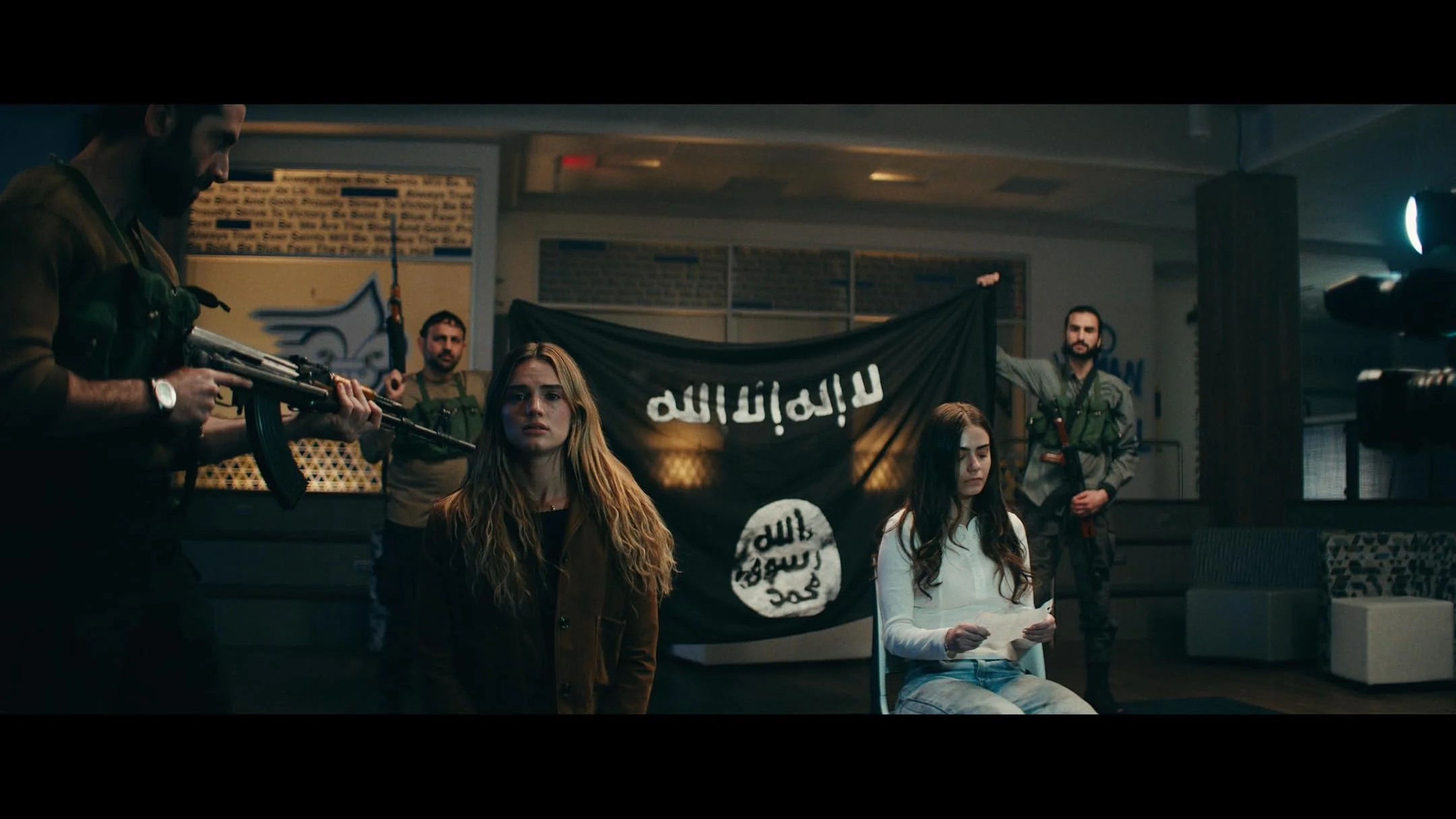
Much of the middle section settles into captivity while Ibrahim gives speeches, humiliates prisoners and forces propaganda recordings. These scenes clarify his cruelty, then keep clarifying it long after the point has landed. The camera has bodies to track and territory to contest, yet the film repeatedly stops moving so its villain can explain what the movie already made unmistakable.
The weakness matters because siege films derive suspense from incomplete knowledge. Who controls the next hallway? Which exit is still open? How long can a frightened civilian remain hidden before movement becomes necessary? Infidels often replaces those questions with ideological certainty.
The dean hesitates because he fears appearing discriminatory. The mayor urges restraint. Protesters are framed as naive enough to help create the conditions for their own capture. Saunders, by contrast, enters the story with his warnings pre-validated by the catastrophe waiting for him. There is little moral shadow here. Every light points in the same direction.
P.J. briefly threatens to complicate that arrangement. He is obnoxious, racist, and dishonest about his military background. Devlin calls out his stolen valor, yet the crisis later gives him a chance to act courageously. That could be useful contamination.
Action cinema has always had room for cowards who stand their ground once, bigots who save people they dislike, and heroes whose bravery does not erase their ugliness. Rankin treats P.J.’s heroism largely as vindication rather than friction. His prejudice does not become a wound the film keeps pressing. It becomes part of the comic noise around a character whom the action increasingly rewards.
Terrence fares better. David Lucas understands that a joke in an action scene works best when it changes the rhythm rather than stopping it. His security guard’s wisecracks release pressure without pretending the danger has vanished, and he gives the ensemble a human pulse missing from many of the ideological mouthpieces around him.
James Bingham pushes P.J. toward a louder comic register, sometimes so aggressively that the character seems to enter from a cruder satire and refuse to leave. The two performances reveal the tonal line Rankin keeps crossing: irreverence can sharpen panic, but broad caricature can drain it.
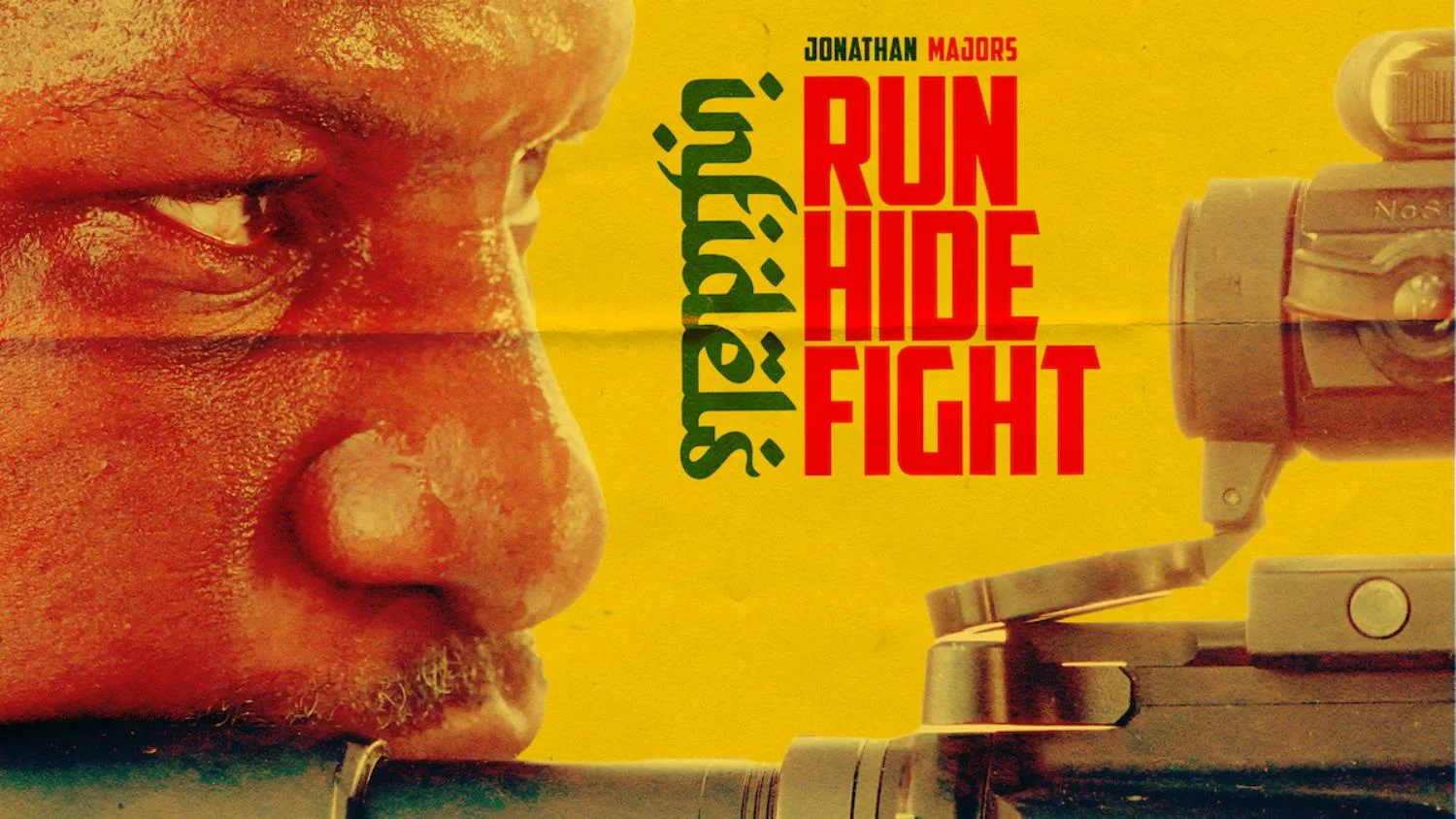
Saunders should supply the movie’s emotional counterweight, especially because his dead comrade links him directly to Devlin. Instead, Jonathan Majors spends surprisingly little time inside the central siege. His limited presence leaves the relationship between Saunders and Devlin underdeveloped, even though that bond could have fused the military prologue, the campus attack and Devlin’s attempt to become something other than a spectator to his father’s legacy. Majors plays Saunders with a muted reserve, but the performance has too little dramatic contact to turn restraint into tension. The script gives him authority without enough collision.
The film’s treatment of Islam creates a similar problem of collapsed distinction. Ibrahim and his fighters are jihadist extremists, yet Saunders’ book warns about Islam conquering the West, and the broader framing rarely pauses to separate a religion from the militants using it as justification.
That choice makes the villains less frightening, not more. Fanaticism is most disturbing when it can be seen as a distortion, a human decision, a system of belief weaponized by particular people. Here, the framing often flattens the distance between extremist violence and Muslim identity until the image arrives pre-labeled. The moral composition becomes easier to read and much harder to take seriously.
Rankin keeps reaching for tonal release as the siege approaches its climax. The student revolt is accompanied by Stone Temple Pilots’ “Vasoline,” and the closing stretch eventually lands on Deep Blue Something’s “Breakfast at Tiffany’s.” The selections have an almost defiant wrongness to them.
They may be intended as swagger, but they expose the movie’s larger instability: a story that demands civilizational stakes keeps undercutting its own weight with the energy of a culture-war prank. By the final stretch, the campus has ceased to feel like contested ground and become a diagram whose arrows were drawn before the first shot was fired. “Breakfast at Tiffany’s” then plays over the aftermath, leaving a strangely weightless tune hanging over a film that spent two hours insisting the world was ending.
Run Hide Fight: Infidels premiered on September 16, 2026, and is available for streaming through The Daily Wire. The action thriller follows a ragtag group of students and a Delta Force veteran who must fight back when radical terrorists hijack a college campus encampment.
Where to Watch Run Hide Fight: Infidels (2026) Online
Full Credits
Title: Run Hide Fight: Infidels
Distributor: The Daily Wire
Release date: September 16, 2026
Running time: 1 hour 30 minutes (90 minutes)
Director: Kyle Rankin
Writers: Kyle Rankin
Producers and Executive Producers: Dallas Sonnier, Ben Shapiro
Cast: Jonathan Majors, David Lucas, JC Kilcoyne, Tyler Aser, James Bingham, Savanna Leigh James, Stephen Hailo, Myles Clohessy
Director of Photography (Cinematographer): Darin Moran
Editors: Matthew Lorentz
Composer: Mondo Boys
The Review
Run Hide Fight: Infidels
Run Hide Fight: Infidels has the geography for a tense siege thriller, yet Kyle Rankin keeps surrendering suspense to ideological certainty. Its campus spaces promise shifting danger, but repeated speeches, blunt characterization, and predetermined moral positions leave little room for surprise. David Lucas gives Terrence welcome comic life, and the premise occasionally hints at a sharper action movie. Jonathan Majors is too peripheral to supply the emotional weight the story needs. The film wants its battlefield to prove a worldview, and that certainty drains much of the tension from the fight.
PROS
- Strong campus-siege premise
- David Lucas brings comic energy
- Clear spatial potential
- A few effective tonal jolts
CONS
- Repetitive hostage sequences
- Thin ideological characterization
- Weak sustained suspense
- Saunders is underused
- Tonal choices dilute the stakes