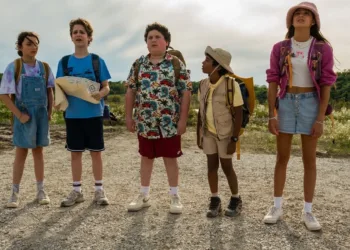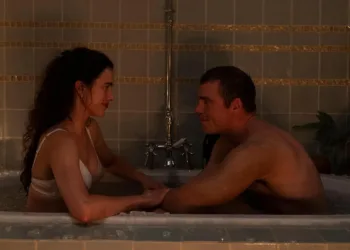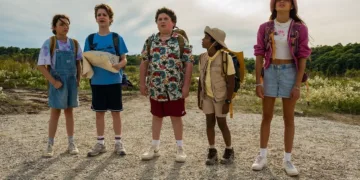


























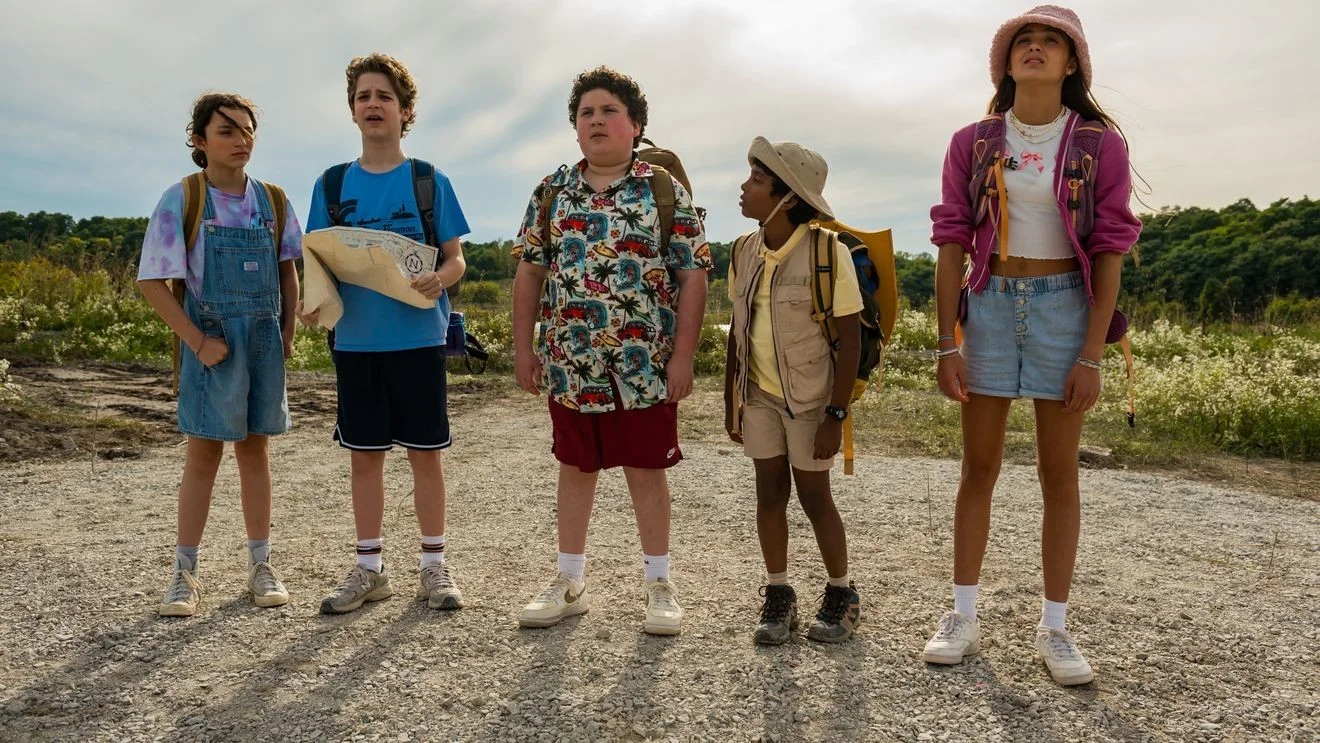

The most convincing feeling in Tiny Fugitives is the panic of realizing that the place where you are happiest has an expiration date. Jacob Udell and his best friend Charness call their lives “10 for 2”: ten months spent waiting for the two months when Camp Fineman gives them friends, confidence, and a version of themselves they actually like. It sounds melodramatic because they are kids. That is also why it works.
Jacob’s life away from camp gives the phrase weight. At school, he imagines himself standing before his classmates and convincing everyone that camp is so wonderful even his teacher joins the rebellion. The fantasy collapses into a cafeteria where Jacob sits alone, bullied and disconnected. His parents are approaching divorce, and the possibility that he may not return to camp next summer turns the end of the season into something larger than a calendar date. Charness understands that fear from his own unhappy home life. Their solution, naturally, is the kind of solution children invent when emotion outruns logistics: escape to the abandoned Old Camp across the lake and simply never leave.
That premise gives director Michael Lewen a surprisingly sturdy emotional foundation for a movie packed with profanity, sex jokes, bodily humiliation, and Johnny Knoxville being treated like an indestructible crash-test dummy.
The crude humor works best when it expresses how these kids relate to one another. Old Camp becomes legendary partly because of stories about sexual milestones that have clearly grown through years of retelling. The campers swear constantly, talk about sex with the confidence of people who barely understand it, and build entire social rituals around jokes that would make little sense outside their circle. They are trying out adult language before they have adult experience.
Jacob and Tali make that gap particularly sweet. Tali likes him. Jacob is far less equipped to process this information than everyone around him, and their interactions become a small catalogue of bad timing, misread signals, and bruised pride. There is no need to inflate their romance into something profound. Its charm comes from watching two kids experience emotions that feel enormous while lacking the vocabulary to handle them. Leon and Sophie’s mock marriage plays the same idea for comedy, ending with Sophie explaining that their relationship cannot continue because Leon is ten. The logic is ridiculous and perfectly reasonable at the same time.
Benjamin Pajak helps preserve that distinction as Jacob. He carries the loneliness underneath the bigger comic beats without turning the character into a sad-kid archetype. Aaron Harris gives Charness a similar mixture of bravado and insecurity, and the young ensemble benefits from a certain lack of polish. Some moments feel awkward in the way real children are awkward, which suits a film that would lose something if everyone delivered dirty jokes with professional sitcom precision.
Then Bob arrives, and the emotional texture changes with him. Johnny Knoxville’s camp counselor is positioned as the great obstacle standing between the fugitives and permanent summer. The kids consider him ancient, mocking his technological habits and treating fifty as an age somewhere between retirement and fossilization. Once the chase begins, Bob gets electrocuted, launched from vehicles, and battered through physical gags that push the movie toward cartoon territory. Knoxville is very good at this. Few performers can make bodily disaster look so casual.
The strange part is that Bob becomes interesting for reasons that have little to do with getting hurt. He has spent his adult life attached to the same camp the children are desperate to preserve. He works around younger people who do not entirely respect him. He is lonely, a little adrift, and deeply committed to a place everyone else assumes adults eventually outgrow. That gives him an unexpected connection to Jacob. One is terrified of leaving camp behind. The other appears to have built a life around never fully doing so.
The movie occasionally recognizes how strong that parallel is. Bob also refuses to talk down to the campers. He insults them, needles them, and treats them as participants in the same social world rather than tiny creatures requiring a special voice. That creates some of the film’s warmest interactions because respect here does not look like kindness in the conventional sense. It looks like taking a twelve-year-old seriously enough to make fun of him properly. I wanted the film to trust that relationship more often.
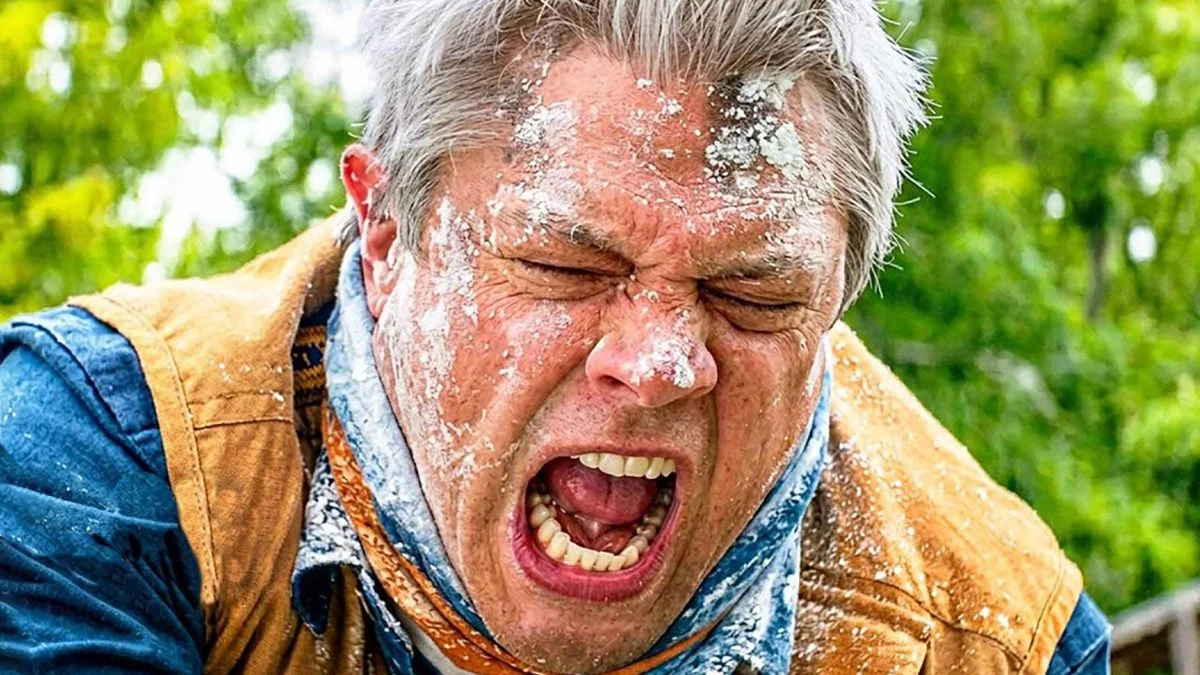
Instead, Bob frequently shifts back into pursuit mode. Jacob worrying about his parents, Tali trying to understand rejection, or Charness admitting how miserable he is at home belong to a softer coming-of-age comedy. Bob being repeatedly destroyed by machinery belongs to a live-action cartoon. Either mode can be funny. The cut between them can feel like switching movies.
The runaway story is too slight to smooth that transition. Once the kids flee toward Old Camp, the plot mostly provides excuses for encounters, jokes, romantic misunderstandings, and Bob’s next injury. That looseness gives Tiny Fugitives some of its appeal. There is something refreshing about a comedy whose greatest crisis amounts to several children refusing to accept that summer vacation ends.
Lewen’s affection for camp carries much of what the plotting cannot. Camp Fineman has its own slang, legends, rituals, and social hierarchy. Old Camp becomes a half-mythic version of the past, the place where the rules were supposedly looser and every ridiculous story began. Some character turns still feel thin, and the tonal changes become harder to ignore whenever the slapstick grows especially broad. The funniest dirty jokes tend to reveal something about the children making them. The weakest comic detours stop revealing much at all.
Still, the feeling behind “10 for 2” lingers because the film understands what Jacob is actually afraid of losing. Camp gives him friendships that school does not, confidence that home does not, and a temporary social universe where he knows his place. The kids’ plan to remain there forever is impossible, obviously. Their belief that they need to try feels completely sincere.
That sincerity is the part Tiny Fugitives knows exactly how to handle. The rest of the movie keeps racing around it, swearing, flirting, crashing into things, and hoping the summer lasts a little longer.
Tiny Fugitives arrives in theaters with a limited release on September 18, 2026, distributed by Inaugural Entertainment. The comedy follows a reckless group of twelve-year-olds on a mission to stay at sleepaway camp permanently, requiring them to outwit the camp’s deranged and relentless counselor.
Where to Watch Tiny Fugitives (2026) Online
Full Credits
Title: Tiny Fugitives
Distributor: Inaugural Entertainment
Release date: September 18, 2026 (Limited)
Rating: R
Running time: 1 hour 39 minutes (99 minutes)
Director: Michael Lewen
Writers: Michael Lewen, Jacob Kaplan
Producers and Executive Producers: Lia Buman, Josh Fagen, Evan Goldberg, Rob Hammersley, Tim Headington, Christopher Irion, Sonya Novak, Seth Rogen, Max Silva, James Weaver
Cast: Johnny Knoxville, Benjamin Pajak, Aaron Harris, Isa Bernal Steiner, Jai Soundar, Alyssa Gervasi, Blake Anderson, Jay Baruchel
The Review
Tiny Fugitives
Tiny Fugitives is funniest and most affecting when its vulgar jokes grow from the kids’ fear of losing the one place where they belong. Benjamin Pajak anchors that feeling, while Johnny Knoxville gives Bob a surprisingly tender parallel to Jacob. The thin runaway plot and abrupt swings into cartoon punishment keep the emotional threads from landing as cleanly as they could, yet the sincerity behind “10 for 2” survives the chaos. It is messy, sweet, and often very funny.
PROS
- Benjamin Pajak’s grounded lead performance
- Genuine chemistry across the young ensemble
- Crude humor tied to adolescent behavior
- Bob and Jacob’s effective emotional parallel
CONS
- Thin central runaway plot
- Uneven shifts between tenderness and slapstick
- Some underdeveloped character turns