












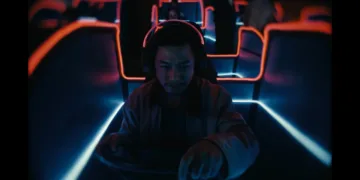






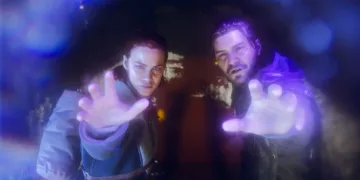



Max Wren intends to transfer his documentary about Lenore to VHS. The choice seems affectionate until one looks at how he works. Surrounded by monitors and video equipment, he replays the missing influencer’s posts, records their supposed common interests and speaks to her image as if a reply might come. A tape would let him hold on to someone who has disappeared from the internet. It would also give his version of her a permanence she never agreed to.
Sam’s arrival makes Max harder to dismiss as an isolated aberration. He brings footage of Lenore and his own resentment at discovering that their imagined connection was not exclusive. Samuel Macdonald plays his intrusion with a bluntness that unsettles Max’s guarded room, but the men share a basic error: each treats access to Lenore’s videos as evidence of a private bond. Nicholas Jaquinot gives Max the more disturbing variation. His tentative manner can make the documentary seem like a lonely person’s attempt to understand an absence, even as his notes and repeated viewings disclose a wish to be recognized by the woman on the screen.
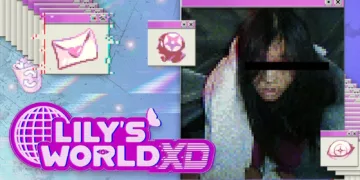
David Ward locates this story in an Australian home, yet little about the habit Max has acquired belongs to one country. Lenore’s makeup tutorials, music and increasingly exposed videos circulate in a screen culture that can make a recorded address feel intimate wherever it is watched.
The film’s local scale matters precisely because it refuses the visual sprawl one might expect from a story about the internet. Max sits in one room, receiving pieces of a life that have passed through platforms and other viewers before reaching him. He can replay a clip indefinitely, but he cannot recover the circumstances around it.
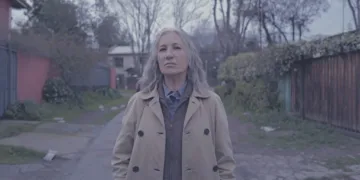
Those circumstances are especially important to Lenore, played by Ruby Duncan. Once known as Veronica Brand, she has become notorious for work that puts painful experiences before an audience. Footage of her miscarriage is spliced into a children’s broadcast without her knowledge.
Max can catalogue the resulting scandal as part of his investigation; for Lenore, the incident shows how decisively an image can escape her control. Her disappearance then creates a second opportunity for others to tell her story. Ward’s mystery works best when the search for an answer makes us aware of how readily we accept the fragments Max has chosen to preserve.
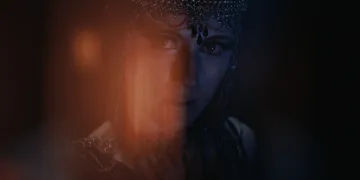
There is a useful comparison with the Japanese thriller Perfect Blue, in which a performer’s public image and private identity become increasingly difficult to separate. Ward approaches that fracture through a fan’s equipment and point of view. In one quiet instance, Lenore seems to look directly at Max through a monitor.
The effect needs no elaborate distortion. For a moment, the film lets us experience the apparent reciprocity on which his obsession depends, then leaves us to recognize that a camera-facing gaze could reach anyone. Jaquinot’s response supplies the dangerous part of the exchange.
The room gives Ward a firm way to control that experience. Sam’s visit and, later, the arrival of police break into a space Max has arranged around predictable images and sounds. His agitation makes an ordinary knock or an unwelcome voice feel disproportionate.
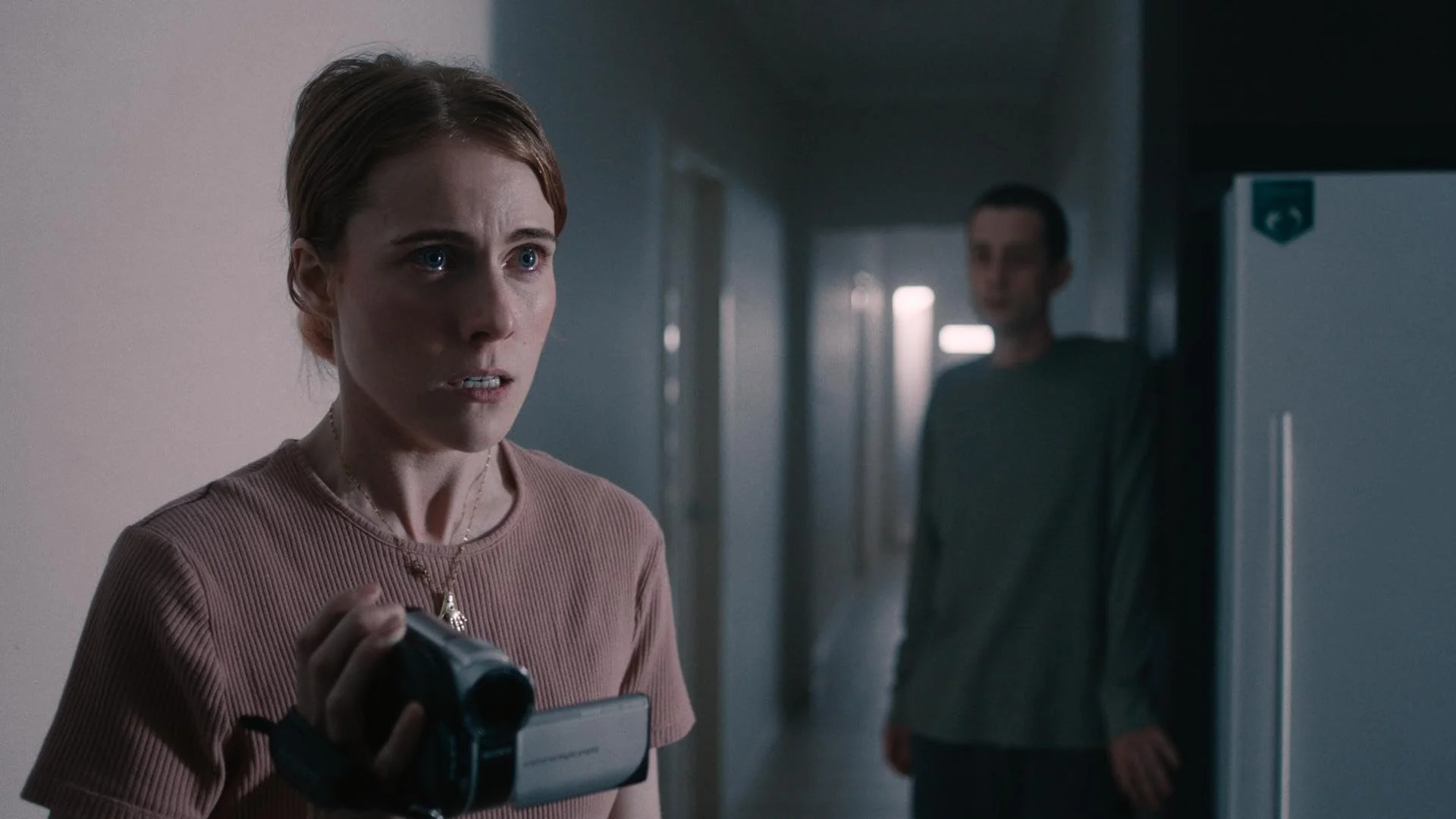
The single location rarely prevents the story from moving, because each interruption alters what Max believes he knows. Yet the film sometimes trusts speech less than it trusts the monitors. Long exchanges retain a stage-bound stiffness, while Lenore’s direct statements about men claiming ownership of her explain an idea already visible in Max’s behavior. The intimate screen encounter has greater force than an explicit declaration of its meaning.
Duncan faces a difficult task within that arrangement. Lenore must register as a person with intentions of her own while appearing chiefly in material selected, replayed or imagined by Max. Her resistance matters, particularly when his idea of devotion begins to look like another attempt to control her. Still, giving her a monologue cannot entirely counter the time the film spends inside his account. The imbalance is productive when Ward makes us question what we have seen through Max. It is less so when Lenore has to step in and state the terms of that question for us.
The late police visit brings the investigation and Max’s conduct into sharper relation without requiring the film to abandon its cramped setting. It rewards the patience demanded by an opening stretch that can feel uncertain of its pace. Ward finds his strongest horror in the distance between a video’s invitation to look and Max’s conviction that looking has made him indispensable. Lenore can speak into the camera, but the film leaves us with the harder question of how much of what she says can survive the people determined to answer for her.
Lenore arrived on digital platforms on September 21, 2026. The psychological cyber-horror thriller follows a reclusive, terminally online aspiring filmmaker who becomes obsessively fixated on tracking down a controversial internet personality after she suddenly vanishes.
Full Credits
Title: Lenore
Distributor: Seven Tales
Release date: September 21, 2026 (Digital Release)
Running time: 1 hour 48 minutes (108 minutes)
Director: David Ward
Writers: David Ward, Josie Hess
Producers and Executive Producers: David Ward
Cast: Nicholas Jaquinot, Ruby Duncan, Sam Macdonald, Caithlin O’Loghlen, Scott Mackenzie, David Gannon, Freya Callaghan, Bobby James
Director of Photography (Cinematographer): David Ward
Editors: David Ward
The Review
Lenore
Ward turns an Australian home full of monitors into a convincing portrait of an obsession that could take root anywhere online. Jaquinot makes Max’s imagined intimacy unsettling, and a glance through a screen does more work than the film’s explicit speeches about ownership. Some exchanges feel confined by the story’s stage origins, while Lenore has too little room outside Max’s account of her. The late turn gives the search a troubling new weight.
PROS
- Jaquinot’s unsettling performance
- Sharp use of screens and confined space
- - A payoff that changes how Max’s search reads
CONS
- Some stiff, theatrical exchanges
- Lenore’s resistance is sometimes stated too directly
- - Limited space for Lenore’s own perspective