

























A camp claims land that may be awkward to defend and only modestly useful to its nearest city. After a Tidefall drains part of Saiadha’s ocean, that same claim might border a resource deposit, a fortress full of loot, or a newly exposed route for an enemy army. Endless Legend 2 keeps changing the value of places you thought you had already assessed. A settlement decision is rarely finished when the camp goes down.
The monsoon before each Tidefall complicates that calculation. Minor factions grow more aggressive, dangerous creatures threaten armies, and a hero sent to finish a quest may be better used protecting a border. Once the water retreats, there is land to scout and another set of claims to make. Amplitude has found a persuasive way to return players to the exploratory phase of a 4X campaign without wiping away the empire they have built. Its dying planet matters because its geography keeps altering the work of governing it.
Saiadha gives the sequel a strong setting for that design. Beneath its seas lie ancient technologies and territories that several strikingly different factions want to control. The world’s science fantasy looks strange, but the basic responsibilities are familiar: develop cities, research improvements, deal with neighbors, and raise armies.
The difference is how often new land makes those responsibilities compete. Sending troops to investigate a revealed fortress means leaving them unavailable to protect a camp. Claiming a promising province may stretch an already thin defense. Exploration remains enticing because it can still cause problems worth solving.
Faction design gives those problems different meanings. The Kin of Sheredyn have reason to invest in fortifications, turning security into a source of strength. The Necrophage operate from a single hive and are pushed toward aggression.
The Sandshapers face an environmental problem of their own: they must seek ruins and transform surrounding land into desert that can sustain them. A fertile-looking region does not offer them the same opportunity it offers another faction. These rules make faction choice consequential at the level of routine planning. They change which land you seek, what you build there, and how you respond when the sea withdraws.
The factions also have story threads that give their competing plans a point of view. Quests can advance those stories, yield useful rewards, and even provide a route to victory. Their best function is to give an army a reason to venture beyond a secure frontier, where the trip itself might uncover another claim or expose a weakness at home.
The connection is less convincing when a quest asks you to repeat a familiar minor-faction task, or places its objective beyond a border that requires a declaration of war. At that point, a story meant to broaden your options can feel oddly specific about the kind of trouble it wants you to cause.
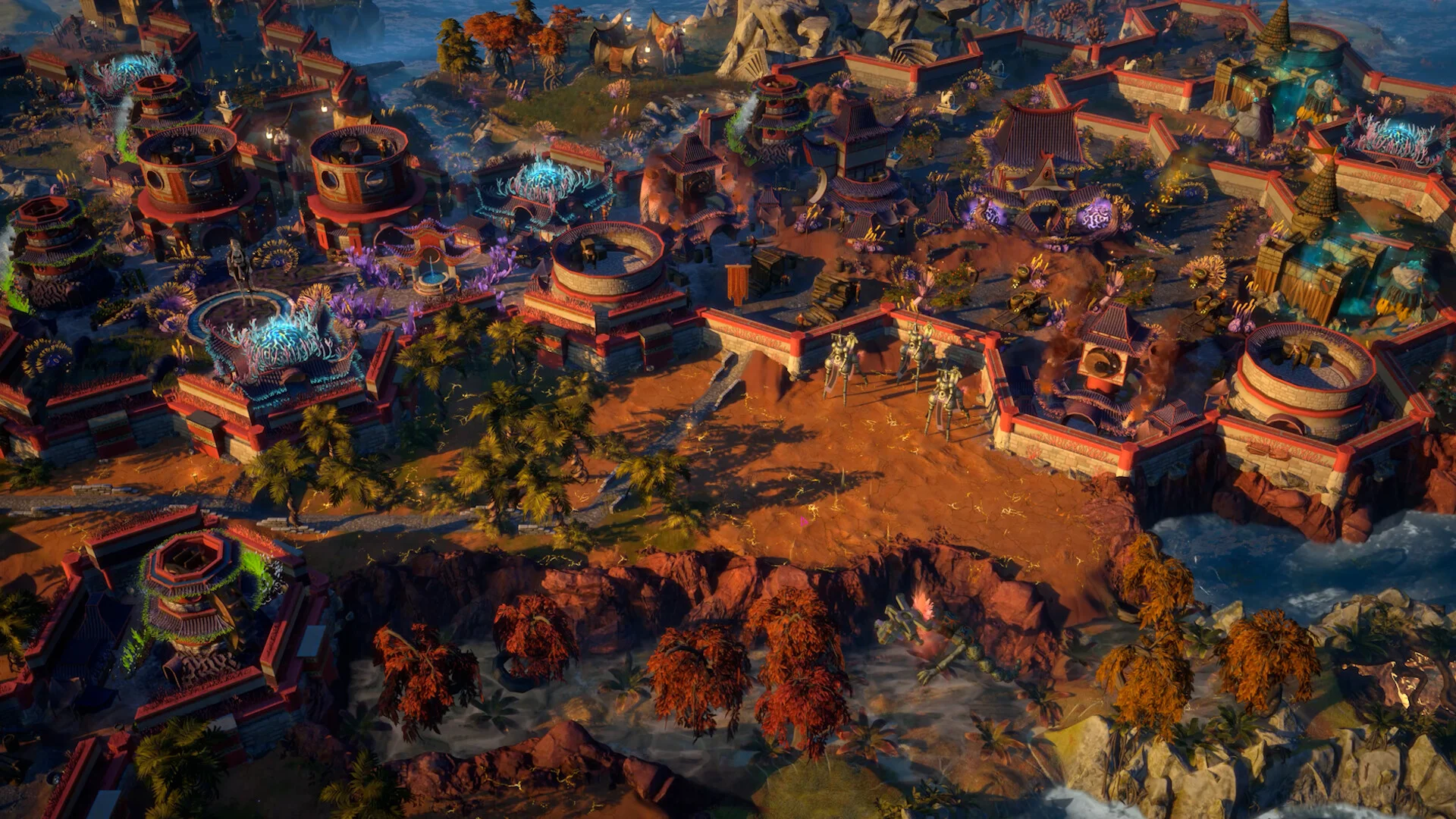
City building is where the discoveries become an economy. Camps extend your reach, while districts fill hexes whose placement affects their neighbors. A fortification can improve nearby tiles as well as help defend them; industrial development can be valuable without being a welcome neighbor for housing.
Attaching territory, securing special resources, and choosing what to research all feed into those local decisions. The pleasure comes from seeing a settlement’s shape reflect a plan, then adjusting that plan when Tidefall changes what the settlement can access.
Getting to that point takes patience. The tutorial offers guidance, yet the importance of establishing camps can be easy to miss, with enough consequences to make an early campaign feel worth restarting. The map’s visual symbols for cities, armies, and resources can also take time to distinguish.

That friction matters in a game built around reassessing territory: the player needs to see quickly what has changed and what is at stake. The environments themselves are much easier to read. Distinct terrain and the exposed biomes give each retreat of the sea a sense of discovery, while the painterly, often alien faction designs make the contest for Saiadha feel specific to this world.
Armies play a substantial role in making those discoveries useful. They scout, tackle fortresses, deal with minor factions, and guard camps as the map changes. When they fight, battles move to a turn-based tactical view where terrain, unit placement, hero abilities, and upgraded troops can influence the outcome.
Manual control can save resources that the quick resolution would spend: a predicted win that costs a hero can become a victory without losses if the player handles the positioning. That makes the decision to command a fight feel meaningful, especially when an injured army would need several turns to recover.
It also creates a tiring incentive. If manual battles regularly produce better results, the efficient strategic choice is to fight even modest encounters yourself. Positioning still demands attention, but limited unit variety and repeated tactical exchanges give those victories diminishing returns. The game needs armies on the move for its changing map to work; it does not always give their many fights the same capacity to surprise as the terrain around them.
Newly exposed fortresses still offer a reason to send a hero out, even when the road promises another familiar fight. The army that goes after the loot cannot guard a camp whose border has just changed. If a rival reaches the new passage first, that camp has to hold without its best troops.
The Review
Endless Legend 2
Endless Legend 2 makes expansion feel provisional. Tidefall reveals new land and changes the value of old claims, while faction rules give each empire a different reason to pursue them. City planning turns those choices into lasting commitments. Repeated quests and the advantage of fighting battles manually can slow a campaign, but Saiadha keeps giving players meaningful reasons to revise their plans.
PROS
- Tidefall keeps exploration and borders in motion
- Factions change how players value the map
- District placement rewards careful planning
- Distinctive world and faction design
CONS
- Manual battles become repetitive
- Minor-faction quests repeat
- Important settlement rules can be easy to miss
- Map symbols take time to read