






























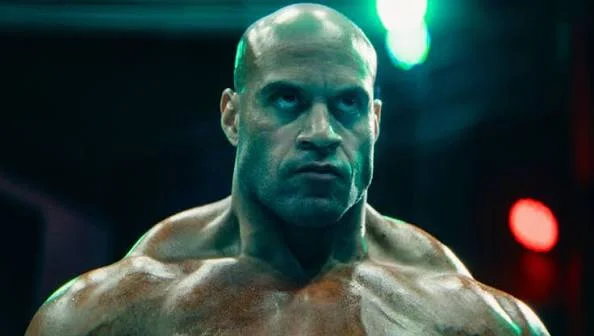
Butch has an unusually full schedule for a tournament villain. He is involved with Joe’s former partner Kate, tied to the gym’s drug business, and waiting at the far end of the competition Joe hopes will pay for his son’s surgery. Each connection gives their eventual fight another reason to matter. It also means that Taim M. Adams’s Lion Fist rarely has to decide which of Joe’s troubles deserves its attention. They keep turning out to be the same trouble in a different room.
Joe and Mei’s attempt to expose the gym brings detectives Williams and Parker into the picture, played by Gary Daniels and Kurt McKinney. Yet the investigation proceeds so casually that it lends little danger to what Joe and Mei have uncovered. Even the plain police setting offers scant sense of an institution taking hold of the case. Butch’s criminal activity seems to exist chiefly to confirm a judgment the film has already made about him. The detectives have badges; Joe has an appointment in the ring.
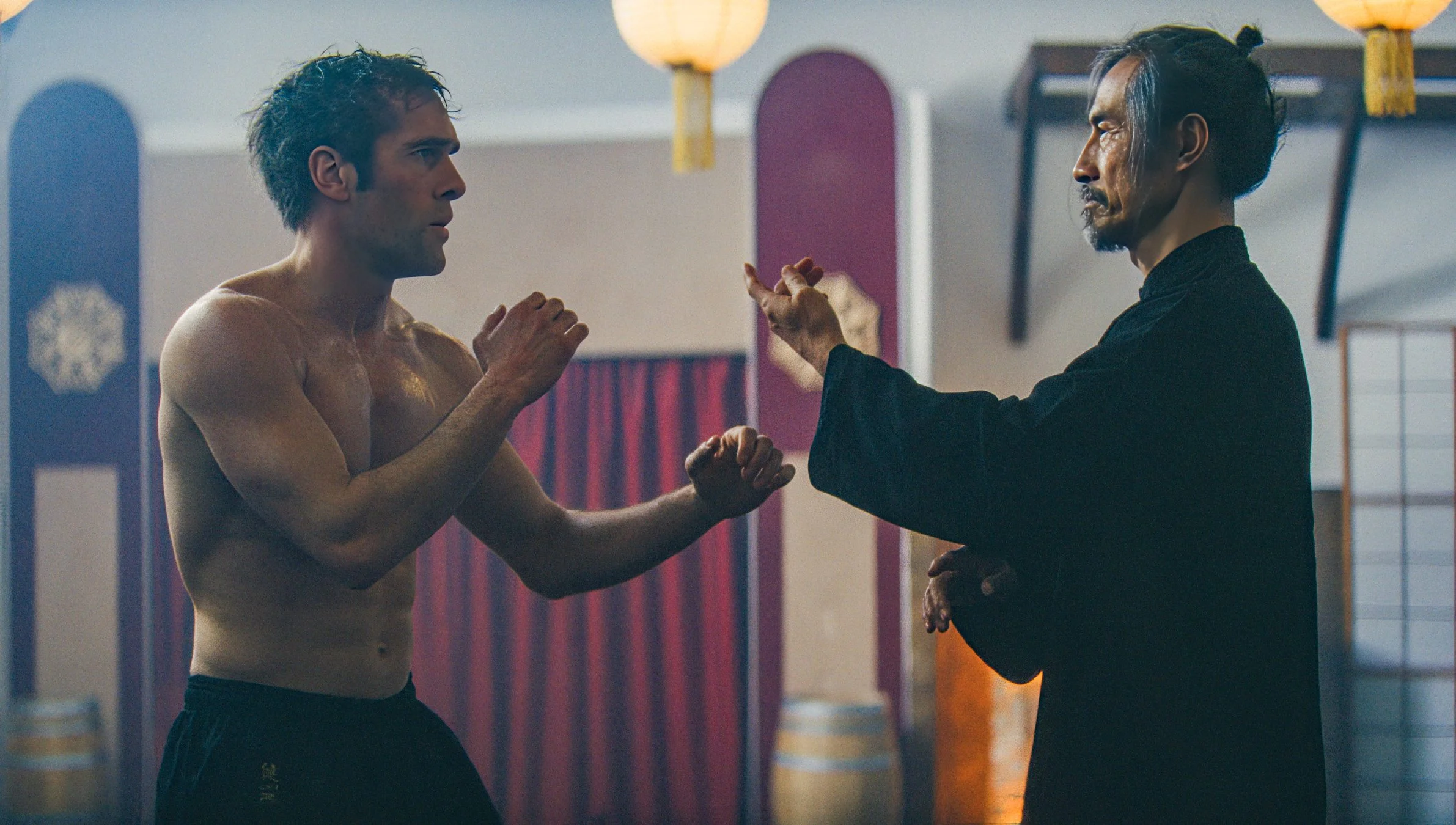
That appointment becomes urgent after Joe, played by Mathis Landwehr, leaves prison and finds work at a mill. Four years have separated him from his son, who now needs costly surgery for a brain tumor. Mei (Julin Täubner) tells him about a tournament offering $100,000, and her father, Grandmaster Wu (Yanlong Li), becomes his trainer. The arrangement has the blunt efficiency of a video-store fight film: a father needs money, a fighter needs training, and the prize is large enough to make the two needs meet. There is nothing inherently wrong with such economy. It gives the bouts a purpose before the first contestant steps forward.
The trouble lies in how completely the story clears Joe’s moral path. His time in prison, his modest job, and his son’s illness establish a man with little room to maneuver. Butch then occupies both the domestic and criminal sides of that predicament. Joe may be entering a contest where people can hurt him, yet the screenplay has removed almost every reason to question his decision to fight. His opponents can threaten his body. They can do little to trouble our view of him.
Landwehr is better equipped to answer that problem with movement than with dialogue. In the training montages, physical repetition gives Joe’s determination a form the script’s declarations cannot. Wu initially doubts him, so progress has some resistance to overcome. Those passages also offer the clearest pleasure in watching Landwehr work. His control matters even if the film has made the destination obvious. Mei’s participation in the action helps, too: for a while, she can do something within Joe’s world besides direct him toward the prize and her father.
The fights themselves offer a less consistent view of that ability. Some exchanges have the direct, energetic appeal the film promises; shorter and darker bouts make the effort harder to follow. Darkness can conceal an opponent and sharpen suspense. Here, the contest also needs to let us see what Joe has learned, how he responds, and what a victory costs him. When a fight passes quickly through shadow, the screenplay’s certainty about his worth takes the place of what his body might have demonstrated. The training has prepared us to watch for improvement, then portions of the action give us too little time to look.
That gap extends to the relationships surrounding him. Mei introduces Joe to the tournament and Wu, helps pursue the gym’s criminal operation, and develops a romantic connection with him. Those are several substantial roles, though the romance gains less from their shared activity than it ought to. Wu’s reluctance has a clearer dramatic function: Joe must win a teacher’s confidence before he can win a match. The son’s illness, meanwhile, supplies an immediate and grave motive, but the film returns to the mechanics of getting Joe into combat so readily that his family life has limited space to become particular. We understand what he is fighting for long before we know much about what he might return to.
Lion Fist comes from the makers of The Last Kumite, and its affection for the tournament films of the 1980s and 1990s is plain. Those films seldom needed intricate plots. Their best training sequences taught us to recognize a fighter’s limits, so that a later blow or change of tactic meant something. Adams’s film catches that pleasure intermittently, especially while Joe trains, and Landwehr gives it a capable physical center. By the time Butch waits across the ring, though, he is carrying Kate, the gym, and the drug plot with him. There is barely room left for the fight to develop a question of its own.
Lion Fist debuted digitally on September 15, 2026, and released through Capelight Pictures. The martial arts action film follows an ex-con martial artist who enters a brutal underground tournament to fund life-saving surgery for his sick son.
Where to Watch Lion Fist (2026) Online






Full Credits
Title: Lion Fist
Distributor: Capelight Pictures
Release date: September 15, 2026
Rating: FSK 16
Running time: 1 hour 31 minutes (91 minutes)
Director: Taim M. Adams
Writers: Sean David Lowe, Keith W. Strandberg
Producers and Executive Producers: Sean David Lowe, David Da Silva, Wayne A. Graves
Cast: Mathis Landwehr, Li Yanlong, Kurt McKinney, Keith Cooke, Brice Akuesson, Mike Möller, Gary Daniels, David Yeung
The Review
Lion Fist
Lion Fist has a capable fighter in Mathis Landwehr and training scenes that let his skill register. The tournament promises a payoff, but brief, shadowy bouts sometimes obscure the effort that should make victory satisfying. Butch’s many roles make Joe easy to support while leaving little room for tension elsewhere. The film knows where its final fight is headed; it is less sure how to make the contest itself matter.
PROS
- Landwehr’s physical ability
- Effective training montages
- Occasional energetic fights
CONS
- Too many plotlines converge on Butch
- Some fights are brief and hard to follow
- Joe’s relationships lack development
- The investigation carries little tension