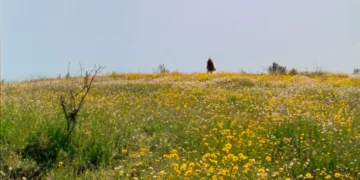














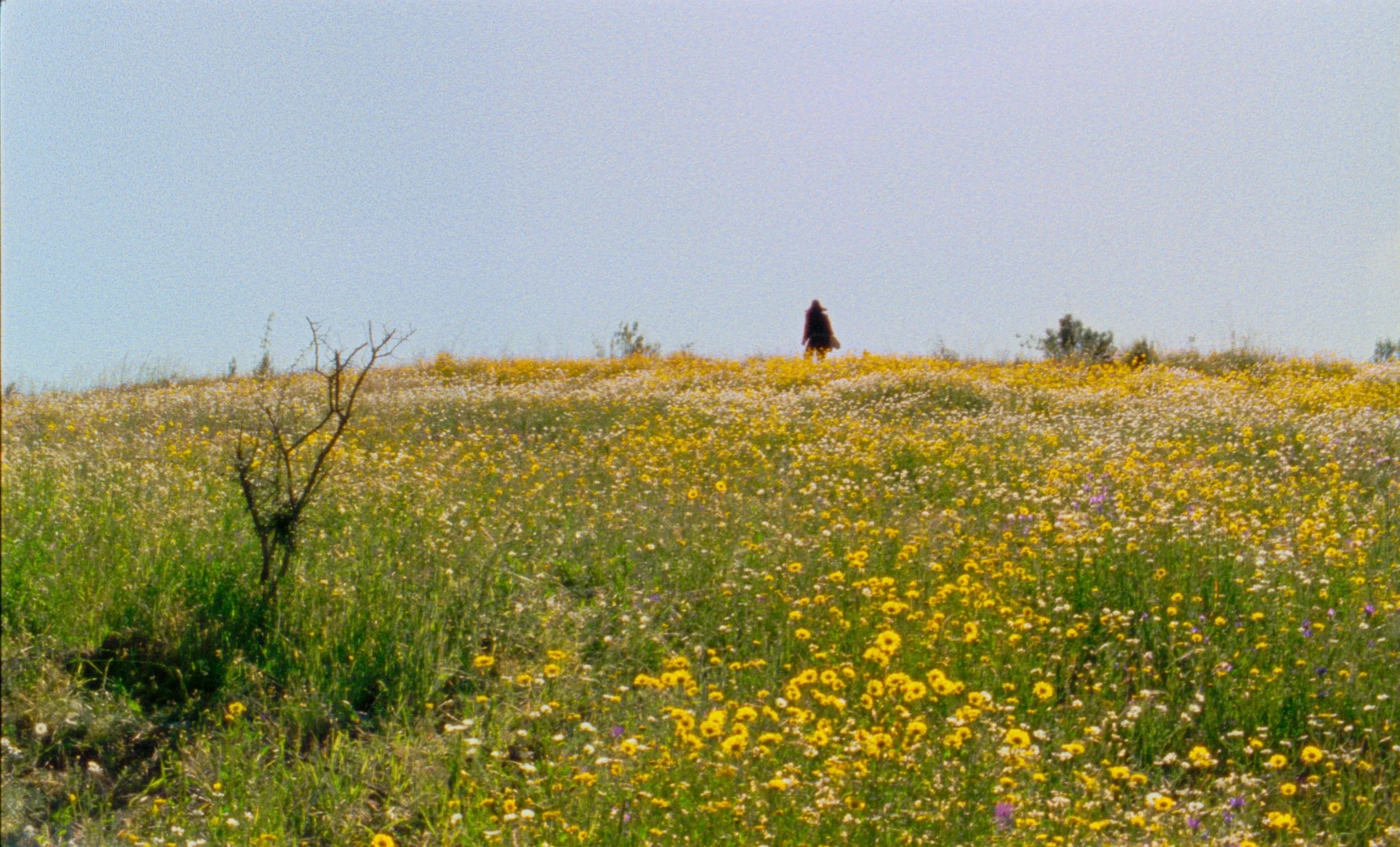

As the camera turns slowly across Alentejo’s farmland, what has slipped out of the frame remains somewhere in the mind, waiting to be joined to the next stretch of ground. Looking acquires a small burden of memory. Maureen Fazendeiro’s The Seasons asks us to inhabit these movements without the usual reassurance of a destination: a hillside gives way to another portion of countryside, and the image takes its time completing what a glance might consider finished. The land cannot be gathered into a single view. We have to spend something of our lives seeing it.
Yet the film’s patience has an unexpectedly buoyant accompaniment. Early percussion and organ notes give the landscape a lightness that resists solemn contemplation, while the rural activity supplies its own competing measures of duration. Farmers herd goats; cork is stripped from trees; sheep give birth.
Abandoned orange groves remain within this world of work and renewal, carrying evidence of cultivation that has ceased. These activities prevent the long takes from becoming exercises in emptiness. Life keeps occupying the image, sometimes according to human purposes, sometimes with an urgency that has little interest in the camera’s attention.
Set in southern Portugal, this 82-minute hybrid documentary moves between present-day observation, archaeological research, correspondence, political recollection, and enacted folklore. Its gentle pace makes those shifts remarkably easy to inhabit.
There is no central life against which every event must be measured, and the freedom from that organizing demand allows other spans of existence to become perceptible. A field can belong to a working day, a dispute over ownership, and a history whose participants are gone. Fazendeiro does not hurry to make these scales agree. The film’s quiet pleasure comes from feeling them occupy the same ground.
The wartime letters of German archaeologists Georg and Vera Leisner introduce a particularly painful disparity. Read in voice-over above images of the region, their correspondence brings the excitement of studying Alentejo’s dolmens into contact with displacement and the destruction of their home. The prehistoric tombs promise a survival their own domestic world cannot guarantee.
Discovery continues under the pressure of personal loss, and the spoken words make that coexistence intimate without supplying an entire biographical drama. We hear people attending to the distant dead while the conditions of their own lives become precarious. The landscape beneath their words has continued into a present they could never inspect.
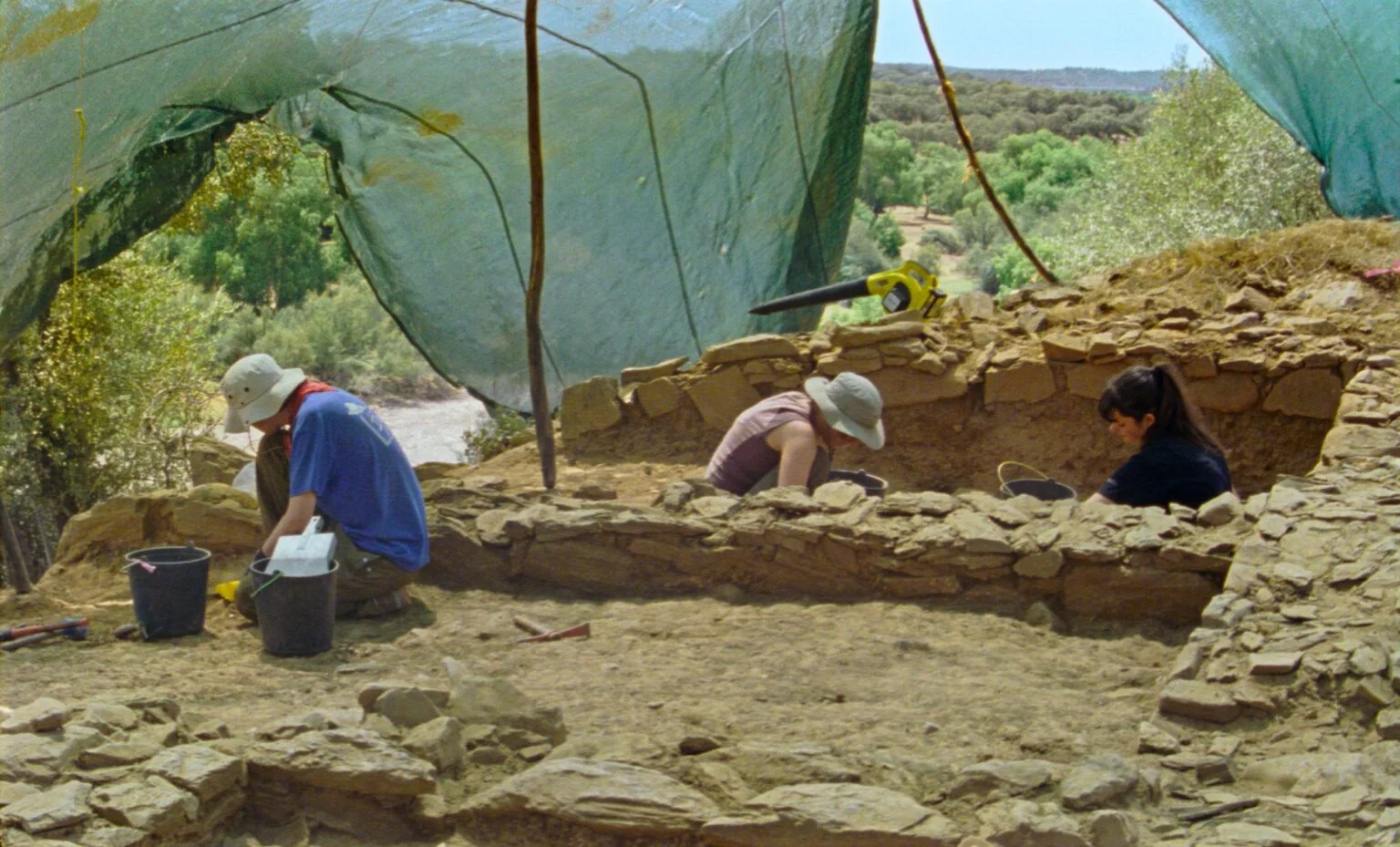
Fazendeiro places this correspondence alongside contemporary archaeologists locating, surveying, and restoring the monuments. Small tools work through dust; measuring equipment and marked areas give the search a modest, practical shape. The care matters. Ancient stones do not arrive in the present carrying explanations of themselves, and the film gives weight to the human effort required to make their survival intelligible.
There is something moving in the disproportion between the scale of the past and the smallness of the instruments brought to it. The Leisners’ voices join this labor across time, though the letters can preserve only the portions of their experience that reached the page.
An older woman’s protest song changes the feeling of that distance. Among residents recalling collective agricultural work, she gives political memory a present-tense action, singing against dependence on landowners. The landscape we have been watching so patiently becomes a place where people sought control over their means of subsistence. Its beauty cannot explain away the struggle.
Her song carries an argument that still requires someone to voice it, while a handwritten volume of poems, notes, and accounts preserves another form of attachment to the collective project. Paper and performance hold different things: the record can be revisited, while the gathering allows memory to pass between people who are still there to answer.
Archival material connected to the Carnation Revolution extends these recollections beyond the gathering, but the film’s attention to individual acts of remembrance keeps political history from dissolving into an abstract procession of eras. The attempt to redistribute agricultural resources, and the loss of that possibility, belong to the same terrain as grazing animals and harvested cork.
Natural recurrence offers no guarantee that a human opportunity will return. A season can come around again while a particular arrangement of solidarity disappears. The elders’ accounts make the film’s calm unsettled in a precise way: continuity in the landscape can accommodate a rupture in the lives lived upon it.
Local legends permit a different approach to absence. A spoken account becomes an enacted scene; period-costumed figures occupy places already made familiar through contemporary observation. The enchanted Moor and the stories surrounding an insurgent bring imagined lives into the film’s visible world.
Fazendeiro’s transitions work because the ground remains recognizable even as its occupants change. We do not need to mistake the enactment for historical proof to feel the past becoming temporarily available. In the wandering associated with Churro, storytelling acquires a body and a route through the region. The terrain gives the performance a place to occur without certifying the tale.
This ease between observation and invention could make every surviving story feel equally recoverable, but the film retains differences in how they reach us. Excavation examines material traces; a letter preserves a particular person’s words; a legend receives a new performance.
Their proximity creates an experience of historical richness without making them interchangeable sources of knowledge. Children visiting caves with prehistoric paintings add another encounter to this chain of transmission. Looking needs guidance here. The marks endure, but their continued presence does not remove the distance between the people who made them and those now standing before them.
The final pan around an ancient cork oak gives duration a form that neither testimony nor reenactment can quite share. Its spreading branches belong to a living organism, still changing while the camera records it. It is difficult to know how much comfort to take from that persistence.
The tree cannot restore a destroyed home or revive a lost collective project, and its age does not make those losses smaller. Watching the pan, I find myself attending less to what the oak might symbolize than to the difficulty of keeping its branches together in my mind as the frame moves on. The film leaves us spending time with something whose life continues beyond the view we have managed to retain.
The Seasons world-premiered at the Locarno Film Festival in August 2025 and later expanded to French cinemas via Norte Distribution. The docufiction feature explores the changing passage of time while examining both the documented and fictional histories of Portugal’s Alentejo region.
Full Credits
Title: The Seasons
Distributor: Norte Distribution, Desforra Apache
Release date: August 11, 2025 (Locarno Film Festival) / December 3, 2025 (France)
Director: Maureen Fazendeiro
Writers: Maureen Fazendeiro, Miguel Gomes
Producers and Executive Producers: Luís Urbano, Sandro Aguilar
Cast: Simão Ramalho, Cláudio da Silva, Ana Potra, Manuel Leitão, António Sozinho
Director of Photography (Cinematographer): Mário Castanheira
Editors: Maureen Fazendeiro, Miguel Gomes
The Review
The Seasons
Fazendeiro gives Alentejo’s beauty the weight of lives that have worked, hoped, and vanished there. Patient panoramas, wartime letters, and political songs make historical distance felt without turning the countryside into a monument to sorrow. The passage into folklore remains graceful, preserving the difference between recovering evidence and giving a story another life. The Seasons rewards sustained attention with a quietly unsettling awareness of what survives us, and how much effort survival requires.
PROS
- Patient camera movements make duration tangible.
- Wartime correspondence gives archaeological research emotional depth.
- Political testimony complicates the pastoral beauty.
- Fluid transitions preserve distinctions between history and legend.