


























The hungry farmer gets the opening scene; the imperial family gets the machinery of explanation. That allocation matters in “Locusts,” the third-season premiere of The Apothecary Diaries. Devastated fields, a crying baby, and dust falling through a farmer’s hands establish an agricultural crisis through people who will suffer it. Their distress is immediate and legible. The episode then transfers sustained attention to characters who can interpret the danger, placing a distance between experiencing catastrophe and possessing the authority to respond.
Before that transfer, a hooded woman offers the farmer medicine that will supposedly free him from his worldly pain. The promise addresses his anguish while leaving the ruined fields untouched. Her identity and purpose remain unresolved, but the scene gives desperation a disturbing dramatic function: it creates an opening for someone offering relief without repair. Hunger makes the farmer vulnerable to a promise whose terms he has little room to examine. The premiere supplies this encounter with menace before it explains the court’s fears, allowing suffering to exist briefly outside its usefulness to the imperial plot.
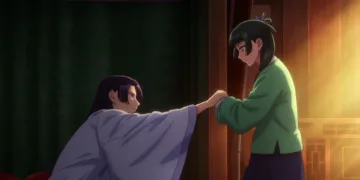
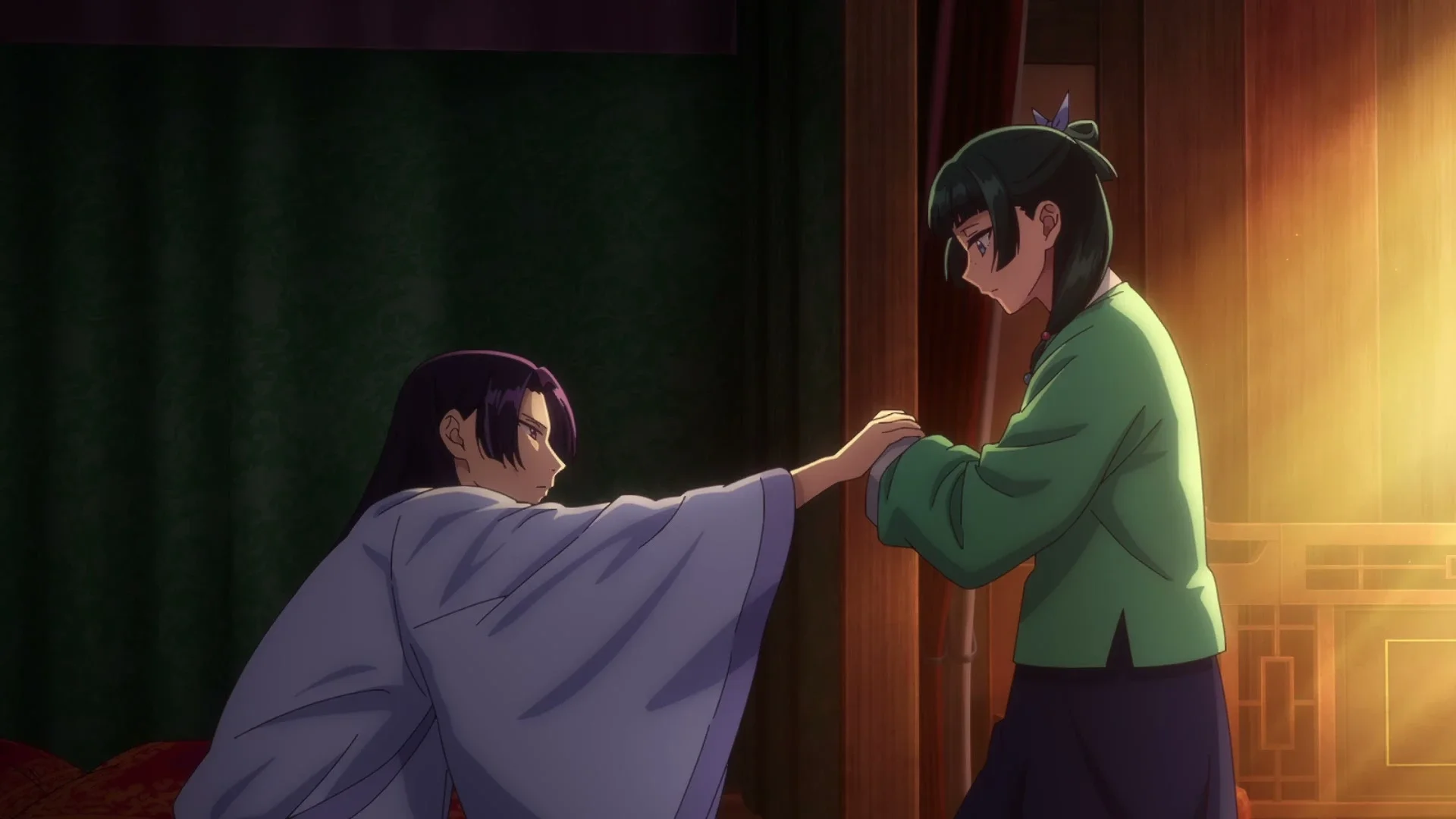
Once Jinshi and Gaoshun discuss the threatened locust plague, the crisis acquires a political vocabulary. Following the destruction of the Shi clan, ruined harvests could be interpreted as divine punishment, undermining the Emperor’s Mandate of Heaven. The connection gives the exposition substance.
Jinshi, now publicly occupying his position as the Emperor’s younger brother, must consider how an agricultural disaster could become a judgment on the regime. Still, the shift changes whose anxiety carries the episode. The farmer fears hunger; the court fears what hunger will mean. For this premiere, ordinary people establish the stakes while established characters receive the extended work of understanding them.
Gyokuyou’s promotion to Empress Consort develops the same emphasis on institutional survival. She has given birth to a son, Lihua has also borne a son, and succession now intersects with competing family interests. The Emperor’s explanation that Gyokuyou’s elevation can secure support from the West makes marriage part of a strategy for possible conflict.
Elaborate costumes and detailed palace surroundings give these arrangements ceremonial splendor, set against the damaged farmland already shown. The animation makes the difference in material conditions visible even as the dialogue concentrates on alliances. Palace beauty belongs to a system whose security may depend on people living far from its comforts.
The ceremony’s competing interests also reveal the limits of this installment’s character drama. Gyokuyou’s new position is explained principally through childbirth, regional backing, and its value to the Emperor. Those are meaningful pressures, but the premiere offers limited access to her response to them. It would be premature to mistake that emphasis for the season’s complete treatment of her.

Within this episode, however, political orientation takes precedence over developing her perspective. The court material is useful and sometimes heavy: it explains reasons for conflict without giving that conflict much immediate expression. Returning viewers receive a careful account of changed circumstances, with relatively little dramatic release.
Maomao’s investigation provides a different distribution of authority. At Verdigris House, Chou-u notices that the cooked insects taste hollow and unpleasant. His damaged memory contains an association with bad harvests that he cannot initially explain. After Maomao buys him paper and ink, his drawings help recover the distinction between the insects. The episode gives a child’s sensory experience and uneven recollection a place in the discovery process. Maomao’s intelligence remains essential, but she works with knowledge supplied by someone whose contribution the palace has no apparent way to solicit.
That choice makes their domestic exchanges productive television. Chou-u can be mischievous and dependent while still contributing something Maomao needs. His drawing links an ordinary activity to the larger investigation without requiring a sudden transformation into a miniature expert. The lighter exchanges, supported by chibi reactions, also have a hard limit. Maomao warns him that people in their vicinity would kill a child for money. The warning places their relative comfort inside a precarious environment. Her care includes teaching him about danger, and his usefulness to the mystery does not make him safe.
The familiar bird book Maomao finds in a shop extends this attention to knowledge circulating outside official channels. Recognizing it from her captivity leads her toward books removed from the Shi stronghold. Lihaku finds the seller, a former guard whom she remembers, and his practical recognition of the insects contributes another piece. His account of an earlier captive apothecary researching locust prevention connects the present threat to work conducted under coercion. The destroyed clan survives here through a child’s incomplete memory, a former guard’s testimony, and books being sold. Maomao has to recover useful information from the unsettled aftermath of the court’s victory.
This is where the premiere’s serial construction becomes both effective and frustrating. A meal leads to a drawing; a book leads to a witness; testimony opens a further inquiry. Each discovery changes what Maomao can investigate, giving the episode movement without resolving its central problem.
The palace passages demand patience through explanation, while the pleasure-district scenes reward attention through discovery. “Locusts” earns interest in the continuation more securely than satisfaction within its own running time. An episode can establish substantial stakes and still leave much of its dramatic reward on the other side of the credits.
The remaining pressure is practical. The former guard’s account suggests that someone had already been seeking a response to the insects, but that research is now dispersed among salvaged books and uncertain testimony. Recovering it may require Maomao to return to the stronghold, bringing her investigation back within Jinshi’s authority. After locating valuable observations among people outside the palace, the episode leaves her facing the problem of access: she needs to reach the surviving work before she can establish what it contains or how it might help.
The Apothecary Diaries Season 3 premiered on Crunchyroll on October 2, 2026. The historical anime series continues the intricate investigations of Maomao, a sharp-witted young apothecary solving complex medical mysteries within the imperial inner court.
Where to Watch The Apothecary Diaries Season 3 Online








Full Credits
Title: The Apothecary Diaries Season 3
Distributor: Crunchyroll
Release date: October 2, 2026
Rating: TV-14
Running time: 23 minutes per episode
Director: Norihiro Naganuma
Writers: Norihiro Naganuma
Producers and Executive Producers: Toho Animation, OLM, Pierrot
Cast: Aoi Yuki, Takeo Otsuka, Yui Ishikawa, Hina Kino, Kengo Kawanishi, Yuko Kaida, Tsuyoshi Koyama
Director of Photography (Cinematographer): Rumi Ishiguro
Editors: Misaki Enokida
Composer: Satoru Kosaki, Kevin Penkin, Alisa Okehazama
The Review
The Apothecary Diaries Season 3
“Locusts” builds a credible national crisis through the unequal distribution of power and knowledge. The court calculates threats to its legitimacy while Maomao’s investigation depends on a child’s memory, salvaged books, and a former guard’s testimony. That movement gives the premiere social substance and investigative momentum. Heavy political exposition and limited access to Gyokuyou’s perspective reduce its immediate dramatic force, while much of the payoff remains deferred. An engaging return, strongest when it lets overlooked people contribute to understanding the danger.
PROS
- Political stakes grounded in agricultural suffering.
- Discovery develops through concrete, connected clues.
- Chou-u contributes meaningfully to the investigation.
- Visual detail distinguishes palace wealth from rural devastation.
CONS
- Court exposition slows the episode’s dramatic momentum.
- Gyokuyou receives limited personal perspective.
- Substantial setup leaves immediate payoff thin.