














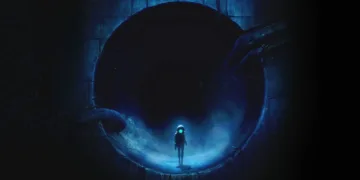
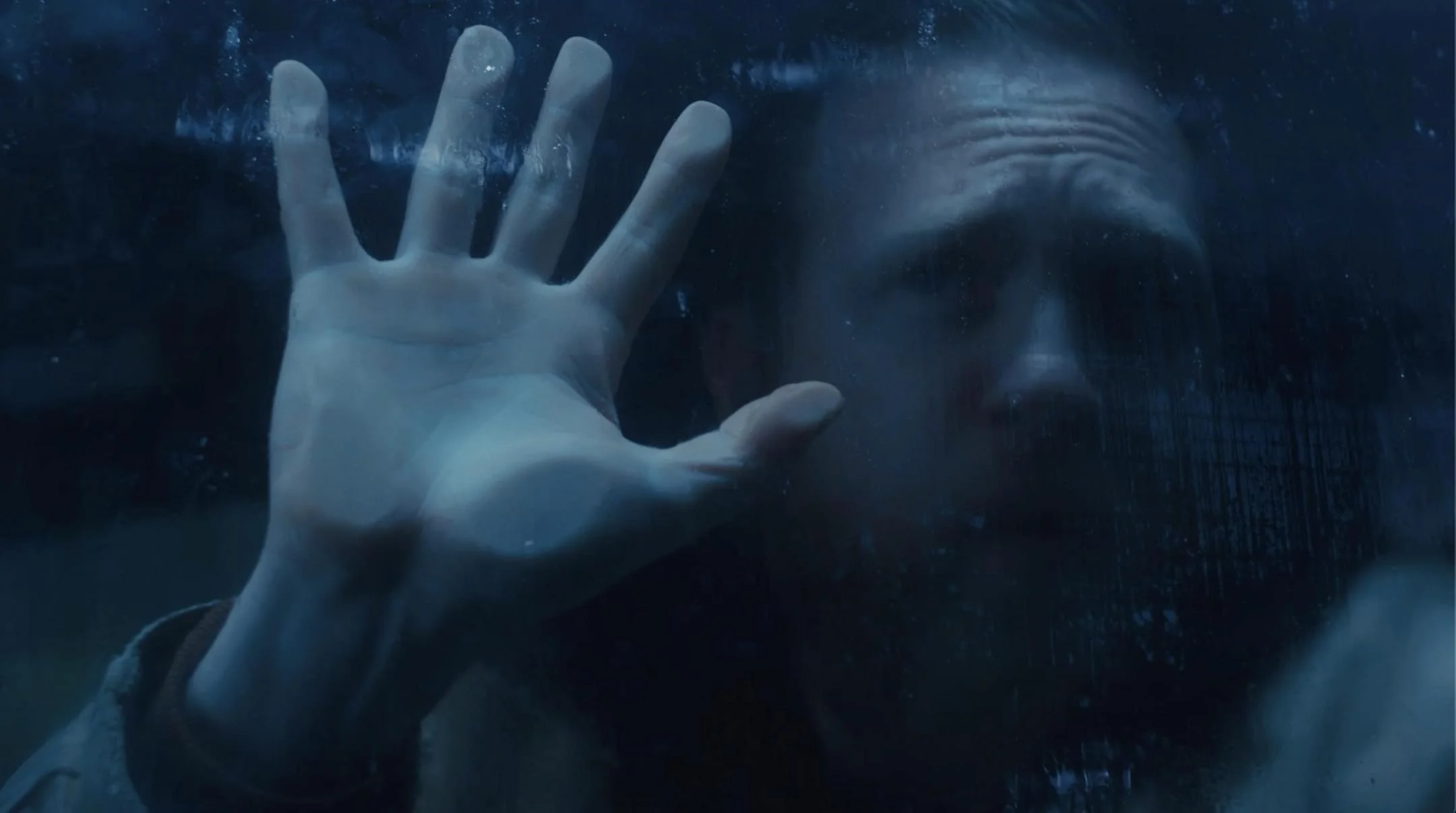

James searches the woods for a creature that might explain the disappearance of his daughter. Erich Cannon’s camera refuses to give us an unobstructed view of it. That refusal is the most productive choice in His Monster: a grieving father’s certainty exceeds the evidence available to the spectator. Even when the creature appears, close-ups and darkness restrict our inspection. James has something to pursue. We have fragments to assess. The space between those positions allows his search to register as an attempt to discover the truth and a possible refuge from it.
Neil Larson’s landscape photography widens that space. Static views of mountainous terrain, crashing waves, and aerial footage establish a world whose scale resists James’s private explanation. His daughter was swept out to sea and never recovered; the coast offers a visible account of danger without supplying an answer to her disappearance. These environmental images are effective because they place the search against something indifferent to its urgency. The woods and water can hold his attention indefinitely. They cannot tell him how to live with what happened.
Gabriel Casdorph plays James, a divorced father living alone in an Oregon cabin and struggling with alcoholism. The setting is familiar horror territory, with isolation practically included in the lease. Cannon makes useful work of it by leaving the relationship between James’s perceptions and the threat unsettled.
When people around him begin dying, he finds further reason to believe in the creature. Yet his conviction remains entangled with drinking, grief, and obsession. The film draws on the psychological thriller’s suspicion of its own central witness without making his addiction an easy instruction to disregard everything he sees.
Its account of dependence has firmer ground beneath it. Present-day pressures alternate with flashbacks to James’s past mistakes, allowing memory to intrude upon his attempts to continue living. Stress brings the possibility of another drink back into reach.
The construction gives relapse a temporal dimension: an immediate difficulty carries the weight of earlier failures, and the past becomes part of the pressure bearing down on the next choice. Cannon finds a credible rhythm here, treating recovery as something vulnerable to ordinary experience rather than a single dramatic decision.
The monster metaphor is less settled. Giving grief and addiction a body creates an opponent James can pursue, which is precisely what makes the device ethically awkward. His suffering deserves attention; his conduct still requires examination. The end of his marriage and the inability of a new romantic relationship to interrupt his fixation prevent isolation from looking entirely imposed upon him.
He continues directing his energy toward the woods while his connections to other people deteriorate. The creature can express that destructive preoccupation, though the film sometimes seems uncertain how much explanatory weight it should carry.
Casdorph’s restraint sustains the ambiguity at a cost. His emotional bursts emerge from a predominantly closed register, an appropriate choice for someone whose pain rarely finds a useful outlet. The performance avoids making every encounter a public demonstration of anguish. It also gives grief, craving, and fear a limited range of outward expression.
Containment becomes monotonous across the longer dramatic stretches, where small distinctions would help us understand what is changing inside James. Meranda Long’s Mira supplies a welcome counterpressure through her warmth and expressiveness. Beside her, his withdrawal becomes easier to perceive as a way of relating to people, with consequences beyond his own discomfort.
Cannon gives these dramatic passages substantial room across the film’s 87 minutes. The difficulty is the intermittent relationship between their emotional pressure and the horror. Brief creature appearances interrupt long stretches concerned with loss and recovery, sometimes changing the register before the drama has generated a need for that change.
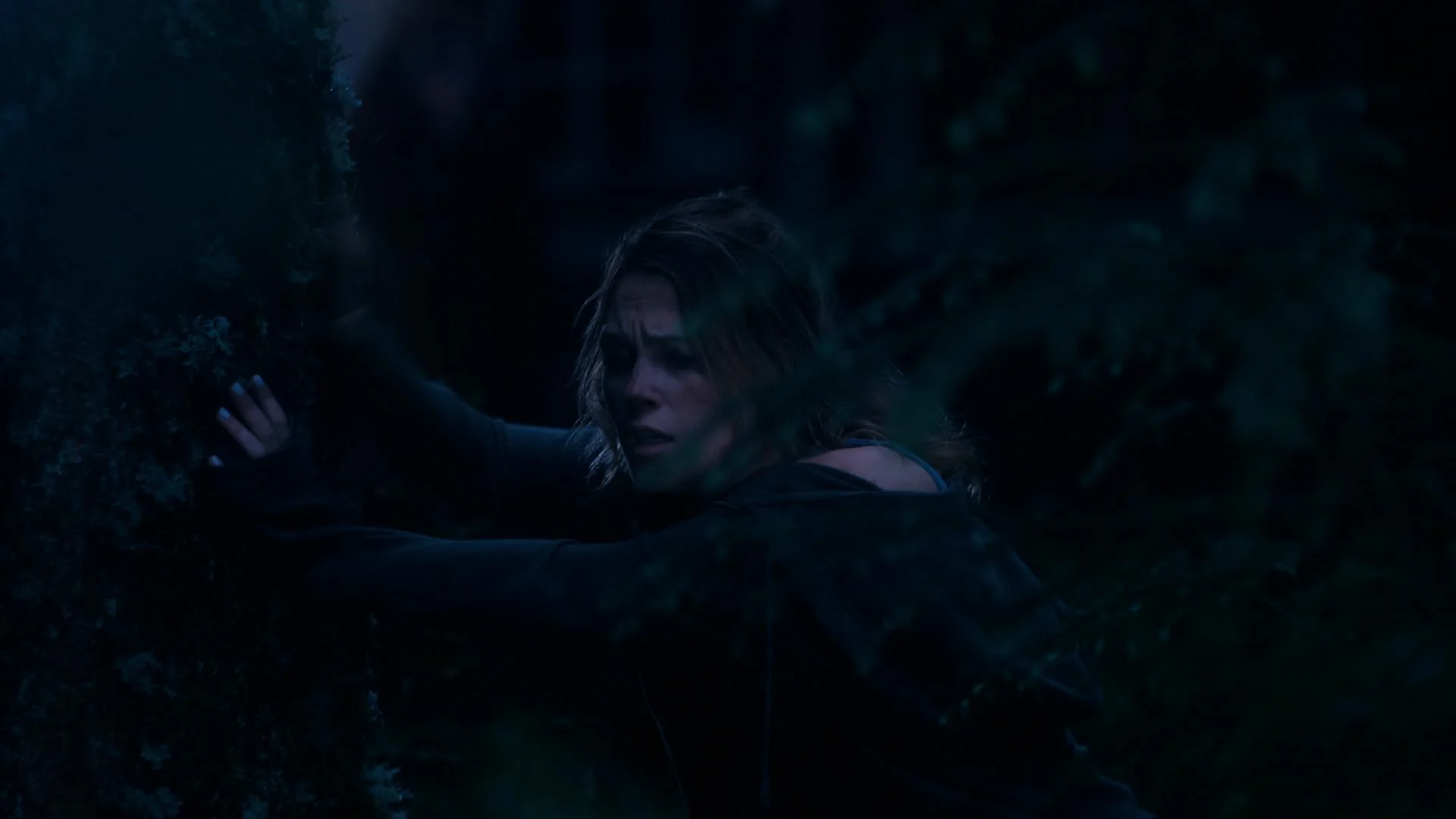
Absence can make a threat accumulate in the imagination. Here, some of the absences allow the creature to feel temporarily detached from the story it is supposed to embody. The film’s strongest uncertainty concerns James’s interpretation; its weaker uncertainty concerns how the genres fit together.
The final act brings that problem into sharper audiovisual focus. The Shojo Monster has glowing red eyes and bright orange fur, features that remain conspicuous even as darkness and close-ups conceal portions of its form. A physical suit and digital, smoke-like imagery give its presence both bodily substance and instability. Cannon’s restriction of the full image preserves something for the spectator to construct, while the emphatic color makes the creature difficult to dismiss. The threat becomes visually assertive without becoming fully available for inspection.
Sound pushes harder. High-pitched shrieks and laughter give the monster an aggressive presence that exceeds what the frame reveals. William Cannon’s score grows from softer passages into louder music, with chant-like vocals intensifying the confrontation; increased camera movement accompanies James’s heightened state. These choices create an effective surge, though they also narrow the perceptual uncertainty on which the earlier material depends. The eye is still asked to investigate while the soundtrack announces danger.
That shift leaves the confrontation carrying two different burdens. James must face what he believes is threatening him, and the recovery drama needs his relationship with his own past to remain active. The restricted image keeps the creature from becoming a wholly legible answer, but the escalating music and movement direct attention toward an immediate contest.
Accepting responsibility has a less spectacular shape. As the film concentrates its force on James facing the Shojo, the mistakes recalled in its flashbacks still demand something a confrontation alone cannot provide: choices that extend beyond facing an immediate threat.
His Monster launched on digital streaming platforms like Amazon Video on October 5, 2026. The folklore horror film follows a struggling alcoholic who becomes convinced that a mythical beast is responsible when his young daughter is mysteriously swept out to sea.
Where to Watch His Monster (2025) Online



Full Credits
Title: His Monster
Distributor: Amazon Video
Release date: October 5, 2026
Running time: 1 hour 27 minutes (87 minutes)
Director: Erich Cannon
Writers: Erich Cannon, Nathan D. Lee
Producers and Executive Producers: Kim Hornsby, Neil Larson, Bryce W. Fillmore
Cast: Gabriel Casdorph, Meranda Long, Ashley Song, Brace Evans
Director of Photography (Cinematographer): William Cannon
Editors: William Cannon, Nathan D. Lee
Composer: William Cannon
The Review
His Monster
His Monster finds its strongest horror in the gap between James’s conviction and what Cannon allows us to see. Restricted creature imagery, expansive landscapes, and intrusive memories give grief and addiction a persuasive psychological shape. The dramatic stretches and monster appearances connect unevenly, while Casdorph’s restraint sometimes hardens into monotony. The final confrontation gains audiovisual force at the expense of uncertainty, leaving the recovery story with questions that spectacle cannot settle.
PROS
- Partial creature reveals sustain psychological uncertainty.
- Landscape photography gives James’s obsession a stark setting.
- Flashbacks connect present pressures to past mistakes.
- Meranda Long’s warmth sharpens James’s emotional withdrawal.
CONS
- Horror appearances sometimes feel detached from the drama.
- Casdorph’s narrow emotional register becomes repetitive.
- The finale’s emphatic sound reduces perceptual ambiguity.