






























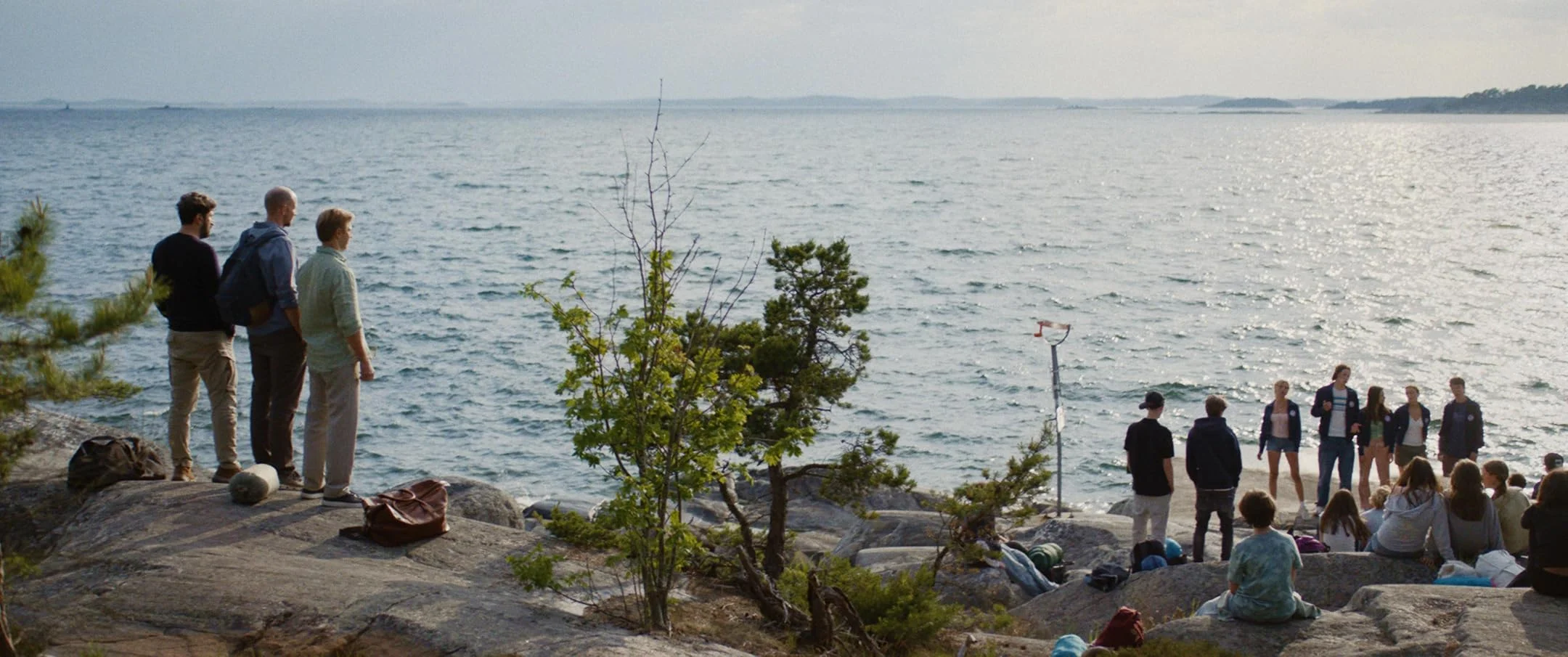
Bill smiles a little too late during the boat crossing to Klippvik. Pontus has made inappropriate sexual remarks about the girls, Bobo has hesitated before laughing, and Bill is trying to conceal his discomfort by joining in. Watch the timing: three men sharing a joke are already negotiating who gets to set the tone. They are accompanying their daughters’ class to an island camp, but Alex Schulman’s debut feature, Adult Supervision, gives them this small test of responsibility before they arrive. Nobody challenges Pontus. Bill’s smile tells us how difficult he finds even that modest act of resistance.
The cafeteria soon offers a test that Bobo can pass. Children introduce themselves with provocative fake names, Bill struggles to manage the confrontation, and Bobo steps in with enough force to frighten them into obedience. Fares Fares makes his confidence attractive here. Someone needs to handle the situation, and he can. I found that initial usefulness essential to the character: Schulman gives us a reason to welcome Bobo’s authority before asking us to examine how he exercises it. Getting a room under control can look reassuring without telling us much about what its occupants need.
There are no teachers accompanying these thirteen-year-olds, though young camp staff are present. Bill, played by Gustaf Skarsgård, has volunteered hoping to spend time with his daughter Ester. His difficulty asserting himself makes that wish feel vulnerable from the outset. Skarsgård supplies a history through posture: shoulders folded inward, wary expressions, a slouch even when Bill is offering advice. Physical performance can let us understand a character before the screenplay explains him. Here, the person trying to offer reassurance seems to be searching for some himself.
Bill’s concern for Kenneth, a boy targeted by classmates, gives that vulnerability a purpose. He recognizes suffering and wants to intervene. Ester’s blunt admission that nobody likes Kenneth makes the boy’s isolation particularly painful, since her response offers Bill so little comfort.
Yet Bill’s own experience of bullying shapes what he thinks he understands. He can recognize a familiar hurt quickly while remaining slow to recognize an unfamiliar situation. Schulman keeps compassion valuable even as he questions the certainty that can accompany it. Kenneth needs help, but Bill’s identification with him does not settle what that help should be.
The changing relationship between Bill and Bobo develops this problem through the actors rather than explanatory speeches. Fares’s easy command begins to acquire a threatening edge as Bobo loses patience with Bill and suggests tormenting him for amusement. Skarsgård’s unease, initially something Bobo’s confidence seemed able to relieve, becomes something that invites aggression.
The adult relationships start reproducing the hierarchy among the pupils. That repetition gives the ensemble its momentum: the men’s attempts to supervise the children keep revealing behavior they have failed to recognize in themselves.
Schulman gives those recognizable social encounters an increasingly strange setting. Jakob Ihre’s photography preserves the island’s appeal, making it easy to understand why this could seem an inviting place for a school trip. The miniature island views used as transitions, the bridges between scenes, produce a different feeling.
Paired with Wilhelm Börjesson and Oskar Rindborg’s score, they make a change of scene feel ominous. We are waiting for the next encounter before it has begun. The film borrows the expectation of danger associated with an isolated setting and attaches it to people whose roles are supposed to reassure us.
The writing on camp bed frames and in the fathers’ cabin extends that unease across time. The men laugh at the cabin graffiti until Pontus suggests that previous adult chaperones probably wrote it. It is a useful correction to their assumptions, delivered through a joke they have already enjoyed. Their amusement depends on recognizing childish behavior; their surprise depends on assigning it to the wrong age group. Those traces of earlier occupants make the camp feel like a place where successive visitors have left evidence of the same impulses.
Pontus’s own behavior is less rewarding to follow. Linus Wahlgren plays his pursuit of counselor Olivia with embarrassing self-assurance, while Elsa Öhrn gives Olivia an intelligence that repeatedly leaves him exposed. The mismatch works as uncomfortable comedy, and her ability to read their encounters resists his treatment of her as an opportunity for a fling. But the thread offers a narrower pattern than Bill and Bobo’s relationship. Pontus keeps redirecting his attention toward Olivia, and each repetition supplies less new understanding of him. His distraction belongs to the film’s subject, yet it can feel detached from its strongest developing conflict.
Noomi makes the cost of that distraction clear. She is distressed by her father’s conduct, including his dancing, while he gives her little attention. Her embarrassment has a different source from Ester’s wish for independence: Noomi is watching a parent neglect her needs while drawing attention to himself. Julia’s relationship with Bobo adds another variation. His angry response to her unwise adventure, followed by laughter about it later, exposes inconsistency beneath his apparent certainty. These daughters prevent adolescent resistance from becoming one undifferentiated problem for the fathers to solve.
The movement into harsher bullying, animal cruelty, and shocking violence is unsettling because intimidation has already become familiar within the group. Schulman builds anticipation through clashes and misjudgments, then gives the threat a severity that dark comedy can no longer comfortably contain. The escalation works, though its force creates a limitation of its own. The quieter failures of care can struggle for attention beside the violent shocks. A frightened response, an ignored daughter, or Bill’s awkward attempt to help can reveal something precise about these relationships without needing the same dramatic volume.
Ester’s changing relationship with Bill leaves a difficulty that force cannot address. He came to the island hoping for closeness, but her need for attention no longer arrives in the form he expects. She can want distance from him and still want him to notice her. Bill’s readiness to recognize his younger self in Kenneth makes that adjustment harder: familiar suffering gives him a role he understands, while his daughter requires him to learn a different one.
Adult Supervision premiered in September 2026 at Fantastic Fest before its scheduled theatrical rollout by Scanbox Entertainment. The dark Swedish comedy explores modern fatherhood and flawed masculinity as three men chaperone their teenage daughters on a chaotic school trip to a remote island.
Full Credits
Title: Adult Supervision
Distributor: Scanbox Entertainment, Warner Bros.
Release date: September 19, 2026 (Fantastic Fest) / October 9, 2026 (Sweden)
Running time: 1 hour 48 minutes (108 minutes)
Director: Alex Schulman
Writers: Alex Schulman
Producers and Executive Producers: Christina Legkova
Cast: Gustaf Skarsgård, Fares Fares, Linus Wahlgren, Olof Olingdahl, Baxter Renman
Director of Photography (Cinematographer): Jakob Ihre
Editors: Dino Jonsäter
Composer: Wilhelm Börjesson, Oskar Rindborg
The Review
Adult Supervision
Adult Supervision turns a school trip into an unsettling lesson in how authority works. Skarsgård and Fares make the fathers’ shifting relationship absorbing, while miniature island views and an ominous score build anticipation between encounters. Schulman understands how sincere concern can coexist with poor judgment. Pontus’s thinner subplot and the late violence sometimes distract from the quieter failures of care, but the film’s strongest moments make those failures painfully recognizable.
PROS
- Skarsgård’s physical performance communicates Bill’s unresolved hurt.
- Fares makes Bobo’s authority both useful and troubling.
- Island transitions and music turn social discomfort into suspense.
- The daughters bring distinct needs into the adult-centered drama.
CONS
- Pontus’s repetitive subplot feels less integrated with the central conflict.
- Violent shocks sometimes overshadow subtler failures of care.