












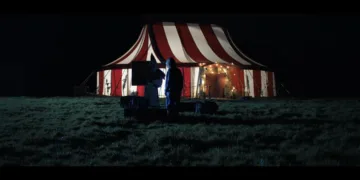















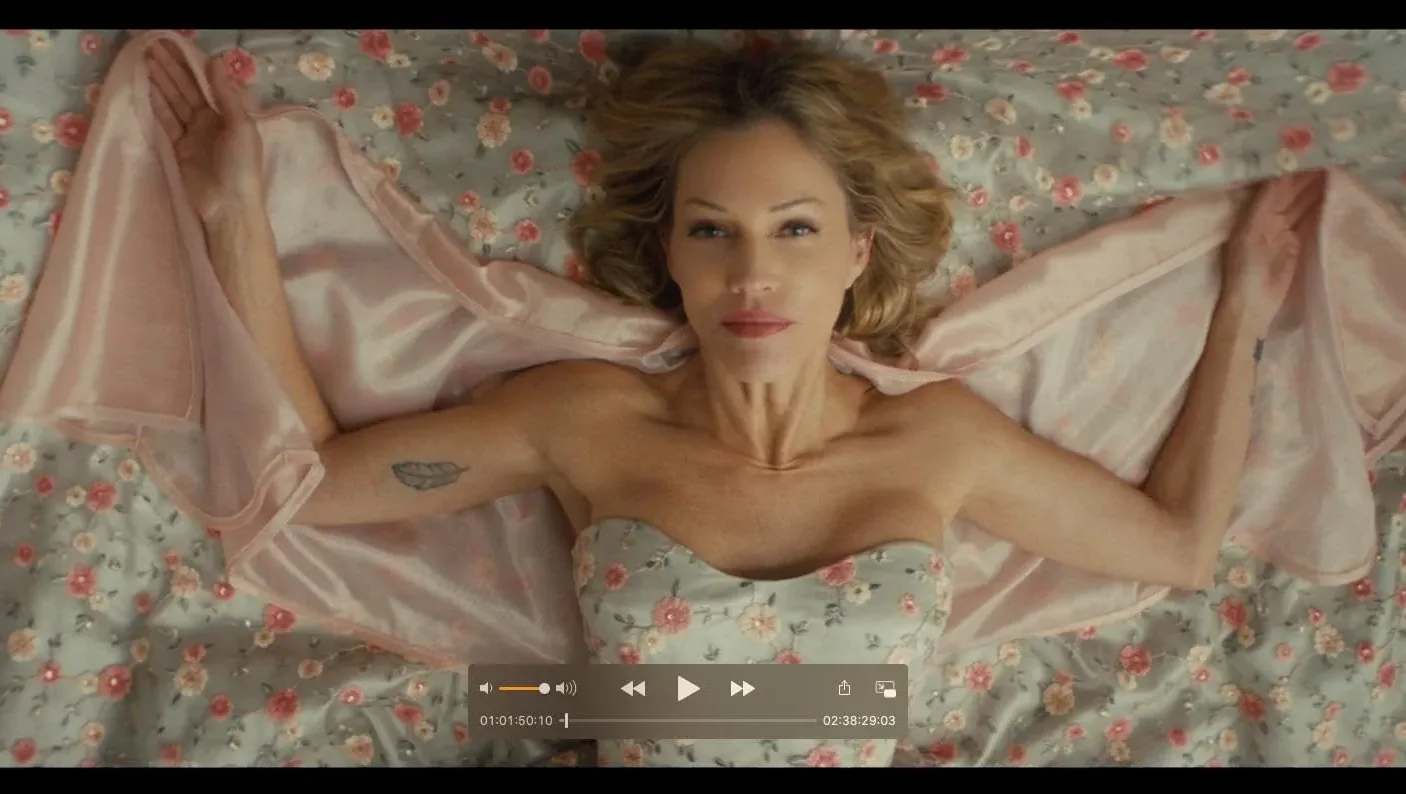

Willow’s early modeling photographs give us a quick education in how she is seen. A scarlet dress draws attention to her body; a bridal gown supplies another recognizable ideal; a floral outfit matches the bed beneath her. Airport announcements place her career on an international circuit.
These details establish success through images made for other people’s approval. In Ziad H. Hamzeh’s Hello Beautiful, Tricia Helfer plays a woman whose appearance is both a livelihood and a familiar source of reassurance. The visual introduction gives her attachment to beauty a practical foundation before the film asks us to understand its emotional cost.
The opening narration brings suicidal despair into this polished world. Placing those elements together creates an immediate distance between the woman in the photographs and the person speaking. It also raises an interesting storytelling promise: we will learn what the photographs leave out.
Adapted from Christine Handy’s Walk Beside Me, which draws on her experiences, the film moves into Willow’s breast cancer diagnosis and treatment. Her fear of bodily change grows from the identity those early images establish, though the screenplay has less patience for exploring the parts of her life that cannot be photographed.
That becomes apparent in her marriage to Khalil, played by Tarek Bishara. Remarks from friends about men leaving their wives after a diagnosis feed Willow’s anxiety that her husband’s love depends on her looks. The suggestion is enough to turn the physical threat of cancer into a fear of abandonment.
Helfer makes the insecurity understandable, particularly when Willow’s distress becomes accusatory. Yet Khalil’s efforts to support her give us limited reason to accept her reading of him. The film leaves the relationship’s earlier history thinly sketched, so it becomes difficult to distinguish an established marital wound from a fear created by the illness.
I found the uncertainty around diagnosis easier to connect with because the film gives it a concrete shape. A test before the weekend leaves Willow waiting. A doctor’s request to discuss results in person communicates alarm before anyone explains what is wrong. The word “aggressive,” applied to treatment without enough detail, creates another gap for her imagination to fill. These situations build tension by controlling information: Willow knows enough to be frightened and too little to feel prepared. They let us understand her anxiety through the circumstances producing it, without needing every feeling translated into dialogue.
Helfer carries that anxiety into treatment with considerable emotional energy. Willow’s anger, despair, and fear of losing Khalil keep her from becoming a politely suffering figure whose main task is to receive sympathy. Chemotherapy, vomiting, weakness, and the loss of her hair threaten her ability to recognize herself, and Helfer gives those pressures a personal charge.
Her vulnerability is especially valuable because Willow can be difficult company. The performance allows fear and unpleasant behavior to occupy the same person. We can understand why she lashes out without having to approve of every accusation she makes.
Hamzeh often adds explanation where that performance has already supplied understanding. A line telling Willow that tearing down Isabel means “killing a part of yourself in Khalil’s heart” spells out a family conflict as though explaining it to the audience. Marco Werba’s score sometimes does the same job.
Underscoring, the music placed beneath a scene, can help us register a feeling a character cannot express. During the head shaving, the emphatic strings insist on an emotional significance already present in the action. I wanted room to watch Willow respond to the change. The music makes the scene’s intended sadness so explicit that her individual response has less space to surprise us.
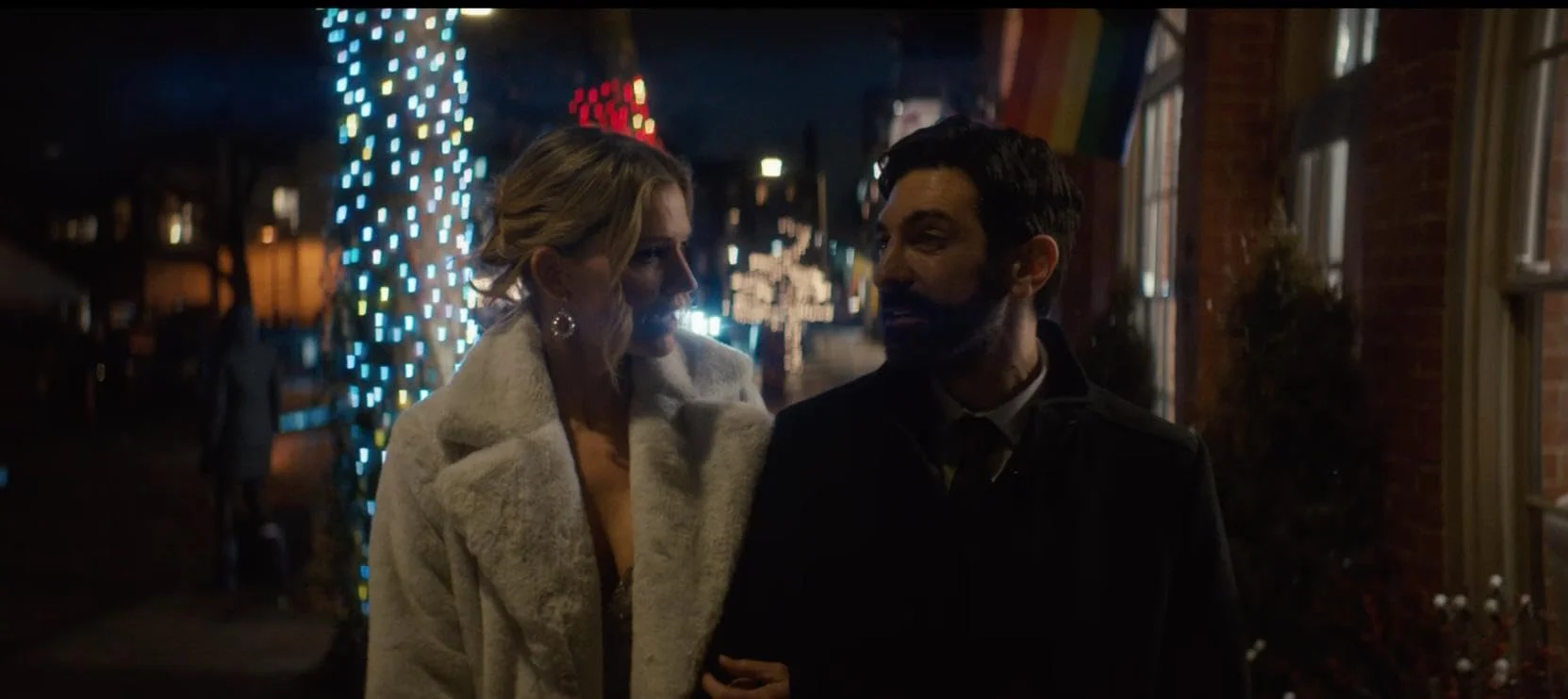
The lighter exchanges involving Candace offer a welcome change in that emotional pressure. Their humor permits treatment to contain moments that are awkward or funny, giving Willow’s world some breathing room. The family material reaches for a similar range, especially through Isabel.
Sara Boustany makes the teenager’s movement between resentment and desperate need feel recognizable. A daughter can be furious with her mother and terrified of losing her without either feeling cancelling the other. Boustany preserves that coexistence, which is useful in a film whose dialogue often tries to settle feelings into clear explanations.
The difficulty lies in the amount of development connecting the family’s earlier conflicts to its later support. Isabel’s changed behavior has emotional credibility in the performance, while the writing compresses the process behind it. Khalil’s mother objects to Willow’s career and questions her attention to the children, introducing tensions about work and caregiving that receive limited exploration.
Elsewhere, a brusque nurse becomes gentler and friends gather with pink umbrellas. The film is eager to show care becoming visible. Several relationships reach reassuring destinations before their intermediate steps have acquired enough weight, leaving the cast to supply continuity the screenplay has hurried past.
Willow’s surroundings further shape the kind of reassurance the film offers. The large house, chauffeur Malek, and private transport give her comfort and privacy during an experience that threatens both. Medical bills and insurance do not become significant dramatic pressures. That focus is legitimate for this particular family, and wealth provides no protection from the diagnosis itself.
It does, however, narrow the practical problems the story needs to address. Appearance, marriage, and emotional support occupy space that another patient might have to devote to keeping a job or reaching an appointment. The film rarely examines that difference within Willow’s own understanding of her situation.
Its final movement toward a revised sense of self-worth carries the same preference for emotional clarity. The early modeling images make beauty legible as something rewarded by work, attention, and desire. Later, bodily change becomes the occasion for recognizing value beyond appearance, but that recognition receives less development than the suffering preceding it.
There is room here for an affirming story about a woman learning to see herself differently. The timing also creates a troubling implication: illness appears to deliver an understanding that ordinary life withheld. Willow’s growth is presented with confidence, leaving little space for the ambivalence of gaining that understanding through an experience she would never have chosen.
Hello Beautiful received a wide theatrical rollout via Freestyle Releasing on September 25, 2026, following its initial festival run. Based on Christine Handy’s novel, the emotional drama follows a successful supermodel whose world is upended by a devastating breast cancer diagnosis.
Full Credits
Title: Hello Beautiful
Distributor: Freestyle Releasing
Release date: April 1, 2025 (Beverly Hills Film Festival) / September 25, 2026 (United States)
Running time: 1 hour 40 minutes (100 minutes)
Director: Ziad H. Hamzeh
Writers: Ziad H. Hamzeh, Christine Handy
Producers and Executive Producers: Tricia Helfer, Ziad H. Hamzeh, Christine Handy
Cast: Tricia Helfer, Tarek Bishara, Sara Boustany, Liam Anderson, Susan Shalhoub Larkin, Lisa Marcos, Sadie Stratton, Olivia Gilliatt
The Review
Hello Beautiful
Hello Beautiful finds its strongest emotional footing in Tricia Helfer’s vulnerability and the unsettling wait for medical answers. Its modeling imagery gives Willow’s fear of bodily change a clear foundation. The dialogue and emphatic score frequently explain feelings already visible in the performance, while compressed family reconciliations weaken the support surrounding her. There is sincere feeling here, but Willow’s eventual affirmation needs the patient development given to her suffering.
PROS
- Helfer makes Willow’s fear and difficult behavior understandable.
- Boustany preserves Isabel’s conflicting emotions.
- Medical uncertainty creates concrete, recognizable tension.
- Modeling imagery establishes Willow’s attachment to appearance.
CONS
- Dialogue overexplains emotional conflicts.
- Emphatic strings crowd the head-shaving scene.
- Supporting relationships reach reconciliation too quickly.
- Willow’s revised self-worth receives limited development.