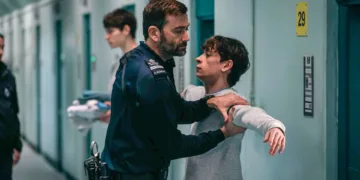



























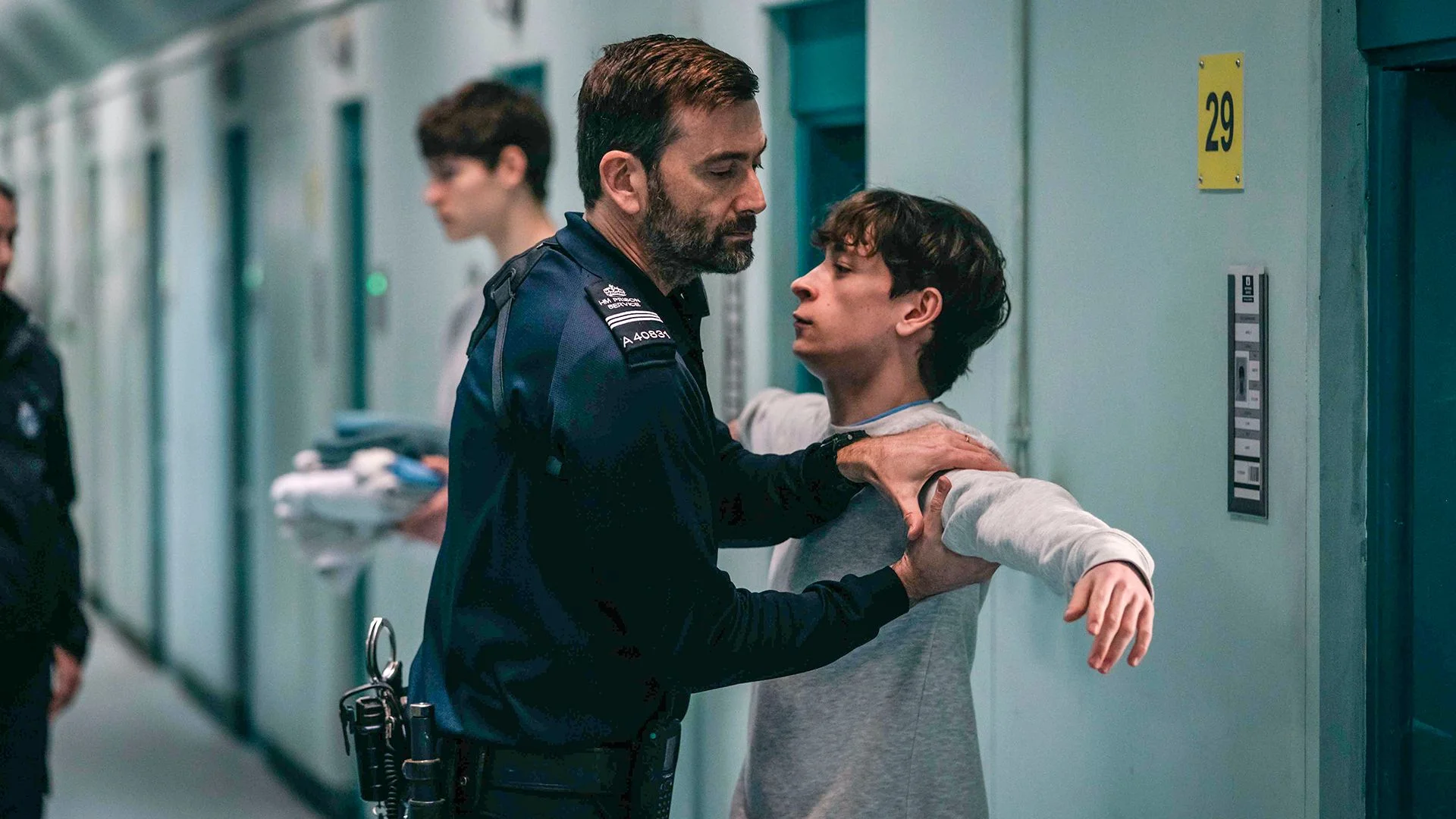

Locked doors do surprisingly little to quiet Alderwick. Boys shout threats, hammer on doors, pace their cells, and turn their distress against themselves. In the third season of Time, the “keep-apart” system prevents inmates considered likely to attack each other from being out simultaneously, sometimes leaving them confined for 23 hours a day. Director Paul Whittington makes that restriction feel horribly busy. The sound keeps people present whom the institution has physically removed from one another. Everyone has been separated. Nobody has been calmed down.
When contact does come, the violence changes the pace without relieving the tension. Fights and improvised blades give the preceding confinement a frightening destination: all that waiting has prepared the boys for another confrontation. Whittington gives the aggression enough physical force to make an encounter feel dangerous before its outcome is settled.
The cries and banging have already done much of the dramatic preparation. Writers Jimmy McGovern and Samuel Bailey build the institutional argument into this rhythm, moving between isolation and eruptions that seem to justify further isolation. Rehabilitation appears to have been left off the rota.
The first episode gives that cycle a particular human cost through Christopher, later called Ushindi, played by Chukwubuikem Molokwu. His birth mother appears during visiting time, and he wants a hug. Beside the surrounding threats and displays of toughness, the simplicity of that wish is startling.
Molokwu’s portrayal of his stammer makes the effort of communication palpable, but the scene’s force comes from the relationship between difficult speech and uncomplicated need. A boy who struggles to get words out wants something that requires none. The visiting encounter lets the drama attend to a need Alderwick’s routine scarcely knows how to accommodate.
There is some heavy emotional preparation here. Ushindi’s gentleness, his stammer, and his longing for maternal affection place several invitations to sympathy close together. The writing risks making its case depend on a boy whose vulnerability is especially easy to recognize.
Molokwu keeps him from becoming merely a collection of those invitations, giving his gentleness a determined quality. Still, the concentration matters. A prison drama’s empathy faces a harder test with someone abrasive, defensive, or difficult to like, and the season has such boys elsewhere in its ensemble. Ushindi’s story occasionally presses harder than his performance needs it to.
The episode’s reconciliation meeting makes the machinery behind that pressure horribly visible. An intervention meant to ease hostility ends catastrophically, and its consequences disturb custodial manager Bobby Bailey’s practiced detachment. This is an effective turn in the three-episode construction because the incident continues through the adults’ responses.
Freddie Jennings’s workplace mistake contributes to the tragedy; his efforts to evade responsibility extend its damage. Bobby begins questioning his own participation in the routine. The same event produces self-protection in one officer and an uncomfortable reckoning in another. Reconciliation has become the occasion for discovering how little agreement there is about responsibility.
Freddie’s treatment of James supplies an uglier version of that refusal. Daniel Ryan’s officer answers a wisecrack with a punch to the stomach, leaving the boy gasping on the floor. Louis McCartney gives James a restless comic energy, making humor a way to conceal distress and test the people around him. Freddie treats that defensive performance as an authority problem requiring immediate correction.
The timing is brutal: a joke creates an opening for violence rather than relief. James has killed his brother, and the drama preserves the seriousness of that history while showing how an adult response can reinforce the behavior it is supposed to address.

David Tennant’s Bobby works through a quieter register. His irritability at Alderwick sits alongside a depleted home life: drinking, staring at the television, and remaining under the same roof as a wife who has announced an affair but cannot afford to leave.
Vinette Robinson’s Erica brings a coldness that gives Bobby little domestic relief. Tennant’s subdued performance makes these scenes useful to the season’s tension. The audience waits for a man who appears to have little energy left to find some destructive reserve. His growing discomfort about the institution has to push against habits of withdrawal already visible in his evenings at home.
The younger ensemble prevents Bobby’s conscience from becoming the only story worth following. Ollie McNulty’s Peter is a new father, implicated in a group’s street murder, and divided between guilt and loyalty. Those competing attachments give him a different pressure from James’s volatility or Ushindi’s wish for affection.
McGovern and Bailey retain the crimes alongside the needs, allowing the boys’ prospects to remain difficult without treating difficulty as a reason to abandon them. Peter’s fatherhood also gives rehabilitation a concrete destination beyond Alderwick: another person will eventually have to live with what this institution teaches him.
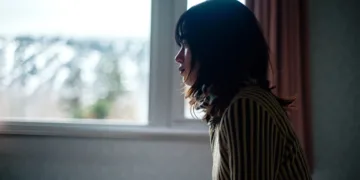
Siobhan Finneran’s Marie-Louise offers a different rhythm again. The returning chaplain arrives after losing her religious faith, expecting that an admission of doubt might cost her the post. Instead, a senior chaplain asks her to continue. Finneran’s steadiness makes care register as sustained work rather than a burst of inspiration.
Against Freddie’s swift punitive response and Bobby’s emotional retreat, her willingness to remain attentive changes the temperature of the drama. The uncertainty in her private life gives that persistence weight. She cannot rely on settled belief to make the job easy, and keeps doing it anyway.
The season’s allowance for hope draws its credibility from that persistence. Marie-Louise does not need to settle her spiritual crisis before recognizing someone else’s distress, just as James does not need to become agreeable before deserving a response that leaves him able to breathe.
The drama is strongest when these different reactions share the same institutional space, making care and coercion observable choices rather than competing speeches. Its harshness would count for little if every encounter merely confirmed that Alderwick was hopeless. What would the place look like if Marie-Louise’s attention were treated as part of the job description?
Time Season 3 premiered on BBC One and BBC iPlayer on October 11, 2026, with episodes streaming on BritBox internationally. The third and final installment of Jimmy McGovern’s award-winning prison anthology series shifts focus to a young offenders’ institution, following a veteran custodial manager and a prison chaplain navigating the tense fallout of a tragic incident among young inmates.
Where to Watch Time Season 3 Online





Full Credits
Title: Time Season 3
Distributor: BBC One, BBC iPlayer, BritBox
Release date: October 11, 2026
Rating: TV-MA
Running time: 60 minutes per episode
Director: Andrea Harkin
Writers: Jimmy McGovern, Samuel Bailey
Producers and Executive Producers: Mark Hedges, Jimmy McGovern, Andrew Morrissey, Lucy Richer, Siobhan Finneran
Cast: Siobhan Finneran, David Tennant, Louis McCartney, Ollie McNulty, Jo Joyner, Daniel Ryan, Vinette RobinsonComposer: Sarah Warne
The Review
Time Season 3
Time Season 3 turns confinement into deafening tension, then makes one failed intervention disturb the entire ensemble. Tennant’s restraint and Finneran’s patient care give its institutional anger a human scale. Ushindi’s storyline stacks the emotional evidence too neatly, leaning toward sympathy that comes readily. Yet the drama’s strongest moments trace what people do with responsibility once avoiding it becomes impossible.
PROS
- Sound makes isolation feel intensely active.
- Violence develops from accumulated tension.
- Strong performances serve interconnected character arcs.
- Marie-Louise’s persistence gives hope credibility.
CONS
- Ushindi’s vulnerabilities are heavily concentrated.
- The pivotal storyline gives empathy a relatively easy test.







