


























The children offer to stay without lunch. They will accept an empty stomach if Davoud Soulan will let them remain in his classroom, and he turns them away. It is a painful encounter in Majid Majidi’s Midday Meal, partly because their offer disturbs the explanation that hunger alone brings them to school.
They want something that the teacher still possesses and can no longer freely give. Mohammad Rahimi allows Davoud’s refusal to sit uneasily beside his devotion to the pupils. A man who has worked to keep children coming must now prevent some of them from entering.
The same narrowing of generosity reaches his mother’s cooking. When she feeds guests, Davoud becomes angry about the provisions that might have fed the children. Hospitality acquires the shadow of another person’s hunger; each welcome seems to contain a refusal elsewhere.
Majidi makes this change frighteningly ordinary. Davoud has a practical reason for his anger, and that reason does little to soften the experience of watching care become possessive. His mother continues cooking for others while he begins to count the people she can afford to feed.
In Goorankesh, an impoverished village in southeastern Iran’s Chabahar region, Davoud teaches 42 pupils under a temporary Ministry of Education contract. The school lunches depend on a private benefactor whose death leaves the programme without funding. His heirs decline to continue it.
For many children, lunch is their only meal of the day; some take leftovers home to their families. Attendance threatens to collapse with the food supply, taking the school and Davoud’s approaching chance of permanent employment with it. His hope of buying a home for himself and his elderly mother now depends upon finding something to put on the pupils’ plates.

Majidi gives that dependence a physical intimacy when Davoud and his mother move into the school to save money for meals. The classroom becomes their dwelling, absorbing the private life that Davoud’s work was supposed to help him build. He spends his savings, then smuggles and sells fuel to sustain the lunches.
Each sacrifice brings him closer to the institution he serves and leaves him with less room outside it. The school holds his pupils’ survival, his mother’s shelter, his income, and his idea of himself. Losing it would mean losing several lives he has imagined living.
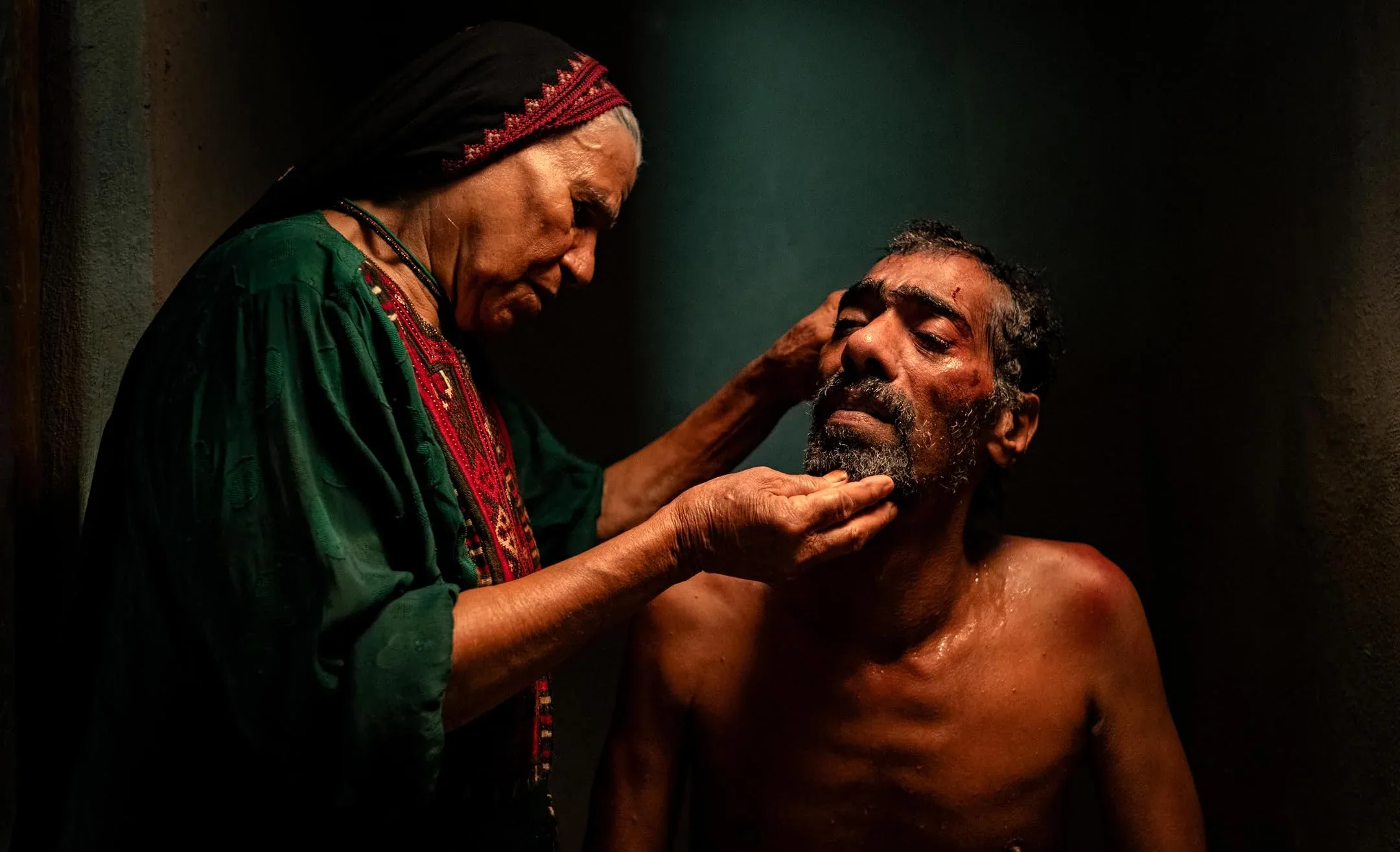
Rahimi’s performance carries the strain without making Davoud’s deterioration a procession of dramatic declarations. The generous, good-humoured teacher becomes brusque and dishevelled; concern remains perceptible, though it grows harder to reach through his guarded conduct. His anger over his mother’s hospitality is especially revealing because the children’s needs give him a defence for behavior that wounds someone helping him.
Rahimi preserves the discomfort of recognizing both things at once. Davoud’s hope of financial security belongs to the same vulnerable person who spends his savings on food. Asking him to possess an immaculate motive would require him to stop needing anything himself.
The official encounters deepen his loneliness. An officer reproaches him for the example his fuel-smuggling sets, while the education authorities expect the school to function without supplying the money its meals require. Davoud points toward the larger operators profiting from the same trade, asking that his purpose count in the judgment of his act. We can feel the force of his protest. We can also feel how urgently he needs it to excuse him. The rebuke leaves him responsible for the children’s conduct and nourishment while withholding a workable means of securing either.
Elsewhere, a man approached about guaranteeing a bank loan imposes a hard bargain and dismisses the expectation of generosity. Davoud’s attempts to obtain assistance become encounters with other people’s limits, other people’s decisions to protect themselves. The education inspector initially subjects his arrangements to suspicion, yet eventually recognizes his efforts and helps as he can. This mercy matters because Majidi allows it to come from within the machinery that has frightened him. Davoud briefly encounters someone capable of responding to the life being lived beneath the administrative problem.
Such moments do not make him easier to know. Once a sick elderly man enters his care, Majidi’s concealment of Davoud’s intentions makes compassion difficult to separate from calculation. Rahimi’s restraint becomes essential here: the vulnerability we have recognized survives alongside behavior we cannot confidently interpret.
The film asks us to remain near a person whose need we understand while denying us the comfort of complete trust. Explaining his desperation cannot resolve everything he does under its pressure. There is a gap between sharing someone’s fear and knowing the limits they will observe.
Houman Behmanesh’s aerial photography gives that fear an exposed, geographical dimension. The dusty, jagged hills stretch beneath the camera, and the travelling figures appear within a terrain that offers little shelter to the eye. Yet the children’s bright clothing persists within these surroundings, and the food-preparation montages bring another rhythm into the film. Through Mahyar Behmanesh’s editing, the work of making meals acquires speed and collective energy. The landscape spreads outward; the preparation gathers people around something they can accomplish. Colour and labour keep deprivation from occupying every available feeling.
Across a running time exceeding two hours, Majidi’s deliberate progression lets these acts of feeding recur against Davoud’s uncertain future. A meal can be completed. The conditions threatening the next one remain. That difference in scale gives the preparation sequences their emotional force: there is satisfaction in work that produces an immediate, edible answer, even as the teacher’s efforts entangle him further. The film’s beauty belongs partly to this persistence, to people finding enough energy to prepare food within circumstances that steadily consume their own reserves.
The closing overhead view of a vegetable garden during a small harvest answers the barren hills with growth. Green occupies the image, and after so much anxiety about provisions, its presence offers a relief that I find difficult to refuse. The change in the land is visible in a way that Davoud’s moral condition never becomes. We can recognize what the harvest makes possible for hungry people while remaining uncertain about the man who has struggled to keep them fed, his guarded intentions still accompanying the sight of something ready to be gathered.
Midday Meal held its world premiere at the Busan International Film Festival on October 9, 2026. Directed by acclaimed Iranian filmmaker Majid Majidi, the social drama follows a dedicated teacher in a remote, arid village who goes to extreme lengths to keep his school open and feed his students after the sudden loss of the local benefactor funding the school’s meal program.
Full Credits
Title: Midday Meal
Distributor: Institute for the Intellectual Development of Children and Young Adults (Kanoon)
Release date: October 9, 2026 (Busan International Film Festival)
Running time: 2 hours 13 minutes (133 minutes)
Director: Majid Majidi
Writers: Majid Majidi, Houman Behmanesh
Producers and Executive Producers: Majid Majidi, Amir Banan
Cast: Mohammad Rahimi, Kheyri Zakeri, Rahim Bakhsh Pira, Heybatmorad Damani
Director of Photography (Cinematographer): Houman Behmanesh
Editors: Mahyar Behmanesh
Composer: Ramin Kousha
The Review
Midday Meal
Midday Meal makes generosity feel increasingly difficult to inhabit. Majidi follows a teacher whose devotion survives alongside anger, calculation, and concealed intentions, while Rahimi keeps his vulnerability painfully accessible. The food preparation and small harvest offer relief without making his choices easier to judge. A deeply affecting film about the strain of remaining answerable to hungry people when your own life depends upon feeding them.
PROS
- Rahimi’s restrained, morally unsettled performance.
- Scarcity expressed through concrete acts of care and refusal.
- Landscape and food preparation give hardship distinct visual rhythms.
- Moments of assistance preserve complexity within institutional failure.
CONS
- The approved review establishes no substantive weaknesses.