






























Discussing a film with Saito, Chieri has a reservation about the ending: why did the leads need to kiss? They agree the film was fine. Her objection concerns the assumption that physical attraction supplies the proper finishing touch. Miki Tanaka places this conversation early in Silver Express, letting her university student question a convention that many viewers barely register. A kiss can settle a story so efficiently that we forget to ask what, exactly, it has settled for the people involved.
Tanaka carries that question into the way she handles time. Haircuts change, workplaces change, and years pass without every transition receiving an announcement. This is elliptical storytelling, which leaves stretches of experience offscreen and trusts us to connect the pieces.
Here, it allows Chieri’s life to continue without a succession of romantic turning points marking her progress. Conversations sometimes disappear into the next scene before their final word is complete. The editing gives these encounters a passing, unfinished quality, even as their effects accumulate.
Chieri, played by Yui Okamoto, does not experience sexual attraction, and other people keep treating this as something an appropriate partner could correct. Meanwhile, her friend and former roommate Yuki moves through career changes, marriage, and pregnancy. Those developments help us read the calendar, but Tanaka avoids making them a schedule Chieri has fallen behind. Her need for companionship remains real. So do her interests and the parts of her life that continue without anyone arriving to supply the expected romantic plot.
The distinction becomes uncomfortable during ordinary gatherings. Friends talk excitedly about boys while Chieri finds little room to participate. Spending time with Yuki and her boyfriend, Keita, leaves her feeling peripheral. Tanaka understands how exclusion can happen without anyone formally rejecting someone: the subject everyone considers universal becomes the price of joining the conversation. These scenes also explain the film’s unusual tempo. It moves readily between encounters, yet its emotional pressure develops through repeated small disappointments rather than a chain of dramatic revelations.
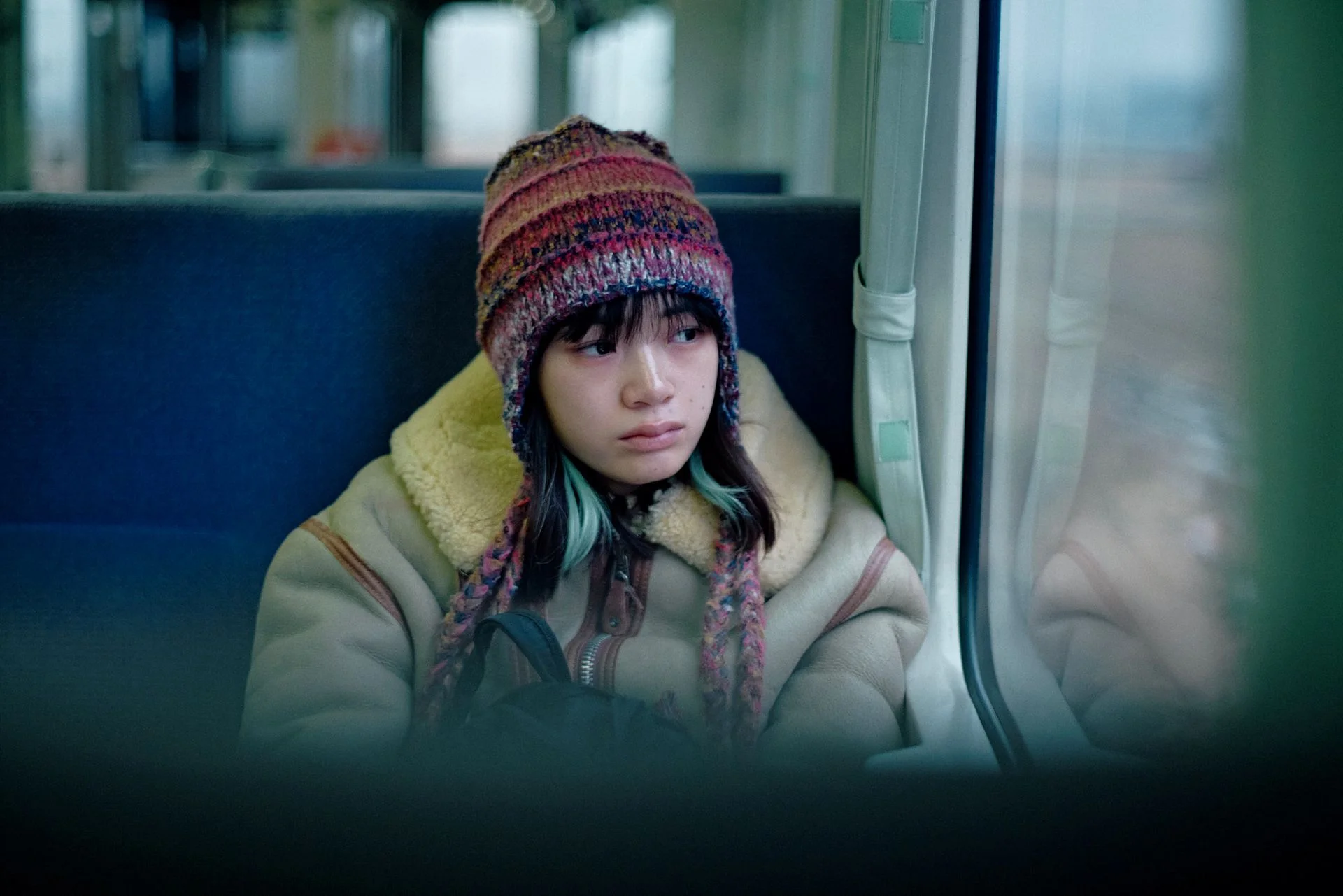
Cinematographer Kohei Tatsutomi makes that pressure visible through changes in distance. Long shots leave Chieri isolated within the surrounding space; close-ups become constricting when people disregard her personal limits. Camera distance determines how much room a character appears to have, and these two approaches give her different kinds of discomfort. From farther away, she seems stranded. Up close, unwanted attention becomes difficult to escape. Harsh, cold lighting during unwelcoming exchanges reinforces the feeling, while scenes of connection with Yuki and, later, Shoya allow warmth back into the image.
The score’s discordance works alongside those choices. Romantic music often tells us that an encounter is desirable before the characters have established anything themselves. Silver Express declines to provide that reassurance. Its sound keeps company and comfort from becoming interchangeable.
Chieri sometimes directs her attention toward a train that others do not seem to hear, creating a small separation between the conversation taking place and the experience she is having. Her imagined destination houses “silver lions,” creatures who cannot find a place among ordinary lions. The image gives her a way to express belonging without having to explain herself entirely through other people’s categories.
Tanaka is sharper about the limits of tolerance in the scene involving Yuki’s visiting male colleagues. Their jokes about Chieri’s virginity and ending it for her turn private information into permission for sexual entitlement. The women’s laughter and minimization leave her without dependable support in the room. Yuki’s involvement matters because the friendship elsewhere contains affection. Tanaka allows someone capable of closeness to participate in an encounter that makes Chieri feel unsafe. Familiarity offers no guarantee that a friend will recognize the moment when laughter becomes harmful.
Okamoto gives Chieri enough awkwardness and irritation to prevent her from becoming an immaculate spokesperson. Her withdrawal during conversations about dating can read as both self-protection and an inability to find a useful response.
Some of the sharper hostility arrives abruptly, and her emotional reserve occasionally makes acceptance of herself difficult to distinguish from simple disengagement. That limits the performance’s clarity in places. Still, I appreciate how little the film asks her to perform anguish for our benefit. Chieri can dislike an exchange without delivering a speech that explains every feeling behind the reaction.
Shoya’s arrival changes the possibilities. Played by Hayato Kurihara, this music enthusiast listens without ridiculing her difficulty understanding romantic attraction. Their recognition is a relief, and the physical closeness that develops between them, including sleeping in each other’s arms, asks us to reconsider another familiar screen convention. An embrace can express trust and comfort without promising a sexual relationship. Tanaka lets that closeness exist long enough for its value to register before bringing their differences into focus.
Those differences require some precision. Aromanticism concerns romantic attraction; asexuality concerns sexual attraction. Shoya is aromantic and experiences sexual desire, while Chieri does not experience sexual attraction. The group conversation that attempts to map their orientations makes this distinction part of the drama.
People are trying to understand where an apparent affinity holds and where it stops. I found the explicitness useful because the information changes how we understand the relationship. A classroom lecture that conveniently touches on Chieri’s preoccupation feels less natural: for a moment, the screenplay arranges the world to deliver an explanation directly to her.
The friendship with Shoya presents a harder task than finding an accurate label. Their shared difficulty with conventional romance makes understanding possible, while their different desires leave the terms of physical closeness unsettled. The earlier embraces retain their tenderness; they also become harder to interpret as a reliable agreement about what comes next. Chieri has found someone with whom she can communicate, and that achievement carries a fresh demand. They still have to discover which forms of closeness each can offer without asking the other to accept something unwanted.
Silver Express premiered at the Busan International Film Festival on October 10, 2026, ahead of its scheduled Japanese theatrical debut on November 13, 2026, distributed by KeyHolder Pictures. The Japanese drama follows a young asexual woman as she explores companionship with an aromantic man, navigating societal expectations surrounding love and human connection.
Full Credits
Title: Silver Express
Distributor: KeyHolder Pictures, The Klockworx Co.
Release date: October 10, 2026 (Busan International Film Festival), November 13, 2026 (Japan)
Running time: 1 hour 37 minutes (97 minutes)
Director: Miki Tanaka
Writers: Miki Tanaka
Producers and Executive Producers: Takatoshi Naoi, Tomonori Akiyama, Koji Fujii
Cast: Yui Okamoto, Hayato Kurihara, Riho Nakamura, Tatsuya Yamawaki, Rio Takahashi, Yuka Nakashima, Tomo Nakai, Rina Saito
Director of Photography (Cinematographer): Kohei Tatsutomi
Editors: Bunny Fanfan
Composer: Kazutoshi Sohta
The Review
Silver Express
Silver Express makes familiar romantic gestures worth reconsidering. Its understated editing, expressive framing, and uneasy sound place us close to Chieri’s experience without turning her into a lesson. The friendship with Shoya gives that approach its richest complication: recognition can open the door to intimacy without settling its terms. Occasional stiffness in the performance and a conveniently relevant classroom lecture weaken the naturalism, but Tanaka’s attention to everyday encounters keeps the drama personal and perceptive.
PROS
- Elliptical storytelling gives Chieri a life beyond romantic milestones.
- Framing, lighting, and sound make social discomfort tangible.
- Chieri retains awkwardness, irritation, and individuality.
- Shoya’s friendship complicates the meaning of physical closeness.
CONS
- Abrupt hostility and emotional reserve sometimes obscure Chieri’s reactions.
- - The classroom lecture feels arranged to deliver an explanation.