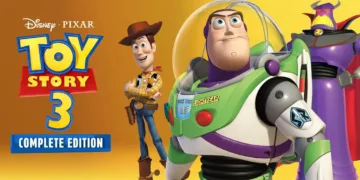


















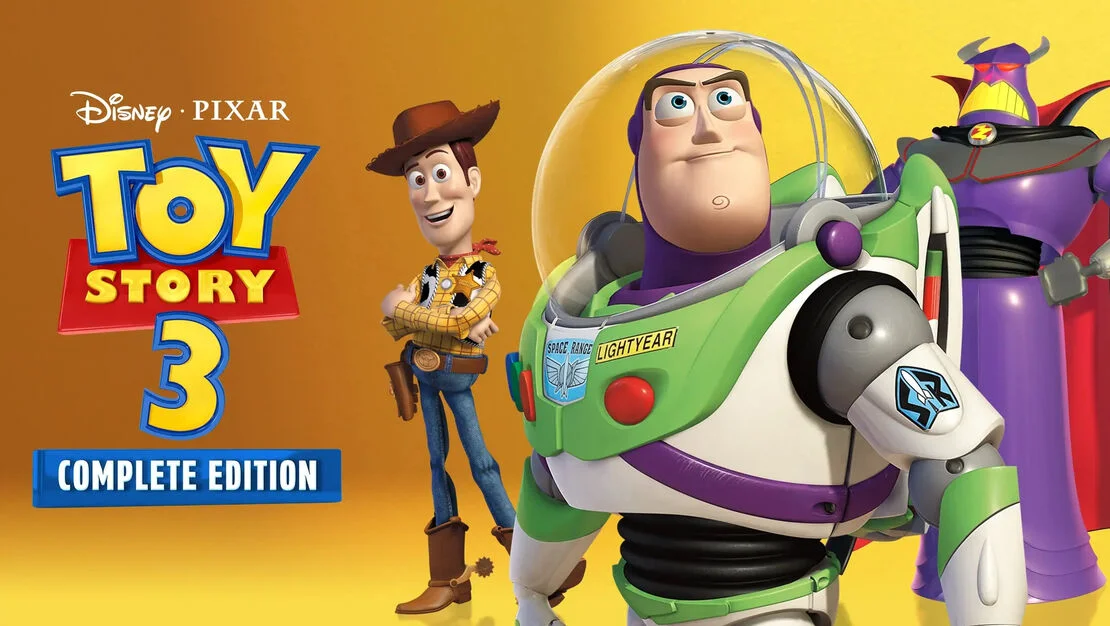

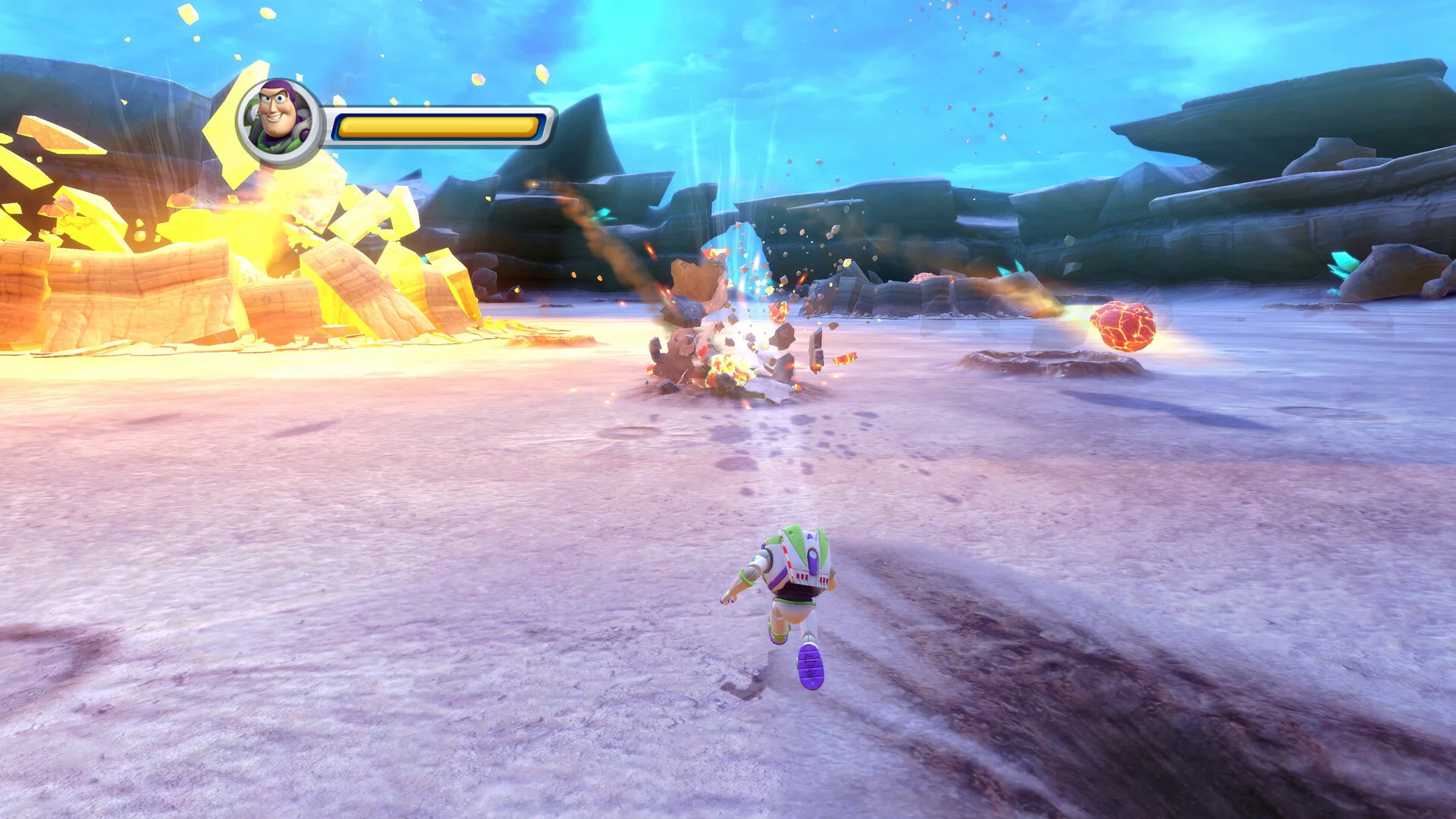
The Buzz Lightyear game glimpsed at the beginning of Toy Story 2 gets a playable counterpart in Disney/Pixar Toy Story 3 Complete Edition. Buzz flies through a hostile environment, fires his laser, and pushes toward Zurg’s stronghold, with even the secret passage referenced in the film finding its place. For returning fans, the pleasure comes from seeing a fictional game become an actual level. The character’s imagined capabilities determine the action, giving this section a different rhythm from the adventures where he is a plastic toy crossing a household room.
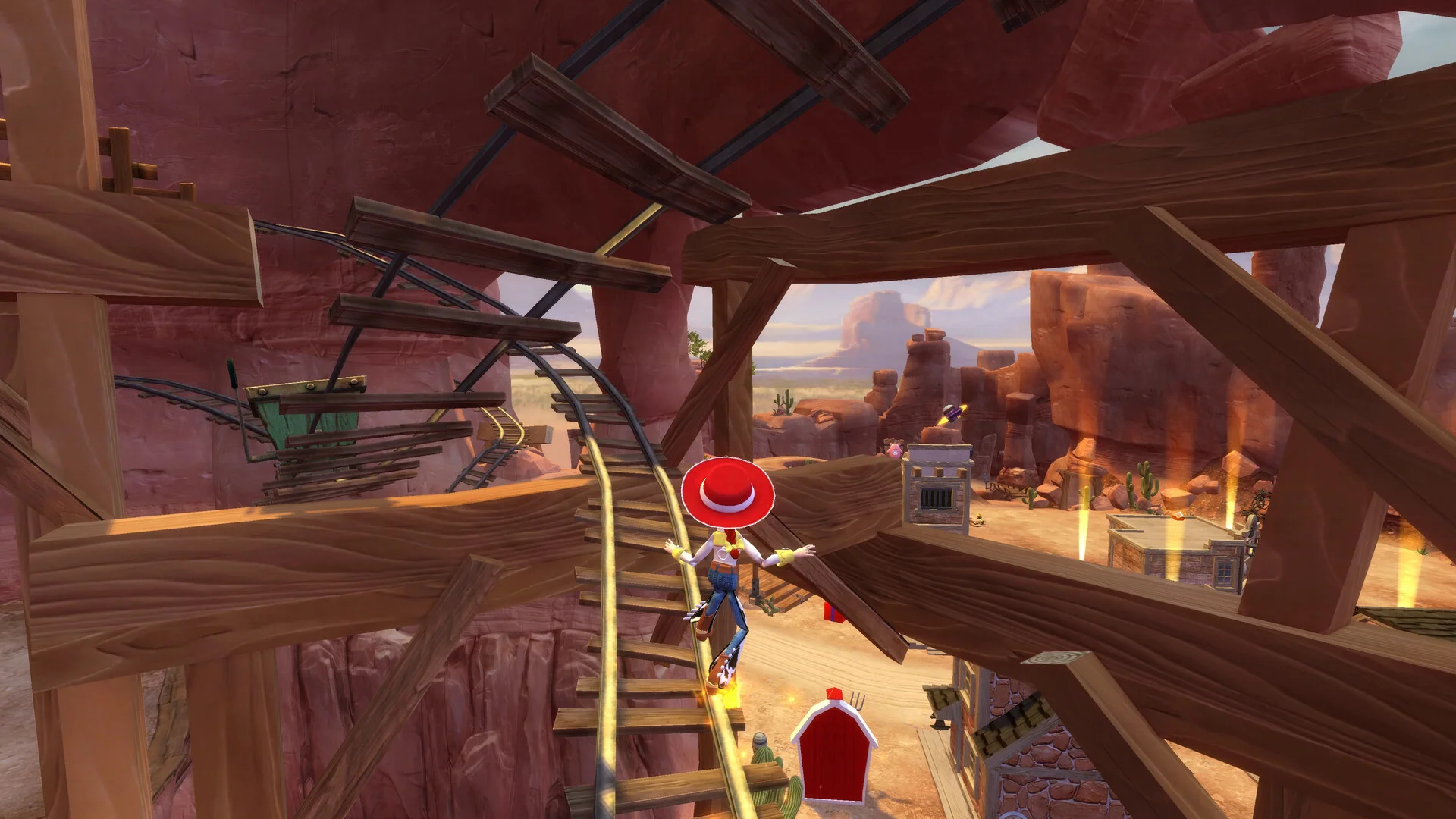
Woody’s pursuit of a runaway train takes a similar approach to the franchise’s make-believe adventures. Riding Bullseye into an attack involving the aliens and Evil Dr. Porkchop gives the campaign an energetic Western scenario before its toy-scale environments introduce other demands. Sunnyside’s rescue mission calls for stealth and the use of different characters’ abilities. Moving between these settings preserves something important about the films: the same toys can belong to an elaborate fantasy and then have their movements dictated by the furniture around them.
Complete Edition brings back the 2010 game with that structure intact. Eight campaign stages sit on a board-game-style selection screen, with some allowing players to switch among Woody, Buzz, and Jessie while others concentrate on one character. Their abilities give the shared stages a useful cooperative logic.
Woody swings from designated points with his pull string, Jessie lands precisely on small surfaces, and Buzz throws companions toward otherwise inaccessible platforms. Recognizing the right character for an obstacle makes the cast matter mechanically, even within puzzles that remain straightforward enough for younger players.
Double jumps, ledge grabs, and simple attacks keep the basic platforming approachable. The controls are responsive enough to make the linear stretches enjoyable, though the camera occasionally interferes with judging a jump. The short campaign gets useful variety from moving between Buzz’s flight and shooting and Sunnyside’s stealth, giving its individual adventures different demands without requiring a lengthy commitment to each.
Toy Box gives the game’s tasks a different purpose by placing them within a Western town that gradually develops around the player. Helping residents and gathering gold funds purchases from Al’s Toy Barn kiosks, bringing new buildings, inhabitants, and customization options into the settlement.
A building can change the town’s appearance, provide another way to dress its residents, or serve a practical function. The jail earns its place when bandits attack and need somewhere to be thrown. Progress becomes visible in a location that players repeatedly inhabit, rather than disappearing behind a completed stage marker.
The themed areas extend that progression beyond decoration. Sid’s haunted area introduces supernatural trouble into the town, while its lightning rod provides ways to free petrified residents and interact with ghosts. Zurg’s area brings a blaster and robot attacks.
These additions give familiar locations fresh activity and make unlocking another destination worth anticipating. The campaign assigns its characters roles inside prepared adventures; Toy Box allows the consequences of those adventures to spread into a shared space. A town that began with Western errands can acquire an entirely different set of problems.
Its smaller tasks make good use of that growing collection of toys. Wheezy’s photography requests develop from finding a subject such as Stinky Pete into arranging appearances and surroundings for particular pictures. Dressing a resident or altering a building gains a purpose beyond filling a customization menu.
Alongside these assignments, vehicles and size-changing goop leave room for experimentation without a mission directing every action. The appeal is in having enough structured activity to suggest possibilities, then being allowed to become distracted by the available objects and characters.
Two-player local drop-in/drop-out cooperation suits that freedom. A second player can help complete objectives or turn an ordinary trip through town into an excuse to experiment with vehicles and objects. Generous respawning also helps players with different levels of experience stay involved, and a stronger partner can progress through difficult passages.
Solo play still offers a substantial sequence of unlocks and challenges, but cooperation gives the sandbox another source of activity beyond its written task list. It accommodates the familiar experience of two people finding different uses for the same pile of toys.
That task list becomes troublesome for anyone intent on finishing everything. Toy Box contains 103 tasks, yet completed entries cannot be filtered out. Its hundreds of collectible capsules lack useful tracking to identify which areas still contain missing items. Returning with a newly acquired tool can be satisfying because the player understands what has changed and what to try next.
Searching an already explored region without knowing if anything remains there offers much weaker direction. The problem becomes most pronounced late in completion, when plentiful discoveries have dwindled to a few unidentified omissions.
The campaign has a related inconvenience. Collectible totals appear before entering a stage, but equivalent information is unavailable during play. A missed item can mean another traversal after the player thought the search was finished.
These limitations matter less to someone casually exploring with a partner, yet they complicate a substantial part of the game’s replay appeal. A rerelease could have made unfinished objectives easier to locate while preserving the original hiding places and tool requirements. Here, returning collectors inherit the same uncertainty along with the activities they remember.
The additional Zurg content offers a clearer benefit over versions that originally lacked it. Previously exclusive to PS3, his playable appearance includes a weapon, vehicle, and three dedicated missions. It is a welcome inclusion, though his inability to complete ordinary Toy Box tasks restricts his role after those missions are done. Returning players receive an extra corner of the original experience rather than a character who changes their approach to the whole sandbox.
Presentation receives the most noticeable improvement, with sharper gameplay and targets reaching 4K and 60 frames per second on supported hardware. The cleaner image makes the town’s customization easier to appreciate, and smoother movement benefits the platforming without altering its basic demands.
Brief hitches when moving between Toy Box areas can still interrupt that smoothness. The prerecorded cutscenes show a larger discrepancy: their soft image sits awkwardly beside the improved gameplay, producing a visible drop in definition whenever the action hands back to an older video sequence.
The Review
DisneyPixar Toy Story 3 Complete Edition
Complete Edition preserves the 2010 game’s strongest ideas: playable franchise fantasies, useful character abilities, and a Toy Box whose expanding town rewards experimentation. Local cooperation gives that sandbox lasting appeal, while sharper presentation makes revisiting it comfortable. Returning players should expect familiar design, including collection tracking that turns the final cleanup into guesswork. Zurg’s previously exclusive content is welcome, though limited. The town remains the reason to stay after the campaign ends.
PROS
- Familiar film scenarios become varied playable adventures.
- Toy Box unlocks change the town’s activities.
- Accessible local cooperation encourages experimentation.
- Sharper gameplay presentation and smoother movement.
CONS
- Poor collectible tracking complicates completion.
- Occasional camera problems interfere with jumps.
- Brief loading hitches interrupt Toy Box exploration.
- Soft prerecorded cutscenes contrast with improved gameplay. 1.