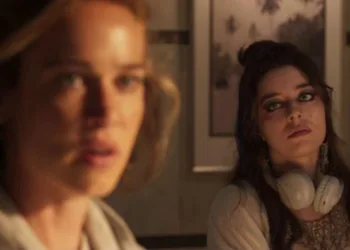
























The tenants of Paradiso Palms complain to Serena about wet floors and broken glass, treating their apartment manager as personally responsible for a building she struggles to keep functioning. In this shabby corner of Los Angeles, authority and responsibility belong to different people.
Mr. Rossmore owns the property; Serena absorbs the grievances. Before the spiders arrive, Crawlers has established a recognizable housing arrangement, with an exhausted employee serving as the human interface for someone else’s neglect. An infestation will give her neighbors an urgent reason to appreciate the work they already depend upon.
Beside Sébastien Vaniček’s Infested, the setting suggests how readily the apartment siege can accommodate different social emphases. Both films place residents and spiders inside a shared enclosure, making proximity a condition of survival. Where Infested gives that confinement an angry social charge, Ángel Gómez Hernández’s film approaches the building as a collection of potential punishments and rescues.
Its Los Angeles includes the aspiring musician doing maintenance work, the livestreamer manufacturing entertainment, and the landlord transferring burdens downward. Those positions give the building some social texture, though the screenplay often reduces the people occupying them to instructions about whom to like.
The infestation itself arrives through professor George, whose return from an overseas expedition ends with a swollen shoulder wound disgorging spiders. They spread through the air ducts, converting the building’s hidden connections into routes of attack.
Authorities impose a quarantine after initially suspecting an infectious disease, leaving Serena to manage a crisis far outside her job description. The wound’s leaking, crawling contents provide an effective early dose of disgust. The ducts supply something equally useful: separate apartments cease to offer meaningful separation, and private domestic problems become everybody’s emergency.
Matilda Lutz gives Serena a weariness that makes her eventual leadership feel like a continuation of her working day. Humiliation has become routine, and Lutz allows the fatigue to register without making the character inert. Serena knows the property and can put that knowledge to use; her competence has a practical foundation.
Jayson Rothwell’s screenplay gives her artistic ambitions too, represented by a guitar bearing the sticker “Music will save you!” Yet that detail functions chiefly as preparation for a later comic payoff. It offers a glimpse of a life beyond maintenance, then folds that life back into the machinery of the siege.
The neighbors receive even narrower assignments. Bradley, played by Gregg Sulkin, shoots paintballs at a mural to entertain his livestream followers, an introduction so insistently obnoxious that his vulnerability comes prepackaged as a pleasure. Lady Lash, the dominatrix played by Melina Matthews, escapes this sorting process somewhat.
Her warmth toward Serena gives their exchanges a degree of reciprocity absent from the complaints elsewhere. The film locates decency in behavior rather than professional respectability, a welcome complication. Still, its appeal to solidarity remains strained when so much characterization exists to make a resident’s suffering agreeable. A survival ensemble needs some relationships capable of changing under pressure.
Hernández is considerably sharper at arranging encounters between bodies and spiders. The opening text cards claim that humanity is vastly outnumbered by arachnids, then tease the audience with the possibility of one lurking nearby. Their direct address belongs to a fairground tradition of horror entertainment: the screen encourages spectators to become suspicious of their own seats.
This playfulness provides a useful license for the creatures’ apparent cunning, including the sinister close-ups granted to a reddish-faced leader. The film invites us to accept spiders with a taste for theatrical menace, then struggles to sustain the same amused confidence through its human exchanges.

Its best sequence needs very little characterization. A spider descends toward a sleeping woman’s open mouth, pushed away by her exhalations and brought closer as she inhales. Recorded affirmations promise safety and protection while her breathing supplies the rhythm of approaching danger.
The joke depends on the precise relationship between sound and movement: reassurance continues undisturbed while the image makes it untenable. It is an effective miniature of domestic insecurity, accessible without knowledge of this particular building or city. Splitting the scene and returning to it later weakens that rhythm, sacrificing the sustained discomfort of watching each breath alter the distance.
Elsewhere, suspense becomes conspicuously arranged. Serena’s prolonged reach into a high cupboard allows spiders to threaten her searching hand and occupy a mug she cannot properly see. The familiar action gives the scare an immediate physical appeal, but the extension of that action makes the director’s requirements visible.
A livestream scene handles the audience’s superior knowledge with greater economy: spiders marked with luminous paint appear behind a tenant who remains oblivious. His technology distributes an image without helping him understand his surroundings. Here, a contemporary habit supplies both the character’s distraction and the means through which the danger becomes legible.
The glass barrier offers a different kind of suspense. Serena discovers that the spiders cannot climb it, establishing a usable limit to their movement. When a cluster finds a way past that obstacle, the threat changes from something concealed in household objects into something capable of responding to resistance.
The sequence gives the creatures a shared problem and allows their behavior to develop around it. That coordination creates an uncomfortable imbalance within the apartment siege: while the residents remain divided into useful heroine, sympathetic exception, and disposable nuisance, the spiders acquire the capacity to act together.
Crawlers premiered in North American theaters on October 16, 2026, with distribution by Roadside Attractions and Saban Films. Directed by Ángel Gómez Hernández, the spider creature feature follows apartment complex manager Serena and a group of trapped tenants who must fight for survival against a rapidly multiplying infestation of venomous spiders after their building is placed under quarantine.
Where to Watch Crawlers (2026) Online

Full Credits
Title: Crawlers
Distributor: Roadside Attractions, Saban Films, Altitude Film Entertainment, Leonine Studios
Release date: October 16, 2026
Rating: R
Running time: 1 hour 28 minutes (88 minutes)
Director: Ángel Gómez Hernández
Writers: Jayson Rothwell
Producers and Executive Producers: Scott Strauss, Peter Welter, Jayson Rothwell, Basil Iwanyk, Erica Lee, Alexandra Milchan, Josh Weinstock
Cast: Matilda Lutz, Gregg Sulkin, Melina Matthews, William Miller, Paul S. Tracey, Andrea Scott Méndez, Isabella Egizi, Sam Lucas Smith, Chris Rogers, Gary Anthony Stennette
The Review
Crawlers
Crawlers finds recognizable housing tensions inside its Los Angeles apartment siege, but its appetite for punishing obnoxious tenants leaves little room for convincing solidarity. Matilda Lutz supplies a credible working heroine, while the spiders benefit from inventive encounters built around breathing, domestic habits, and shared space. The bedside attack reveals Hernández’s talent for physical suspense, even as its interruption exposes his uneven control. An intermittently effective creature feature whose social relationships receive less care than its arachnid choreography.
PROS
- Lutz’s weary, practically capable Serena.
- Inventive use of breathing and reassuring audio.
- Spiders whose adaptive behavior strengthens the siege.
CONS
- Caricatured residents weaken the appeal to solidarity.
- Interrupting the bedside attack disrupts its suspense.
- Prolonged cupboard staging makes the scare feel contrived. 1.