




























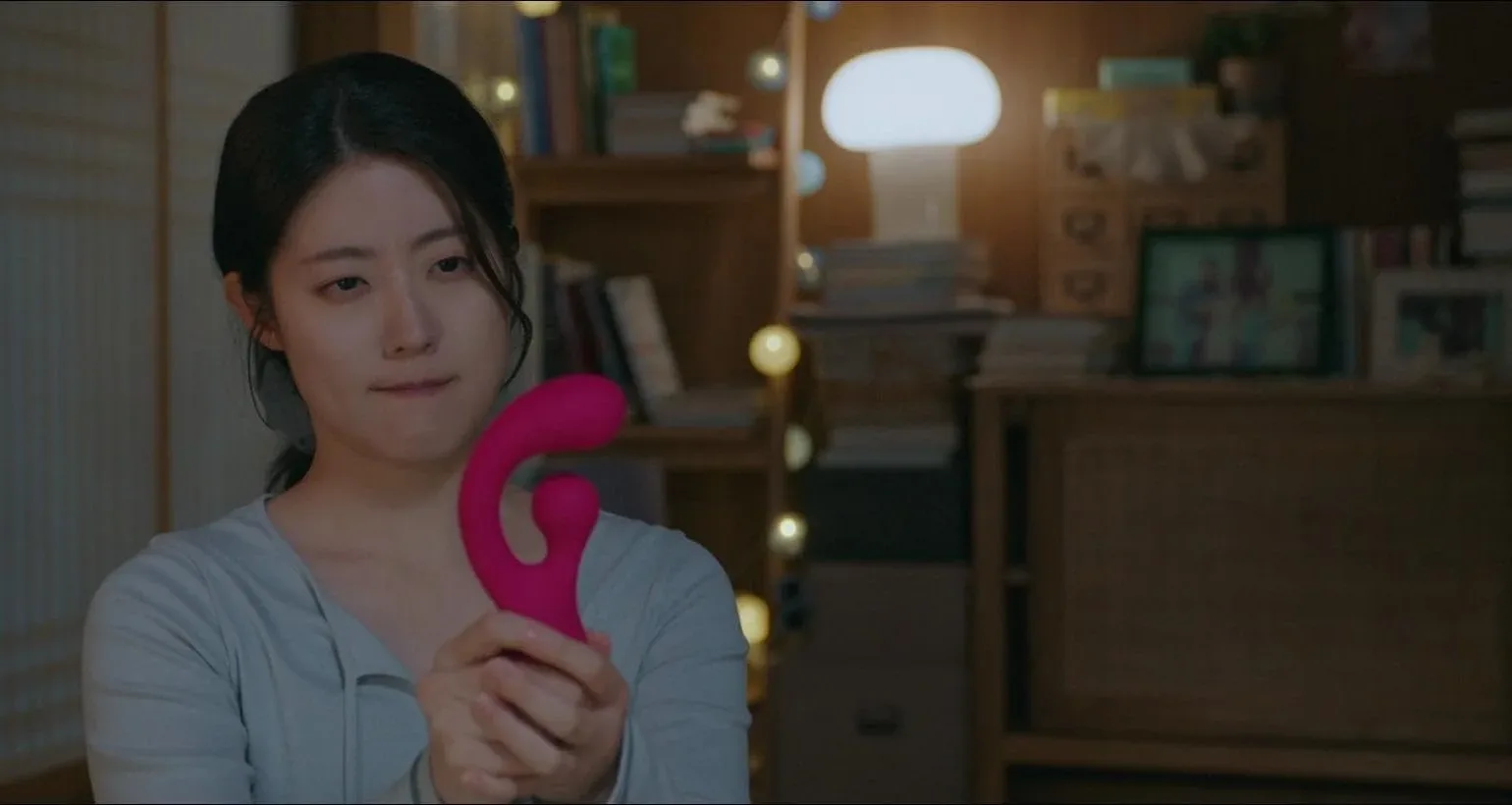

Yeon-su tries to retrieve her vibrating bag during an ancestral rite and manages to spill its contents in front of her family. The attempted rescue makes everything worse, which is sound comic engineering, even if the device tumbling into public view has done considerable service elsewhere. In episode 2 of Make Me Tingle, the location supplies the extra charge. Yeon-su has brought a sample from the sex-toy company she is helping to market into a household where marriage plans are family business and sexual curiosity requires an emergency cover story. Her aunt Mi-young volunteers one: it is her neck massager.
That intervention gives the joke somewhere useful to go. Mi-young accepts the trouble attached to the object, turning a familiar embarrassment routine into a small act of solidarity. Her encouragement to choose a life outside the family’s instructions carries weight because she is prepared to absorb some of the consequences. The vibrator has already switched on aboard a crowded train, so repeating the accident risks diminishing returns. Bringing it home changes who can be hurt, who can help, and how quickly Yeon-su needs the floor to open.
Across these first four episodes, the series sometimes asks Nam Ji-hyun to perform the same mortification too often. Yeon-su’s panicked responses to unfamiliar products and a workplace discussion of suction can make a capable marketer seem stranded at the starting line.
Nam is engaging when embarrassment competes with determination; the repeated scandalized reactions give her less room. A flashback to Yeon-su’s first period provides necessary emotional substance. Her mother supplies sanitary products while teaching her to keep the event secret. The adult confusion has a history. The comedy becomes wearing when it keeps testing knowledge the script has already established she was denied.
Her inexperience also makes her vulnerable to deliberate misinformation. When boyfriend Seung-jun refuses a condom and tells her it will hurt her, he turns an absence of education into an opportunity for pressure. Yeon-su insists on protection, and he leaves. That refusal matters to the romantic structure: she can lack experience and still recognize a condition she will not accept. Dal, the CEO of Loand and her disastrous recent blind date, later tells her to break up with the man who supplied that advice. On this subject, his bluntness is welcome.
The next encounter with Seung-jun makes clever use of an episode break. Episode 2 ends with Dal intervening as the drunken ex threatens Yeon-su, placing him in the familiar position of romantic rescuer. Episode 3 lets her deliver the kick that sends Seung-jun away. Dal has asked what she wants him to do; she supplies an answer with her foot. Her injured back then creates an awkward assisted walk home and an encounter with the assembled family. The physical comedy follows her resistance, allowing the episode to recover its lighter tone without making the threat itself funny.
Dal is less helpful when every difference between them becomes evidence that Yeon-su needs correcting. Their recurring disputes about love, pleasure, and casual sex establish opposing positions efficiently, then keep returning to them. She believes emotional commitment gives sex its meaning; he dismisses romantic love as an illusion. The attraction needs those declarations to become unstable. Otherwise, the courtship begins to resemble a panel discussion whose participants have unfortunately been seated together for dinner.

The kisses do disturb that arrangement, although the script has another delaying device ready. Yeon-su’s belief that Dal and his colleague Ji-o are a couple survives the first kiss and interrupts the rain-soaked encounter at the end of episode 3. Her confusion initially gives her attraction an awkward comic obstacle. By the second interruption, a misunderstanding is doing work that a direct conversation could finish. Dal and Ji-o joking about getting divorced supplies a pleasing release in episode 4, partly because the joke finally permits the story to move on.
The workplace plot offers a stronger way to keep the pair in productive conflict. Yeon-su draws inspiration from an exhibition’s message-box installation and proposes mystery boxes tailored to different customers. Her contribution makes professional sense: someone conscious of hesitation and emotional associations can identify needs a product expert overlooks. She has volunteered to lead this campaign, and these scenes allow that decision to produce something besides discomfort. Dal’s interest in her work becomes credible once the work gets a chance to exist.
Their argument over including a scented candle is especially effective because it gives them a practical disagreement with a possible answer. Dal wants the box focused on sex toys; Yeon-su argues for atmosphere and the customer’s feelings. Then an office blackout places them beside a candle while they discuss childhood fears. His memory of being left alone in darkness exposes the loneliness beneath his self-sufficient manner. The situation is plainly arranged to bring them closer, but it also changes the campaign: he agrees to include the candle. A romantic scene has altered a business decision. Someone should put that in the meeting minutes.
Kim Jae-young becomes considerably more charming as Dal’s certainty loosens. His fear during the blackout gives Yeon-su an opening to help him, while his smile at the pictures and work notes in her room lets affection register without another speech about his position on love. The character’s sexual confidence has concealed a narrow emotional repertoire. Yeon-su can contribute to its expansion, just as he can challenge the shame surrounding her curiosity. Their chemistry improves when each has something to discover about the other that cannot be settled by winning an argument.
Episode 4’s family meal lets them work together with much less respectable intentions. Briefed on the household’s dislikes, Dal arrives late with Yeon-su, performs fussiness about food, reveals his business, and claims he cannot father children. Kim enjoys the opportunity to make Dal deliberately objectionable. The sequence turns the family’s marriage criteria into a checklist for sabotage, and the pair finally share a comic objective. Once their performance has discouraged the elders, Yeon-su asks him on a date. She can now risk choosing a man her family has been carefully persuaded to reject.
Make Me Tingle premiered globally on October 15, 2026, streaming on platforms including Rakuten Viki, TVING, and Amazon Prime Video. Directed by Kim Ye-ji, the South Korean romantic-comedy series revolves around the hilarious clash between a traditional marketer with conservative views on intimacy and an outgoing adult-toy company CEO, who clash before unexpectedly developing real feelings for each other.
Where to Watch Make Me Tingle Online

Full Credits
Title: Make Me Tingle (Korean: 찌릿찌릿한)
Distributor: Rakuten Viki, TVING, Amazon Prime Video, KT Studio Genie
Release date: October 15, 2026
Rating: PG-13 / TV-14
Running time: 60 minutes per episode (10 episodes)
Director: Kim Ye-ji
Writers: Ahn Sae-bom, Kang Eun-kyung, Ju Hwa-mi
Producers and Executive Producers: KT Studio Genie, Gleline, Studio Icon
Cast: Nam Ji-hyun, Kim Jae-yeong, Kang Tae-ju, Park So-jin, Jeong In-ji, Jeon Kuk-hwan, Cha Mi-kyeong, Woo Mi-hwa
The Review
Make Me Tingle
Make Me Tingle spends its first four episodes finding better uses for embarrassment than another horrified expression. The romance clicks when workplace disagreements change decisions, and the family farce gives both leads room to be funny together. Repetitive debates and an overstretched misunderstanding slow the attraction, but the candle earns its place in the gift box. So does this promising, occasionally flustered comedy.
PROS
- Workplace collaboration gives the romance substance.
- Family farce brings out Kim Jae-young’s comic charm.
- Yeon-su’s choices remain central to her development.
- Mi-young’s practical support strengthens the comedy.
CONS
- Repeated embarrassment gives Nam Ji-hyun limited room.
- Love-versus-pleasure debates begin to circle.
- The mistaken-couple subplot delays direct communication.