






























Bruiser Stone and Deck Shifflet are meeting clients who want to know where Rudy Baylor is. He is duck hunting with lawyers interested in recruiting him. The Rainmaker’s second-season premiere gets useful mileage out of that division of labor: Rudy’s colleagues handle the business while his name becomes the business’s principal attraction. Two months after the Great Benefit victory, the appeal still stands between the firm and financial security. Celebrity, however, has arrived ahead of the money.
The partnership offer Rudy receives gives Bruiser a problem that professional jealousy alone cannot explain. She has helped train a young lawyer whom another firm can now acquire as a finished product, even though his education has barely begun.
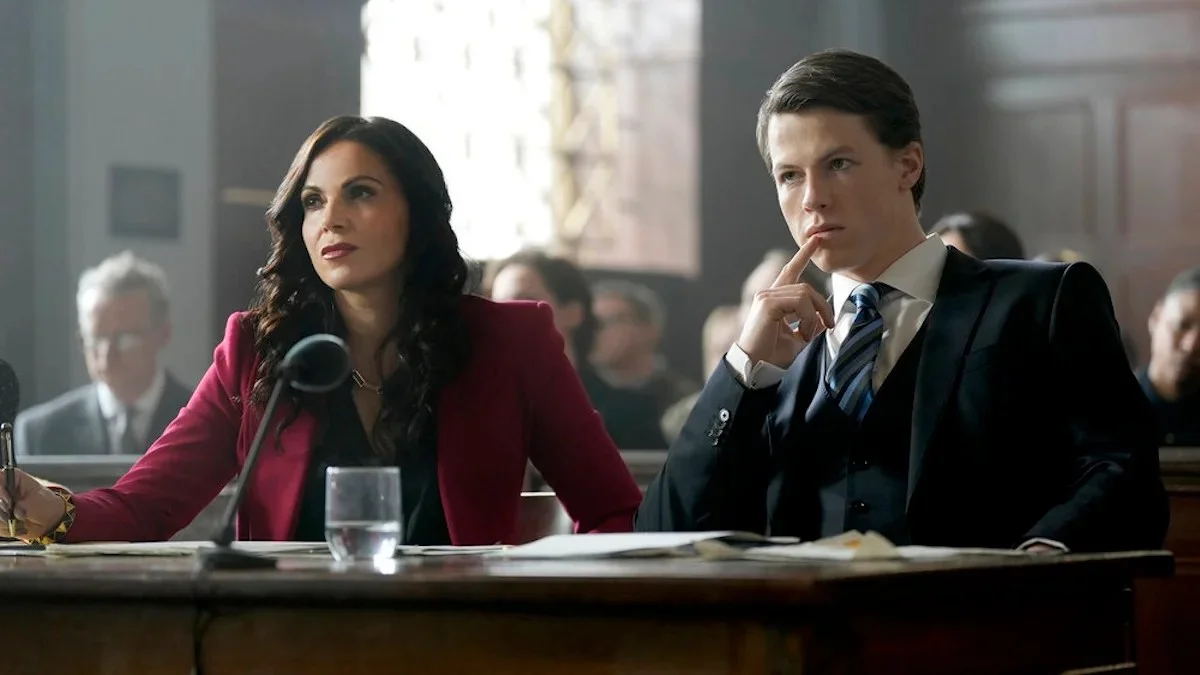
Her refusal to make him a partner herself has practical weight. Winning an exceptional case establishes talent; running a practice requires sustained judgment across cases that offer little glory. The episode lets Rudy’s ambition press against Bruiser’s experience without making either position ridiculous. He has earned recognition, and she still has reason to question his readiness.
His handling of the snack-brand dispute supplies the missing evidence. Rudy reaches for the moral grandeur of his previous victory, trying to extract a principled confrontation from a case that ends in an unsatisfying settlement. Milo Callaghan keeps that appetite for meaningful work close enough to impatience that Rudy remains fallible. He wants another cause, but he also wants to feel the way winning made him feel. The mundane case interrupts that expectation before the season supplies a client whose need is impossible to dismiss.
Bruiser’s separate entanglement with her ex-husband, Tom, is less tightly attached to this argument. His request for help over trouble involving his minor-league baseball team gives Lana Parrilla an opportunity to turn professional bargaining into personal retaliation.
Bruiser leaving his house with a Birkin bag as payment makes her resentment specific and funny: an unwanted obligation acquires a price she can collect immediately. The subplot is entertaining on those terms, though another troublesome man from her past feels like familiar equipment being brought out for a new season. Its strongest scene establishes her leverage before the larger trouble has taken shape.
Victor Suffredes’s situation operates on a different clock. The episode shows a detention official destroying his request for help and striking him before returning to the firm’s ambitions and grievances. That sequence gives the office comedy an uneasy accompaniment. We know a child is trying to reach Rudy while Rudy is occupied with the professional possibilities attached to his name. The delay creates urgency without requiring him to behave callously. Victor’s disguised birthday card must first survive the facility, then attract attention in an office that has other business.
Deck makes that attention possible. He deciphers the message through its dollar-bill code, pursues information, encounters Victor’s indifferent stepfather, and persuades Rudy to visit. P.J. Byrne’s familiar affability acquires a clear dramatic purpose through those actions. Deck keeps looking when other people provide reasons to stop. His importance also corrects the clients’ opening assumption about the firm: Rudy may be the lawyer they recognize, but the case that matters reaches him because someone else takes responsibility for it.
The detention visit then changes the problem from investigating a sentence to obtaining the right to intervene. Victor describes a school-computer prank, a guilty plea he says he was misled into accepting, and a three-year punishment. Rudy sees his bruises before guards remove him.
The stepfather’s refusal becomes another obstruction, requiring Bruiser’s procedural knowledge and Rudy’s appeal to Dot Black for help with guardianship. Each member of the firm contributes something the previous action could not supply. Dot’s return earns its place through that practical need and her established bond with Rudy, rather than asking recognition to carry the scene.
The case’s moral clarity is effective, though its accumulation of hostile figures leaves limited uncertainty about whom to distrust. The abusive official, evasive lawyer, and uncaring guardian all point in the same direction. Victor has ingenuity, demonstrated by the coded appeal, but the adult opposition is sketched chiefly through its failures toward him. There is enough here to establish danger and justify Rudy’s commitment. There is less evidence yet of the complicated institutional resistance that could sustain a long legal fight.
Sarah Plankmore receives a less settled position. Her failed approach to Amanda Vonn makes the Great Benefit fallout tangible through exclusion from work. The dinner with her parents then divides the explanations available to her: her father concentrates on failure, while her mother directs her toward responsibility. Those scenes give her ambition a history of competing encouragements. Madison Iseman has room to recover Sarah’s vulnerability because the writing makes her endure rejection before offering another route back into court.
Her apology to Rudy is especially useful because it does not settle her character for us. Career desperation can coexist with regret, and Rudy has sufficient reason to distrust both. Callaghan’s resistance prevents an emotional admission from repairing the relationship on schedule. Sarah’s subsequent opportunity therefore arrives with that damage intact. The episode has allowed her to attempt a different choice without granting her immediate forgiveness, an important distinction if her professional decisions are going to carry personal consequences again.
Amanda’s hiring reversal supplies those consequences with conspicuous efficiency. She rejects Sarah, learns that Rudy has taken Victor’s case, and discovers a use for the applicant she dismissed. Replacing Leo Drummond with another powerful attorney who employs Sarah against Rudy repeats a familiar arrangement.
The final tight close-up and ominous orchestral buildup underline Amanda’s role with almost administrative thoroughness; the villain designation has been processed before her legal methods receive much examination. Yet her decision creates a precise difficulty for Sarah. The offer answers her immediate need for work while making her damaged relationship valuable to her employer. She accepts before she understands why the position has become available.
The Rainmaker returned for its second season on USA Network on October 16, 2026. Based on John Grisham’s best-selling novel, the legal drama series follows fresh-out-of-law-school Rudy Baylor as he goes head-to-head with courtroom lion Leo Drummond while uncovering complex insurance conspiracies.
Where to Watch The Rainmaker Season 2 Online









Full Credits
Title: The Rainmaker (Season 2)
Distributor: USA Network
Release date: October 16, 2026
Rating: TV-14
Running time: 42–45 minutes per episode
Director: Russell Lee Fine, Jason Richman, Michael Seitzman
Writers: Michael Seitzman, Jason Richman, Barbara Curry, Julia Cohen, Wendy Mericle
Producers and Executive Producers: Michael Seitzman, Jason Richman, John Grisham, Wendy Mericle, Julia Cohen, David Gernert, Russell Lee Fine, Patrick Moran, Jason Blum
Cast: Milo Callaghan, Lana Parrilla, Madison Iseman, P. J. Byrne, Dan Fogler, Wade Briggs, Robyn Cara, John Slattery, Karen Bryson, Merle Dandridge
Director of Photography (Cinematographer): Russell Lee Fine, Tim Fleming
Editors: Bryan Lamoureux, Derek Holland, Darragh Moran
Composer: Clinton Shorter
The Review
The Rainmaker Season 2
The Rainmaker’s second-season premiere gives Rudy’s victory useful consequences: fame unsettles the firm while Victor’s case demonstrates how much he still needs his colleagues. Sarah’s attempted recovery adds uncertainty to an otherwise plainly divided moral landscape. Familiar antagonist machinery and Bruiser’s loosely connected subplot limit the freshness, but the central case develops through decisions that make the ensemble necessary.
PROS
- Rudy’s success creates credible professional friction.
- Victor’s case gives each colleague a consequential role.
- Sarah’s vulnerability complicates her renewed ambition.
- Character-driven humor supports the legal drama.
CONS
- Victor’s adult opposition has limited complexity.
- Amanda and Sarah repeat a familiar adversarial arrangement.
- Bruiser’s personal subplot connects less tightly to the main argument.