




























“The Marine Corps is the greatest offensive line in the history of football,” a character declares in Peter Berg’s The Mosquito Bowl. For the college stars exchanging their sporting futures for military service, the comparison offers something reassuringly familiar. They understand coordinated effort. They have trained their bodies to withstand punishment. They know the satisfaction of doing their part while someone beside them does his. The metaphor gives them a way to imagine being good at the thing they have volunteered to do.
Some expect to be home by the Fourth of July, 1942. That expectation belongs beside the offensive-line analogy: both presume an undertaking whose demands can be understood beforehand. Football has a clock, after all. The film’s passage toward Okinawa steadily removes that reassurance, leaving men accustomed to measuring their abilities against a task inside an experience that offers no dependable relationship between effort and outcome.
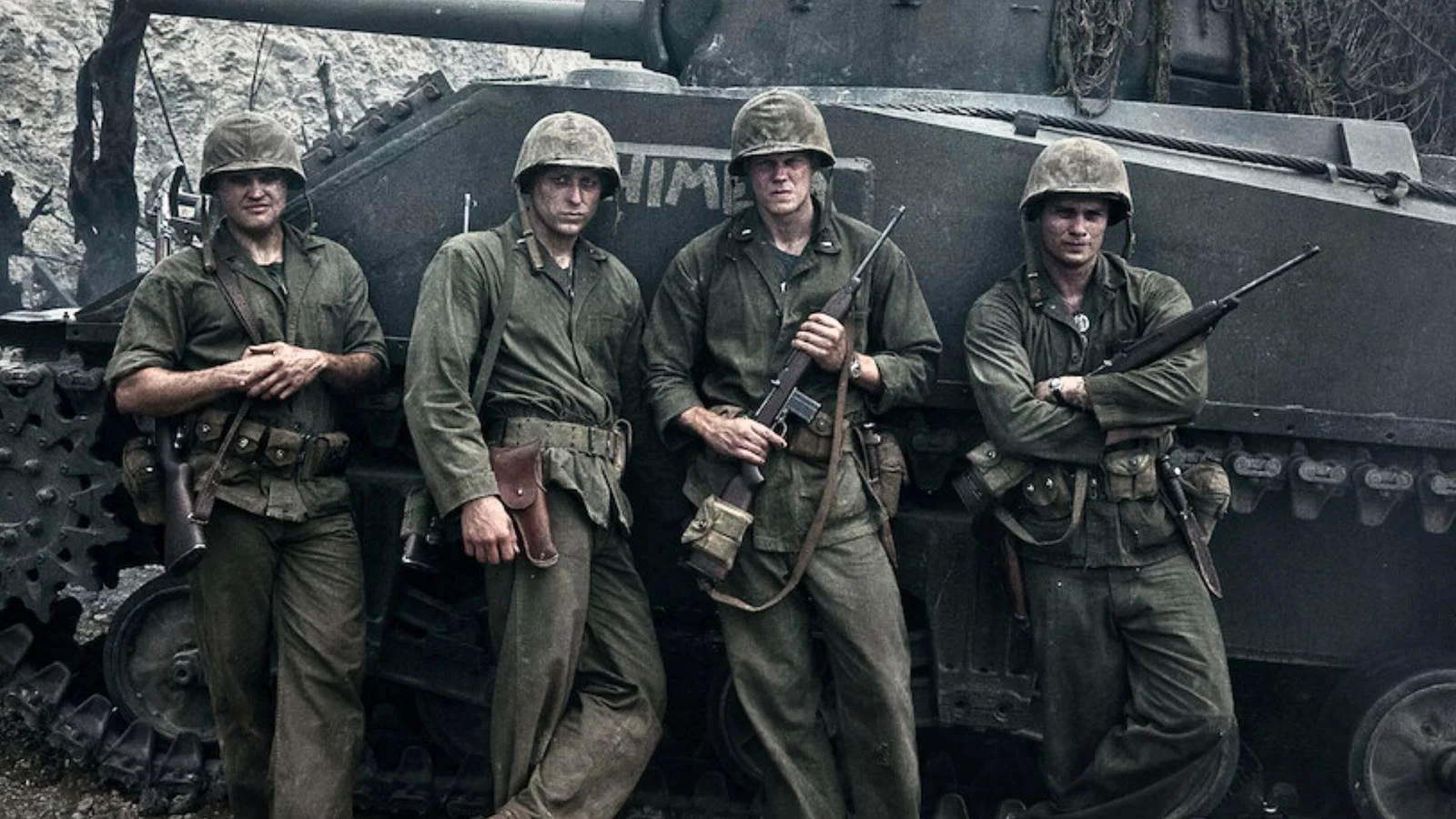
Adapted by Berg and Mark L. Smith from Buzz Bissinger’s book, the film concentrates on four players who enlist after Pearl Harbor. Their athletic distinction makes the interruption of their lives immediately legible. John McLaughry, Bob Bauman, Tony Butkovich, and David Schreiner have already acquired evidence that discipline and talent can secure a future. Berg sends those bodies into conditions where being unusually strong or fast supplies no exemption from a bullet arriving during a conversation.
That interrupted conversation gets closer to the film’s argument than any declaration about sacrifice. A person is speaking, participating in the small assumption that another moment will follow this one, and then he is struck. Berg can make the destruction of that assumption feel appallingly immediate.
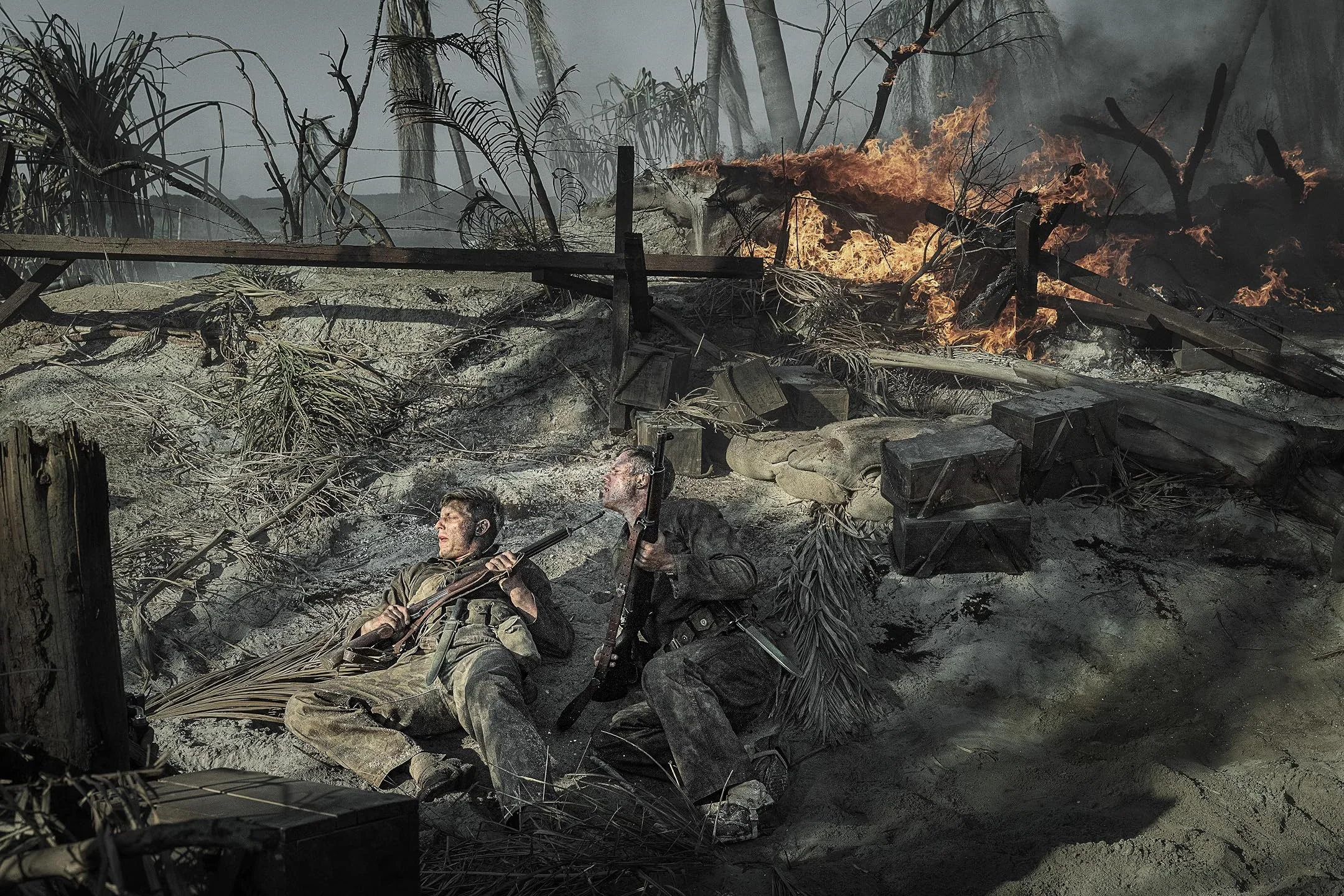
Working with cinematographer Jacques Jouffret, he keeps close to the men without granting them a clear account of their surroundings. Smoke and trees conceal other soldiers. Machine-gun fire pins bodies down while its sound occupies space the eye cannot confidently inspect. Flamethrowers move through the periphery. Information reaches the men without resolving their uncertainty. Physical strength becomes painfully inadequate when they cannot even establish what is happening beyond their position.
Slow motion and selective changes in sound levels further disturb the sense of a shared, measurable present. Certain noises acquire terrible prominence while others recede. These passages make the players’ earlier optimism seem almost linguistically obsolete: an offensive line requires opponents you can locate and an objective you can recognize. Here, holding yourself together occupies the attention once available for strategy.
I initially took this destruction of sporting confidence as evidence that Berg was dismantling the romance of military service altogether. Bob’s boot-camp eagerness to learn to kill Japanese people complicates that reading. His declaration exposes something uglier than youthful miscalculation, yet the screenplay gives its motives little sustained attention. Combat punishes his confidence; the film leaves the moral content of his enthusiasm comparatively unexamined. Its reverence for the men’s service survives the damage done to their bodies.
That distinction matters. Courage remains possible inside an experience represented as horrific. But the film’s account of enlistment settles comfortably around noble intention, even after supplying a detail that could disturb it. Berg subjects these men to terror with a severity he does not consistently bring to their beliefs.
The same restricted attention affects their characterization. Nicholas Galitzine’s McLaughry supplies the main perspective, with his wish to return to his girlfriend giving survival a destination. It is an entirely credible wish. Its dramatic usefulness wears thin because the script gives that longing limited personal texture. Wanting to get home tells us what he stands to lose without telling us much about the life he imagines resuming.
The supporting players acquire sharper distinctions. Ray Nicholson gives Butkovich’s confidence a sociable appeal; Bill Skarsgård makes Bauman’s recklessness register alongside it. Tom Francis’s Schreiner has anxiety and a lingering grievance against Butkovich from their football days. That old resentment is useful precisely because it is small. Schreiner has carried a piece of his former world into circumstances that should render it irrelevant. People are inconsiderate enough to retain their personalities during history.
Brief exchanges between bouts of gunfire let such differences surface, but the movement through training and combat repeatedly cuts their development short. There is a reasonable defense here: survival narrows attention. I felt that narrowing in the battle scenes. Yet the screenplay also chooses how much time to spend outside them. Sharing the men’s incomplete knowledge of a battlefield does not require knowing so little about their lives.
The Christmas Eve 1944 game at Guadalcanal briefly changes what the film permits them to want. Rivalry, recognition, and pleasure become available again. Its warmer photography interrupts the prevailing gray, brown, and blue, but the emotional release comes from seeing these men occupied by purposes that do not require an account of their bravery.
Berg reaches the match with surprising haste. Low morale is identified, an order to organize football follows, and the film moves quickly to play. The missing preparation matters because arranging the game could itself have revealed character: the work of making something happen together, with survival temporarily displaced as the sole objective. The finished event supplies personality that the brisk approach to it has passed over.
Its brevity also places pressure on the film’s use of athletic fame. These men’s achievements establish the futures they expected, but their lost potential cannot reasonably be measured in professional contracts or sporting records. Schreiner’s stubbornly retained grievance helps here. It supplies an individual attachment that needs no public importance to deserve preservation.
Berg’s commemorative images operate at a different scale. Monochrome freezes, sometimes drawn from archives, insist on the historical existence of the people behind the drama. They give the film a solemn obligation that its fleeting personal encounters only partly fulfill. Elsewhere, a seabird walks along a beach containing bodies, and Earth appears from space, detached from the suffering below. Those images invite perspective, but perspective has its losses too. Pull far enough away and Schreiner’s old Wisconsin grievance vanishes with everything else.
The Mosquito Bowl held its world premiere at AFI Fest on October 22, 2026, ahead of its limited theatrical release on October 30, 2026, and global streaming premiere on Netflix on November 25, 2026. Directed by Peter Berg and based on Buzz Bissinger’s non-fiction bestseller, the World War II epic follows four star college football players who set aside their athletic careers to enlist in the U.S. Marines, facing off in an iconic, fateful football game on Guadalcanal as they prepare for the brutal invasion of Okinawa.
Where to Watch The Mosquito Bowl (2026) Online
Full Credits
Title: The Mosquito Bowl
Distributor: Netflix, Imagine Entertainment, Film 44
Release date: October 22, 2026 (AFI Fest), October 30, 2026 (Theaters), November 25, 2026 (Netflix)
Rating: MA 15+ / R
Running time: 2 hours 7 minutes (127 minutes)
Director: Peter Berg
Writers: Peter Berg, Mark L. Smith, Buzz Bissinger
Producers and Executive Producers: Peter Berg, Brian Grazer, Alex Gayner, Ezra Emanuel
Cast: Nicholas Galitzine, Bill Skarsgård, Ray Nicholson, Tom Francis, Stacy Clausen, Brent Comer, Ella Newton, Lola Bond
Director of Photography (Cinematographer): Jacques Jouffret
Editors: Jon Otazua, Garret Donnelly
Composer: Explosions in the Sky
The Review
The Mosquito Bowl
Berg makes athletic confidence look painfully fragile under fire. His combat filmmaking is forceful, and the supporting cast gives these men distinctions the screenplay struggles to develop. I believe the terror; I am less persuaded by the film’s examination of the beliefs that brought them there. The football match briefly restores lives beyond military purpose, making its hurried preparation especially frustrating. Respect for the dead supplies an obligation the drama only partly fulfills.
PROS
- Visceral combat photography and sound
- Distinctive supporting performances
- Football scenes reveal individual personalities
CONS
- Thinly developed central viewpoint
- Limited scrutiny of enlistment motives
- Hurried preparation for the title match