












Marisa’s support for her adopted children’s search gives Abandoned an unusually generous understanding of parenthood. Ramón, Ricard and Elvira want to discover who brought them into the world and why those people disappeared. Marisa remains a steady, cautious presence as they investigate, attentive to the pain that answers might bring. Her participation leaves room for a desire that a possessive account of family would treat as disloyalty. The four-part documentary allows her security as a mother and her children’s uncertainty about their origins to occupy the same emotional space.
The photographic montage of their childhood with Marisa and Lluís gives this arrangement its substance. Here is a family with a history of its own, accumulated after the abandonment that supplies the investigation’s central mystery. Those photographs prevent the search from swallowing everything that followed.
The siblings have been loved, raised together and given a home; their earlier lives still contain questions that affection cannot answer. Elvira’s decision to investigate while preparing to start a family makes the gap newly consequential. Becoming a parent brings her back to the parents she cannot remember.
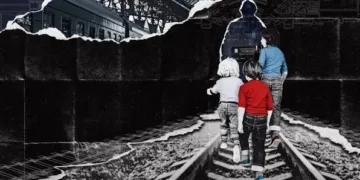
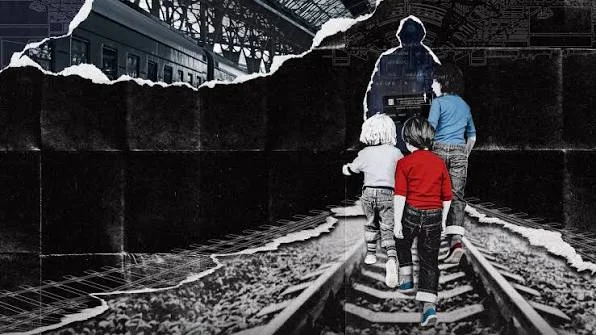
In 1984, the three children were found at Barcelona’s Estació de França without luggage or identification. A man they knew as Denis had reportedly gone to buy them sweets and never returned. A carer remembers their appearance with surprise: they were healthy, well dressed and articulate, unlike many children arriving in her care. Yet they could provide little identifying information. The discrepancy generates suspicion without supplying an explanation. Ramón’s later belief that their parents had trained them to conceal information remains a son’s attempt to interpret a childhood whose rules he could not then understand.
His recollections give the documentary its most absorbing investigative material. A crocodile in a toy-shop window, a park fountain, an elderly woman in black: these are fragments organized by a child’s attention, with little respect for what an adult investigator might find useful.
The drawings used to give remembered images a visible form make that difficulty tangible. An impression can be shared, examined and compared with a place. The process also exposes how much effort separates remembering something from knowing what it means. A detail may have survived for decades while the circumstances surrounding it have vanished.
Among these fragments is Ramón’s memory of firing a gun and seeing sparks where the bullet struck stone steps. Its violence unsettles the ordinary sensory recollections without making them irrelevant. The child who remembered warm milk could also have encountered a weapon; adult categories of domestic life and criminal danger offer no reliable guide to how those experiences were stored. Abandoned draws suspense from the possibility that a fragment will acquire an explanation. Its emotional interest lies in the long interval during which Ramón has possessed the memory without that explanation.
The investigation becomes a collective undertaking after Elvira appeals for help on RAC1’s Islàndia. Women responding to the broadcast become significant collaborators, alongside genealogists, journalists and volunteers pursuing leads across European countries.
Their contribution gives the series’ optimism a practical basis. Someone searches a record, follows a contact or supplies expertise the siblings do not possess. Compassion acquires a workload. Carles Porta’s limited presence on screen helps preserve that distribution of attention: the recognizable storyteller does not take possession of the family’s search, and assistance remains visible as the work of several people.
The emails, public records and WhatsApp exchanges also create the series’ principal pacing difficulty. In the middle episodes, the concentration of investigative material can make effort easier to register than progress. Returning to a line of inquiry conveys the difficulty of recovering a buried history, but repeated returns occasionally flatten the distinction between an obstacle and another stretch of television. The siblings’ bond sustains interest through these passages. Their continued involvement gives the documents a human consequence that the accumulation of information cannot produce by itself.
The handling of revelations introduces a related tension. Cliffhangers and delayed answers make the investigation readily watchable, while occasionally leaving the sequence of questioning feeling arranged for suspense. A documentary about people who lack essential knowledge has particular reason to be careful with the viewer’s lack of knowledge.
Here, the rationing of information sometimes draws attention to the construction rather than the discovery. This is a limited weakness, attached to the density and sequencing of the investigation. The scenes of recollection and family interaction retain their force because the siblings’ desires remain intelligible before the next revelation arrives.
Connections involving a post-office robbery, a stolen identity and the Gold Bandits of Andalucía could easily turn the absent parents into glamorous criminal figures. Photographs of Ramón Sr and Rosario introduce a different pressure: these are people whose children want evidence of their affection.
“I wanted to know if they loved me,” Elvira says. The question makes a criminal biography insufficient. Establishing where someone went or whom they knew cannot, by itself, establish what they felt toward a child. The suspicion that both parents are dead leaves that distinction painfully exposed, with their fate still officially unresolved.
In a Belgian park, the siblings recreate photographs taken during their early childhood. The old images supply positions to occupy, while their adult bodies make the distance from those children unmistakable. Then they play together, and the activity exceeds the practical business of identifying a location.
The scene permits pleasure without requiring an explanation for everything that happened there or afterward. A recovered place becomes somewhere they have now visited together, consciously and with affection. They leave with a shared recollection whose circumstances belong to them, even as the older photographs continue to hold questions.
Abandoned premiered on Disney+ in Spain and globally on Hulu on May 29, 2026. Created by Carles Porta, directed by Carlos Alonso-Ojea, and written by Anna Punsí, the four-part true-crime docuseries investigates the real-life 1984 disappearance of a couple who abandoned their three young children at a Barcelona train station, following the now-adult siblings as they search for the truth about their origins.
Where to Watch Abandoned Online

Full Credits
Title: Abandoned (Spanish: Abandonados)
Distributor: Disney+, Hulu, True Crime Factory, Goroka
Release date: May 29, 2026
Rating: TV-MA / 16+
Running time: 35–44 minutes per episode (4 episodes)
Director: Carlos Alonso-Ojea
Writers: Anna Punsí
Producers and Executive Producers: Carles Porta, Pablo Fernández Masó, Laura Rubirola Sala
Cast: Carles Porta, Giles Tremlett, Sven Tuytens, Ramón Moral, Ricard Moral, Elvira Moral
Director of Photography (Cinematographer): Yuse Riera Camps
The Review
Abandoned
Abandoned understands that a secure family life can coexist with an unresolved need to know one’s origins. Marisa’s support, Ramón’s fragmentary recollections and the volunteers’ patient research give that understanding concrete emotional weight. Repetitive investigative passages and conspicuously delayed revelations occasionally interrupt its sensitivity. Its finest achievement is allowing the siblings’ affection to remain meaningful without asking it to explain or erase their abandonment.
PROS
- Adoption and biological curiosity receive equal emotional respect.
- Childhood recollections become absorbing investigative material.
- Volunteer research gives the series’ optimism substance.
- The playground sequence finds joy without declaring the past repaired.
CONS
- Investigative detail occasionally becomes repetitive.
- Delayed revelations sometimes expose the suspense machinery.