








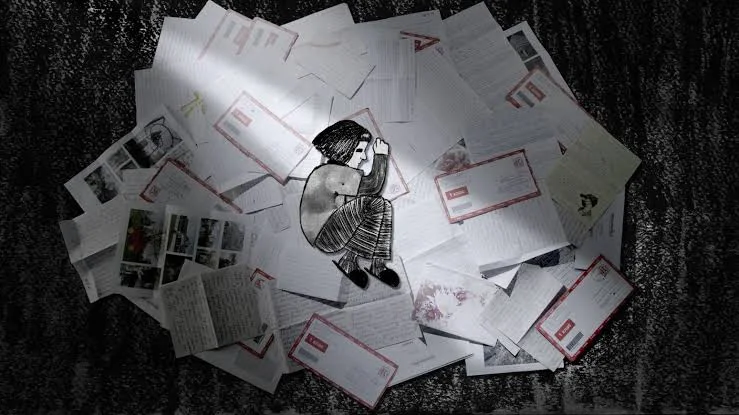

Vitold Ashurak asks for photographs of ordinary life. Printed in colour and sent into prison, these amateur images carry the almost unbearable privilege of having been somewhere else. Someone could stand there, look around, decide what was worth keeping. For the person receiving them, that freedom has contracted to the dimensions of a picture. Ashurak’s correspondence preserves an appetite for the world beyond his confinement, and the photographs answer it imperfectly: each offers something to look at, something to remember, something he cannot reach.
Then there is the body recorded by the prison camera. Against the endurance of Ashurak’s letters, the CCTV footage exposes a man physically diminished, held within an institution that will outlast him. He dies in custody. Andrei Kutsila allows these records to remain painfully unequal. The camera has access to his suffering; the letters carry his effort to speak to another person. Neither cancels the other. To read his resilience as mere illusion would surrender another part of him to the institution already possessing his body.
Letters From The Silenced Country gathers such fragments from lives fractured by the repression following Belarus’s disputed August 2020 election. Working from exile in Poland, Kutsila assembles correspondence, private footage, surveillance recordings, online maps and animation. The absence of unrestricted access gives the documentary its wounded form. People arrive through materials that have crossed distances they themselves cannot cross. The film offers relatively little historical explanation, which leaves viewers unfamiliar with Belarus supplying some bearings for themselves. Its knowledge of what happens between separated people is much more exact.
An anonymous man hiding inside Belarus tries to maintain a relationship with his young daughter while anticipating the arrest that could sever it. Over deserted winter streets, his description of the country sinking beneath ice gives the silence a terrible physical density. The streets remain visible; the people withdrawing from them become harder to find. His fear enters the ordinary work of being a father, making a future absence part of their present relationship. He has to live with his daughter’s possible loss of him before either knows when it might happen.
For former criminal investigator Andrei Astapovich, living in Poland, distance offers an uncertain shelter. He isolates himself to protect relatives still at home. Asked whether he feels safe, he cannot confidently affirm it. His testimony before the Polish authorities belongs to a life in which crossing a border has failed to settle the question of who might be watching. Kutsila keeps this different from the hidden father’s predicament. One man fears being taken away; the other has escaped and remains vulnerable through those he loves. Affection provides the threat with somewhere to travel.
Across these accounts, looking becomes an uneasy activity. Online maps circle prison boundaries. Enlarged images of security personnel dissolve into pixels. A cursor searches through pictures of watchers, while police and soldiers return the camera’s gaze or hold cameras of their own. There is information everywhere, yet intimacy remains scarce. We can approach a prison from above, inspect its perimeter and still know almost nothing of the hours passing inside. The digital movement promises proximity that the image cannot fulfil.
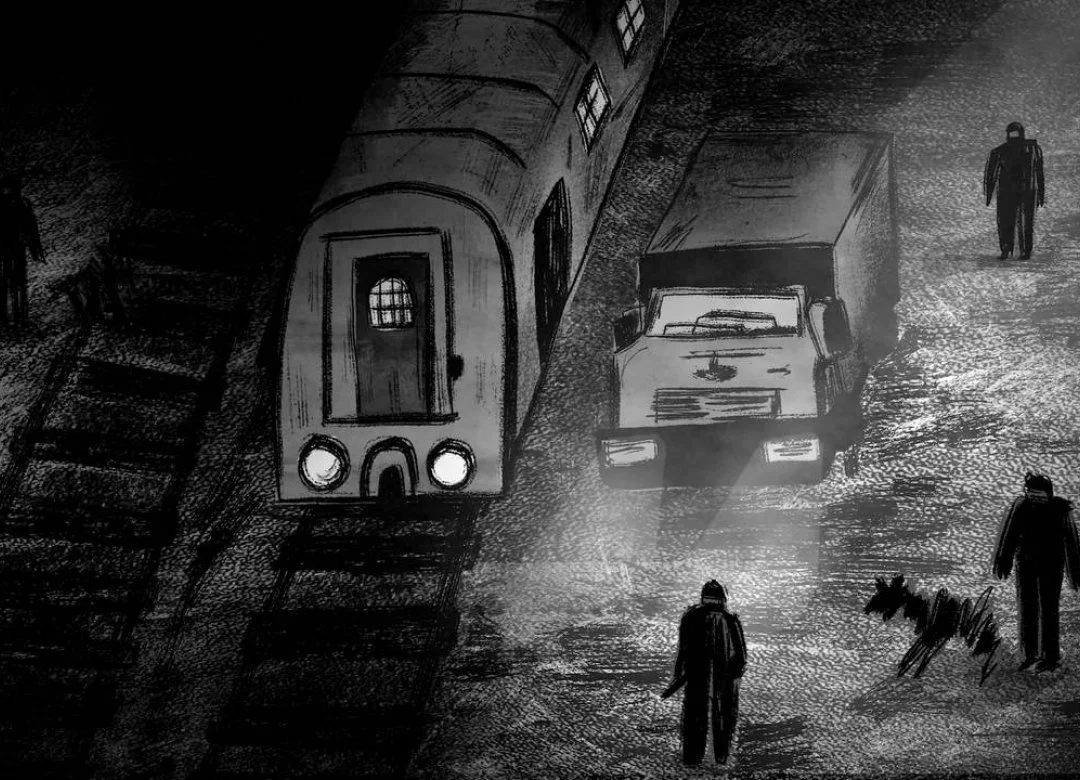
Editor Piotr Ogiński gives these changes of visual register a mournful continuity. Fear persists as the film passes between materials, inhabiting the gaps in what each can disclose. The subdued electronic score by Vygintas Kisevičius and Paulius Kilbauskas deepens that atmosphere without furnishing an emotional release. The documentary’s shifting surfaces keep us aware of the labour of reaching its subjects. Even when a voice is close, the person remains elsewhere.
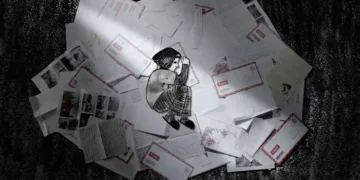
Kasia Budzko’s drawings bring us closest to an experience being shaped from within. Imprisoned as a young student for attending a protest, she sends images from a women’s penal colony. Natalia Spychała develops them into black-and-white animation whose charcoal-like textures give confinement a rough, enclosing presence. These sequences retain the importance of a hand making something under conditions intended to narrow its freedom. Kasia can still choose an image. Through animation, the film lets that choice move.
When her animated figure looks through a cell’s peephole into live-action footage of protest arrests, the opening joins her enclosure to the violence beyond it. The exterior offers no relief. Elsewhere, family and friends appear inside the prison with her, an imagined companionship made painful by its very availability to the drawing. They can be brought into the image because they cannot simply come to her. The sequence gives longing a place to gather without disguising the absence that produced it.
A tin can associated with Kasia’s account of confinement sprouts a ladder. Its impossible extension carries the modest, stubborn freedom of being able to imagine another arrangement of space. The force of the animation lies in such specific transformations. Where the CCTV records Ashurak’s bodily exposure, these images allow a prisoner’s own metaphors to determine what we see. They grant access to desire and memory without pretending to reproduce experience completely. Their beauty remains troubled by the conditions under which the original drawings had to be made.
That expressive freedom has an outer limit, and the film reaches it when Kasia reports that letters from friends can no longer reach her and her drawings are restricted to abstractions. By then, correspondence has acquired the weight of an ordinary necessity. Receiving a letter means that someone has spent time addressing you, has imagined you reading it, has continued the relationship across the enforced distance. Its withdrawal deprives Kasia of an encounter as well as a piece of paper. The restriction on her drawings reaches into what she may send back.
Kutsila leaves these injuries unresolved. His film has made Kasia’s images available to people she will never meet, while the exchange with people she knows is being constricted. That difference unsettles the comfort of having listened. We have received something from her; the passage in the other direction remains subject to permission.
Letters From The Silenced Country premiered at the Venice Film Festival in September 2026. Directed by Andrei Kutsila, the powerful mixed-media documentary portrays contemporary Belarus through personal correspondence, archival materials, and animation to examine the human cost of political resistance.
Full Credits
Title: Letters From The Silenced Country
Distributor: DocEdu Foundation, Inselfilm Produktion, Moonmakers
Release date: September 9, 2026 (Venice Film Festival)
Running time: 1 hour 15 minutes (75 minutes)
Director: Andrei Kutsila
Writers: Andrei Kutsila
Producers and Executive Producers: Mirosław Dembiński, Giedrė Žickytė, Gregor Streiber, Friedemann Hottenbacher
Cast: Andrei Astapovich, Kasia Budzko, Vitold Ashurak, Volha Bykouskaja
Director of Photography (Cinematographer): Wojciech Węglarz, Anonymous
Editors: Piotr Ogiński
Composer: Paulius Kilbauskas, Vygintas Kisevičius
The Review
Letters From The Silenced Country
Kutsila gives enforced separation a form we can feel: photographs carrying an unreachable world, surveillance images exposing a body, drawings preserving the freedom to imagine. The limited historical context leaves some bearings uncertain, but the intimacy is devastatingly precise. Kasia’s animation becomes the film’s deepest achievement, allowing an imprisoned person to shape our vision while leaving the limits of that freedom painfully visible.
PROS
- Kasia’s drawings become expressive, emotionally precise animation.
- Letters and surveillance footage reveal different dimensions of captivity.
- Distinct personal accounts preserve the individual costs of repression.
- Editing and electronic music sustain the atmosphere of unease.
CONS
- Limited historical context demands prior knowledge from unfamiliar viewers.