




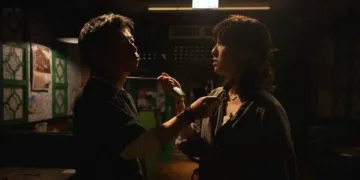


























Sharm and Tarina speak Zulu. Their son has still neglected to tell them that the woman he is bringing home is Black. That combination gives How to Ruin Diwali: Meet the Parents an awkwardness worth exploring: these parents possess a familiarity with the world around them that has not prepared them for their son’s relationship. The prospective daughter-in-law arrives carrying the burden of information he should have supplied.
The series’ multilingual exchanges make that omission particularly revealing. Languages mingle within conversation, allowing cultural contact to register as an ordinary feature of life in Durban. Nobody needs to cross an ocean to encounter a different tradition. The difficulty lies in extending that familiarity into the household, where marriage makes it personal. Sharm and Tarina’s knowledge of Zulu cannot tell us how they will receive Mmabatho; it does, however, prevent their surprise from being explained away as simple unfamiliarity.
Mmabatho, played by Rosemary Zimu, has reasons to expect a difficult visit. An accomplished eye surgeon, she is engaged to Varshen (Kyle Clark), who abandoned medicine for baking. His relatives form a medical dynasty, and the engagement remains another piece of news he has withheld. He intends to announce it during Diwali. He also secretly invites her family, including her long-divorced parents, Penelope and Mandla. For a man arranging a celebration, Varshen has an unfortunate habit of deciding what everyone else would enjoy.
Professional status supplies the comedy with a sharper instrument than the inevitable succession of accidents. Varshen’s sister’s wife is repeatedly identified as a veterinarian, her occupation taking the place of a name. Mmabatho finds common ground with the family through the suggestion that a vet does not qualify as a “real doctor.” It is a funny, unpleasant little accommodation. The anxious visitor discovers that she can belong by helping the others place somebody beneath them. Her surgical credentials offer an entry into this household’s hierarchy, even while Varshen’s departure from medicine complicates his position within it.
This attention to rank stops the families from becoming tidy representatives of opposing cultures. Mandla invokes Zulu tradition when it suits him; Penelope shows little interest in observing it. Their disagreements make Mmabatho’s family exhausting company, yet they also prevent a single parental voice from standing in for an entire community. The medical household’s composure encourages her to imagine a unity her own relatives lack. What she envies is partly a difference in presentation: one family makes its fractures immediately available to visitors, while the other has information it prefers to keep private.
Sharm’s conversation with Mmabatho turns that distinction into effective embarrassment. Apparently warmer toward her than Tarina, he tells her about a Black woman he once dated. Mmabatho repeats the story in a toast, unaware that his wife and family have never heard it. The joke depends on the gap between what a confidence means to its speaker and what it means to its recipient. She hears a connection that might make her welcome. He has handed her a piece of family history without explaining the conditions attached to knowing it.
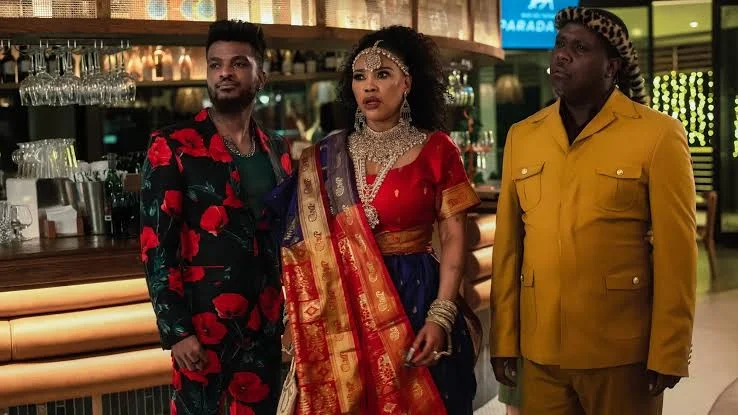
Zimu gives this predicament an emotional credibility that the larger comic machinery needs. Mmabatho’s eagerness to make a good impression remains understandable through the toast’s disastrous disclosure. Repeating Sharm’s story is an attempt to use the reassurance he has offered her, and Zimu carries the embarrassment without losing that underlying wish for acceptance. There is an unfairness here that helps the comedy: Varshen controls the invitations, Sharm controls the initial disclosure, and Mmabatho must stand in front of everyone when those decisions become uncomfortable.
The fireworks are less discriminating. A car erupts with them, the electricity goes out, and Diwali is declared cancelled before the story returns to thirty-six hours earlier. The flash-forward establishes a clear promise of catastrophe, but it also makes the gathering feel destined for destruction before its participants have done much. Exploding fireworks can threaten almost any screen celebration. The veterinarian joke and the toast belong to this particular family, with its professional vanity and carefully distributed knowledge. Those smaller encounters produce the more satisfying laughs because understanding the people sharpens the joke.
Diwali nevertheless gives the series expressive possibilities beyond a convenient occasion for disaster. Its associations with renewal and light overcoming darkness sit awkwardly, and usefully, beside a family keeping its engagement and romantic history concealed. The celebration outfits combine Indian and Zulu elements, making room for both traditions within a shared festive appearance. The pleasure comes from seeing that combination worn, rather than hearing the characters deliver a lesson about mutual respect. Cultural participation becomes something they can do together while remaining difficult people.
The dance number develops that possibility through movement. Indian and Zulu dance elements share the performance, giving the encounter a physical expression that conversation, with its omissions and accidental disclosures, struggles to achieve. Hindi family cinema frequently uses collective celebration to make relationships publicly visible; here, that familiar dramatic function acquires a specifically South African vocabulary.
The sequence offers warmth without requiring either tradition to disappear into a neutral party routine. The shared celebration offers a kind of belonging distinct from approval of a marriage, allowing pleasure and uncertainty to occupy the same gathering.
How to Ruin Diwali premiered globally on Netflix on October 30, 2026. Created by Rethabile Ramaphakela and Katleho Ramaphakela, the South African comedy series follows an overachieving perfectionist whose accidental exposure of a family secret throws an upcoming Diwali celebration and two merging families into total chaos.
Where to Watch How to Ruin Diwali Online


Full Credits
Title: How to Ruin Diwali (also known as How to Ruin Diwali: Meet the Parents)
Distributor: Netflix
Release date: October 30, 2026
Rating: TV-MA
Running time: 39 minutes per episode (3 episodes)
Director: Johnny Barbuzano, Vivek Mehta
Writers: Gillian Breslin, Lihle Msimang, Vanishia Kisten, Bradley Katzen
Producers and Executive Producers: Tshepo Ramaphakela, Katleho Ramaphakela, Rethabile Ramaphakela, Jayan Moodley
Cast: Rosemary Zimu, Kyle Clark, Jailoshini Naidoo, Koobeshan Naidoo, Sonia Mbele, Meshack Mavuso, Denise Zimba, Asish Gangapersad
The Review
How to Ruin Diwali
How to Ruin Diwali earns its warmth through the cultural familiarity its families share and the personal acceptance they struggle to offer. Rosemary Zimu gives the embarrassment emotional weight, while professional snobbery and private disclosures supply the sharpest laughs. The fireworks feel comparatively interchangeable. Multilingual conversation and shared dance give this family comedy a specificity its louder disasters cannot match.
PROS
- Zimu’s sympathetic comic performance
- Sharp observations about professional status
- Everyday multilingual exchanges
- Dance and clothing that express cultural participation
CONS
- Spectacular accidents offer less distinctive humor
- The flash-forward makes catastrophe feel predetermined 1.