


















Seen close enough, the damage in spruce wood acquires an almost intolerable delicacy. Bark beetles have left narrow, wandering channels across its surface, and the eye follows their turns with a pleasure that becomes uncomfortable once the camera gives us the forest again: grey trees, depleted slopes, green withdrawn from whole stretches of the image. Victor Kossakovsky’s Holy Wood Dust finds its most persuasive scale somewhere between these views. The small marks need the devastated woodland to disclose their consequence; the woodland needs those marks to become something we can begin to read.
Wind makes that reading harder. Across the Dolomites, spruces bend in a storm, their movement registering the force passing through them. Gianmarco Donaggio’s cinematography gives us both the reach of the disturbance and the textures on which destruction leaves its record, moving between mountains, treetops, and wood with an ease unavailable to anything rooted in the ground. We can travel everywhere these trees cannot. That freedom produces extraordinary images, but it also keeps our position unstable: the forest becomes accessible through a mobility belonging entirely to the camera. Looking closely and possessing a view remain uneasily adjacent experiences.
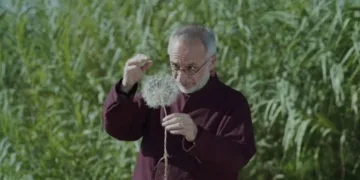
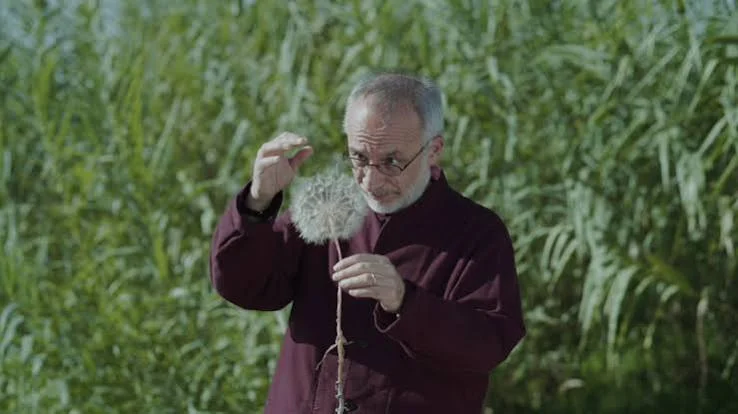
Botanist Stefano Mancuso brings the film down to walking pace. Accompanying schoolchildren through the forest, he talks about plant senses, communication, and problem-solving, making intelligence seem less securely attached to the human arrangements through which we recognize it. His teaching has an appealing lack of ceremony.
There are earthy jokes; he falls, and the children are delighted. These encounters give the documentary a human warmth that its aerial passages cannot supply. They also give its images a causal vocabulary. Mancuso’s account of the bark beetle’s place in the ecosystem, and the infestation associated with the storm-damaged forests, connects the minute excavations to the grey expanses.
His presence leaves a difficulty that the film only partly addresses. We hear about capacities for which we are given limited observational evidence. The images make trees look newly strange, while the explanations ask us to understand them as intelligent beings; the distance between those achievements remains considerable.
A camera moving over bark cannot disclose an organism’s experience. Nor does Mancuso’s description of plant perception establish a human form of suffering. The film can solicit care without settling those questions, and its uncertainty could be fertile. Yet it sometimes lets the authority of his words carry an encounter that the images have promised to make tangible.
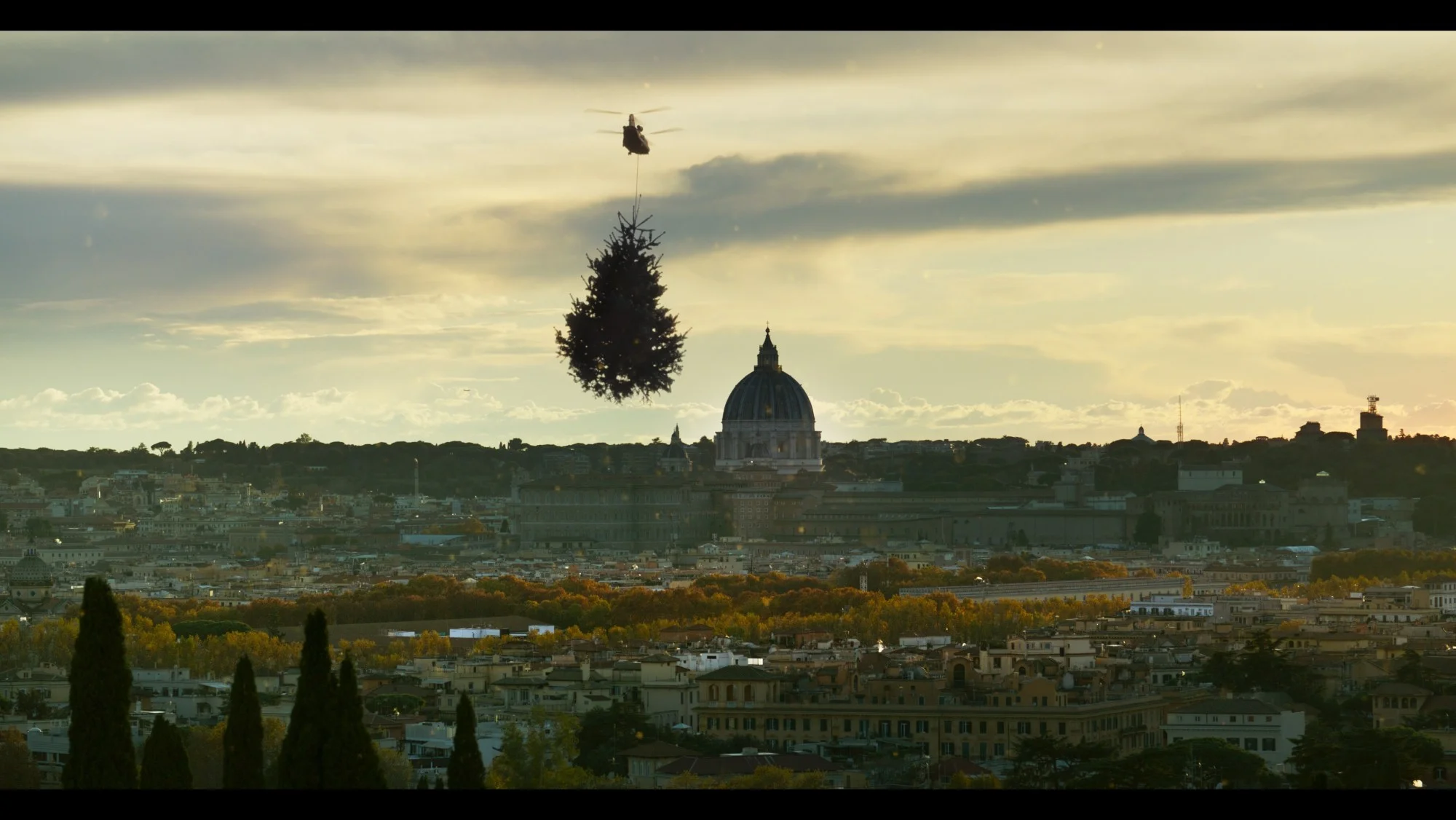
The Christmas-tree passages give that uncertainty a physical weight. A large spruce is cut, lifted by crane, and taken through mountain tunnels and along roads toward St. Peter’s Square. The movement is disturbing in a different way from the wind’s. Here, a tree’s passage through space depends on its separation from the place that sustained it; machinery supplies the apparent freedom. Kossakovsky watches it become transportable, then ceremonial. Its destination grants it an attention inseparable from its usefulness as a spectacle. The title’s suggestion of sacred wood acquires an uncomfortable specificity beneath the Vatican’s decorations.
Elsewhere, smaller evergreens pass through netting equipment, their branches compressed into shapes suitable for handling and sale. Accumulated in quantity, they become difficult to distinguish. The contrast with the Vatican specimen is sharp: one receives an elaborate public identity, while the others are processed into interchangeability.
Yet both forms of attention prepare a tree for temporary display. The netting is especially effective because the transformation is so practical. Nothing in the machinery needs to resemble cruelty for the sight of a branching form being gathered and constrained to become troubling. The film lets an ordinary procedure alter the emotional meaning of an ordinary purchase.
It also watches that procedure beyond the point at which its meaning continues to develop. Repeated netting and the extended transportation of the enormous spruce gradually lose the pressure of discovery. Long stretches without speech can give us room to register a tree’s physical presence, but these passages establish the terms of handling and destination, then continue to occupy them without sufficiently changing our relation to what we see. Duration begins to feel like insistence. The tree remains remarkable, but the film’s attention to it becomes less searching, more certain that further looking must deepen the response already secured.
Adrián Berenguer’s score contributes to that certainty. Its orchestral force can answer the scale of the forest, but the shift between delicate wonder and grandeur repeatedly supplies an emotional interpretation before the image has had room to trouble us.
Time-lapse shoots emerging into view carry their own astonishing adjustment of time; the invitation to marvel grows wearying when the accompaniment reinforces it. Kossakovsky has a lighter touch elsewhere, particularly in the visual-effects gag that turns the title into something a tree can smash. That moment admits the pleasure of manipulation. The more reverent passages can seem less candid about how firmly our feelings are being arranged.
After Christmas, the trees enter streets as discarded objects, and some reach zoo animals as material for play. The encounters with orangutans and elephants loosen the film’s emotional grip. We are allowed amusement without forgetting the cutting and packing that preceded these encounters.
An ornament has lost its appointed significance, yet its capacity to occupy another creature’s attention remains. The pleasure is modest and oddly difficult to classify: neither the ceremony nor the waste quite accounts for it. Watching the animals play, the film briefly allows a cut tree to matter without requiring everyone present to agree on what it means.
Holy Wood Dust premiered at the 83rd Venice International Film Festival in September 2026 before rolling out to international cinemas. Directed by Victor Kossakovsky, the visual documentary explores the intricate relationship between humanity and the vegetal world, tracing the journey and cyclical fate of trees.
Full Credits
Title: Holy Wood Dust
Distributor: Mindjazz Pictures
Release date: September 2026 (Venice International Film Festival) / Late 2026 theatrical releases
Running time: 1 hour 45 minutes (105 minutes)
Director: Victor Kossakovsky
Producers and Executive Producers: Mattia Guerra, Emanuele Nespeca, Alba Sotorra, Mayca Sanz, Frank Muller
Cast: Stefano Mancuso
Director of Photography (Cinematographer): Gianmarco Donaggio
Editors: Ainara Vera
Composer: Adrian Berenguer
The Review
Holy Wood Dust
A forest becomes newly visible without becoming fully knowable. Holy Wood Dust finds unsettling beauty in beetle-marked wood and trees compressed for seasonal display, while Mancuso gives its ecological concerns an approachable human presence. Yet prolonged processing sequences and emphatic music wear down the uncertainty that makes the images affecting. Kossakovsky changes how an ordinary Christmas tree looks; his film sometimes leaves too little space for the feelings that altered sight might produce.
PROS
- Striking connections between minute damage and devastated forests.
- Mancuso’s warm, accessible encounters with schoolchildren.
- Tree processing makes seasonal consumption newly troubling.
- Zoo sequences introduce welcome playfulness and ambiguity.
CONS
- Extended transport and netting passages lose their expressive force.
- Emphatic scoring prescribes wonder too insistently.
- Plant-intelligence claims depend heavily on verbal explanation.